October 23, 2026
By: The Bellesguard Team

From 22 to 25 October, La Pedrera hosts the 1st edition of the Gaudí International Congress 2026, the first international scientific congress specifically devoted to research on Antoni Gaudí. Held within the framework of the Gaudí Year 2026, the event brings together researchers, academics, and professionals from around the world to share new studies on the architect’s work, thought, and legacy.
The Bellesguard Research Group is taking part in this first edition of the congress with three papers that explore the history, architecture, and memory of one of Gaudí’s most unique projects.
Geometry and Modulation at Torre Bellesguard
The paper presented by Galdric Santana Roma, conservation architect and director of the Torre Bellesguard Research Group, analyzes the role of geometry in the design and construction of the building. The study shows how Gaudí used geometry to establish a direct relationship between the project and the built work, rationalize the modulation of ornamental elements, and ensure the structural performance of the whole ensemble.
The research also highlights how this geometry transcends strictly technical aspects to become a vehicle for architectural and symbolic expression. At Torre Bellesguard, modulation, repetition, and construction become tools that integrate construction efficiency, resource economy, artistic expression, and symbolic meaning within a single work.

Galdric Santana presenting his invited lecture, entitled “Geometry and Modulation at Torre Bellesguard”.
Bellesguard: The Medical Use of a Gaudí Work
The paper presented by Amelia Guilera Roche, Anna Mollet Guilera, and Carles Salillas Vallés revisits a little-known chapter in the history of the estate: its transformation into a center of medical activity during the twentieth century.
The study focuses on Dr. Lluís Gonçaga Guilera Molas, a pioneer in cancer treatment through radiotherapy in Catalonia, who transformed Torre Bellesguard into a family residence, an oncology clinic, and a pathology laboratory. This research reveals a largely unknown facet of the monument and highlights its role in the history of Catalan medicine.
The paper also links architectural heritage, family memory, medical history, and cultural identity, showing how the same place can accumulate many different layers of meaning over time.
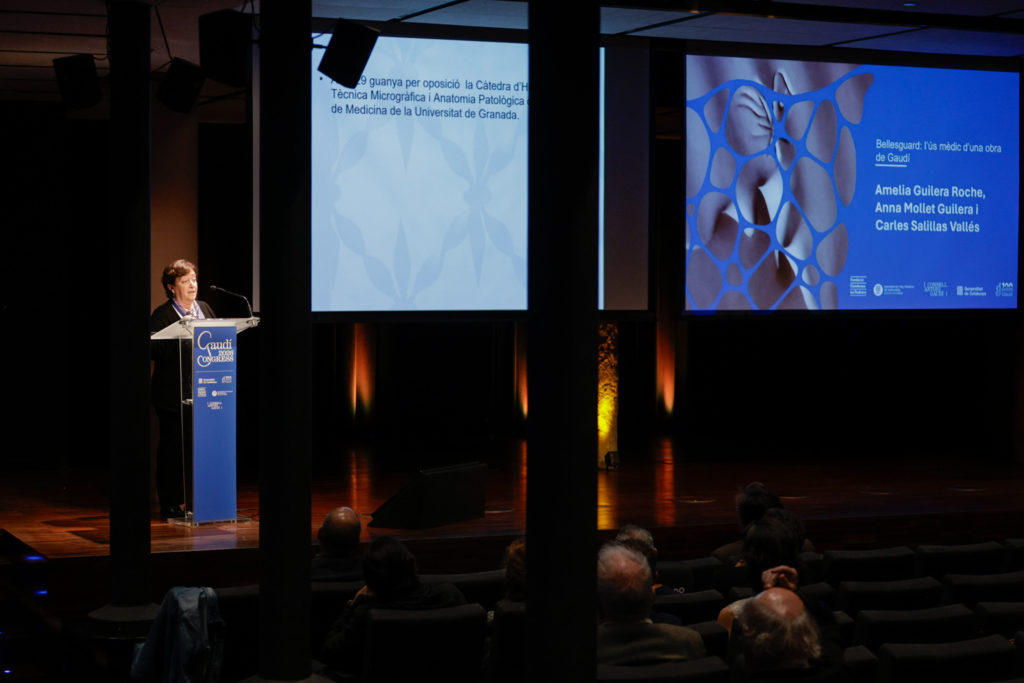
Amèlia Guilera Roche presenting her paper: “Bellesguard: The Medical Use of a Work by Gaudí”.
Bellesguard, Gaudí Against Oblivion: History, Memory, and Catalan Identity
The third paper, presented by Ferran Garcés Blázquez, examines the process of historical recovery carried out in recent years around Torre Bellesguard. Based on documentary and historiographical research, the study demonstrates how episodes, figures, and contexts connected to the estate that had been partially forgotten have been brought back to light.
The study introduces the concept of Bellesguard’s “dual Catalan identity.” On the one hand, there is the symbolic Catalan identity incorporated by Antoni Gaudí through the architectural project itself. On the other, there is the identity rooted in the site’s own history, closely linked to key moments in the history of Catalonia and to figures such as King Martin I of Aragon, known as Martin the Humane.
This perspective allows Bellesguard to be understood not only as an architectural work, but also as a place of memory that connects heritage, history, and cultural identity.

Ferran Garcés Blázquez presenting his paper: “Bellesguard, Gaudí Against Oblivion: History, Memory and Catalan Identity”.
Galdric Santana is a member of the congress’s Scientific Committee. Our manager, Anna Mollet, represents Torre Bellesguard on the Honorary Committee and is involved in the organisation of this international gathering as Communications Manager for the Gaudí Year at the Technical Office of the Government of Catalonia.

Anna Mollet, Communications Manager for the Gaudí Year, and Josep Maria Vall, Head of Institutional Relations, greet Sònia Hernández Almodóvar, Minister of Culture of the Government of Catalonia, at the opening ceremony of the first edition of the Gaudí International Congress 2026.

Members of the Honorary Committee of the Gaudí International Congress 2026, made up of representatives of Gaudí’s works and the organisations responsible for managing his legacy. Pictured are the Minister of Culture, Sònia Hernández; the Director General of Cultural Heritage, Joaquim Borràs; and the Director General of the Fundació Catalunya La Pedrera, Marta Lacambra.
Torre Bellesguard’s presence at this first edition of the congress reinforces the monument’s commitment to research, knowledge dissemination, and the generation of new insights into Gaudí’s work. The three papers presented demonstrate the richness of a site that continues to offer new perspectives for study one hundred years after the architect’s death.