January 17, 2026
By: Ferran Garcés
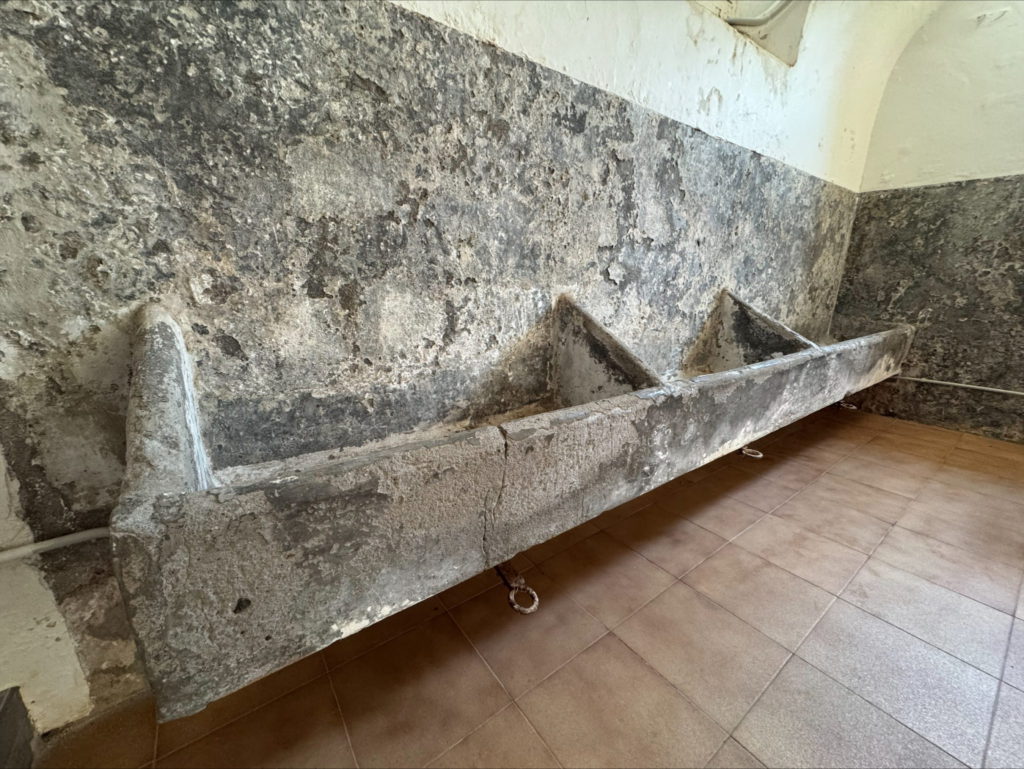
During Christmas and Epiphany, the spotlight goes to the Nativity scene; to the point that the word itself is synonymous with the birth of Baby Jesus. However, near that Nativity scene there was surely a watering trough. The mule and the donkey needed to eat, but also to drink. And like them, the camels and horses.
Today, January 17th, the feast of Saint Anthony Abbot, we want to pay a small tribute to this everyday element—now vanished and poorly remembered—with centuries of history. An element that we can still see at Torre Bellesguard. One of the few preserved in the city of Barcelona.
The Saint of animals and carters
Why today? Saint Anthony Abbot, also called the Saint of donkeys or of the little pig, is the patron saint of hoofed animals, especially in Catalonia, and of the men who worked closest to them: the carters.
In the past, Saint Anthony’s Day was widely celebrated across Catalan lands, and in recent years it has started to be revived.
The main ritual is Els Tres Tombs, which consists of giving three laps with horses, carts, and other draught animals through the town center.
“The first lap was to ask for protection for the animals, the second to request a good harvest, and the third to ask for health for the people.” (1)
A celebration that would be unthinkable without watering troughs.
Places of gathering and rest
In Gaudí’s time, one did not need to wait for a festival to see animals. Many watering troughs were public and served as meeting points for both animals and people.
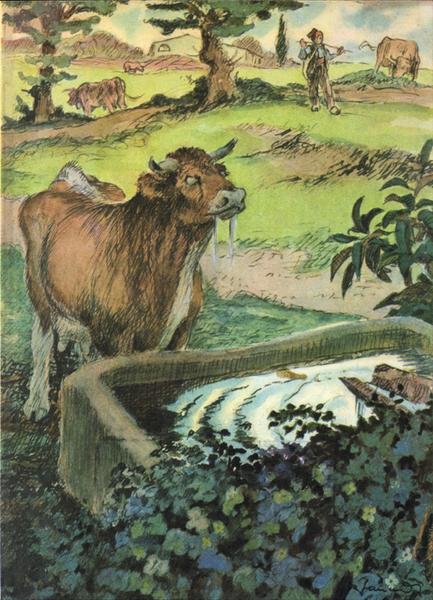
A good example is the creation of “La vaca ciega” (The Blind Cow), a well-known poem by Joan Maragall written in Sant Joan de les Abadesses in the summer of 1893.
The poet got his inspiration during an excursion, after he and his wife stopped at the Covilar spring and asked a young boy about the strange behavior of a cow that was approaching the watering place (2).
The illustrator Joan Junceda captured this moment in an advertisement for Gallina Blanca in 1938.
A near past and a distant world
Sant Joan de les Abadesses, in a pre-Pyrenean valley, may seem like the ideal setting for Maragall’s scene. However, in Gaudí’s time, you didn’t need to go that far.
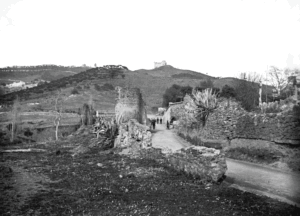
In Barcelona itself, including the Bellesguard area (see: International Horse Day), such a scene could easily have taken place.
Let’s recall a few of the public watering troughs that have survived in the city.
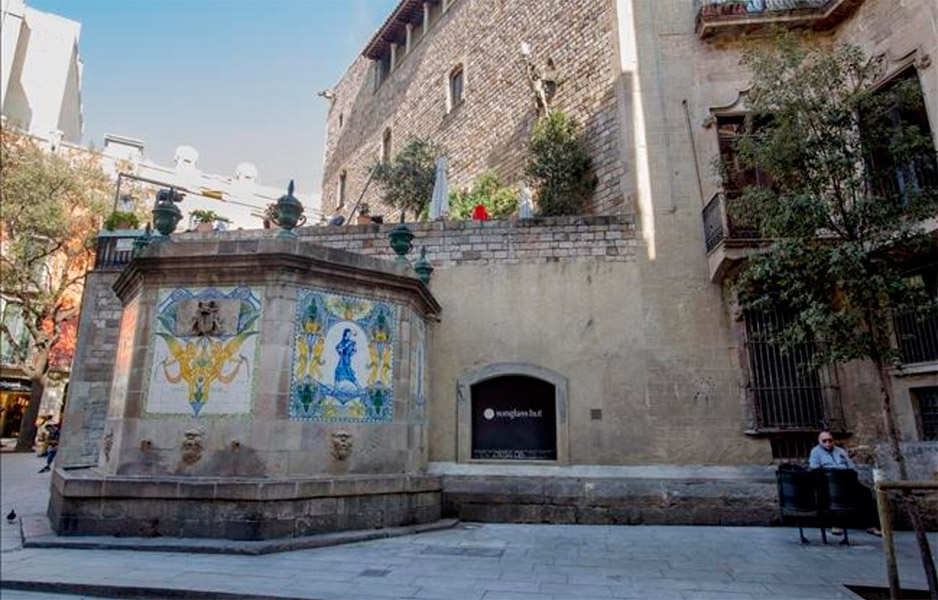
Santa Anna Fountain, on the corner of Portal de l’Àngel Avenue and Cucurulla Street.
This fountain, built in 1356, is one of the oldest preserved in Barcelona.
Its current structure is the result of several later modifications.
Its watering trough now serves as a planter.
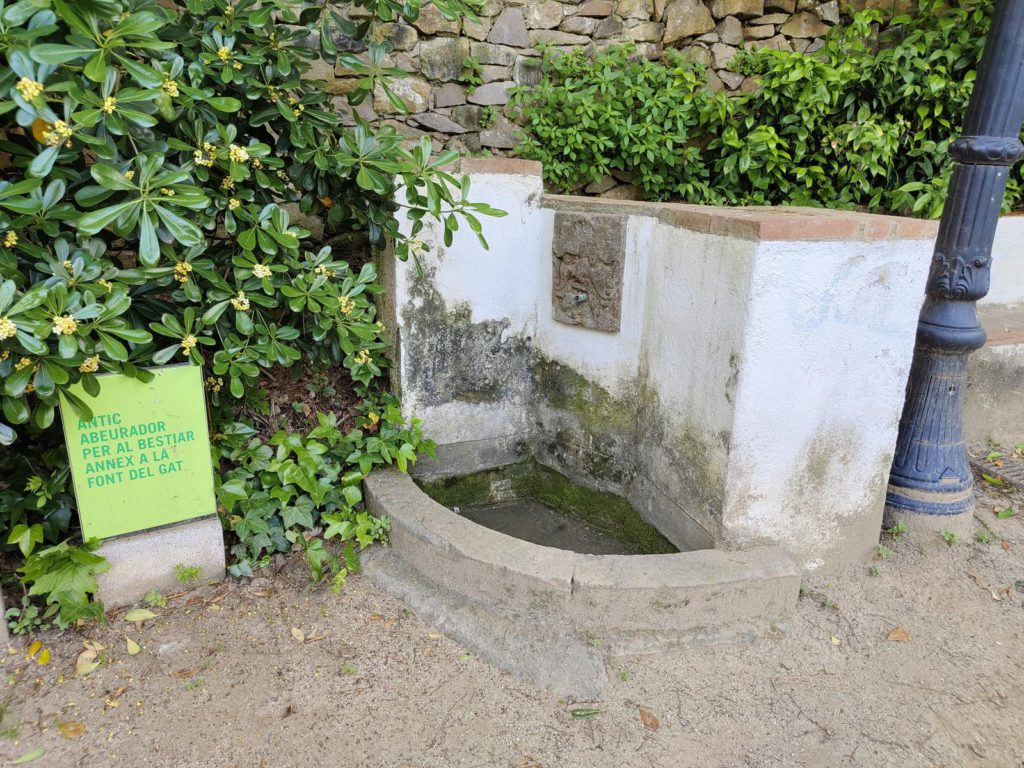
Font del Gat, in the Laribal Gardens, Montjuïc Park.
A very popular Catalan song gives fame to this fountain, which was a well-known meeting point for couples during the Modernisme era. What is less known is that this place also served as a watering trough for livestock, as indicated by a sign posted by the City Council.
Poble Sec watering trough. Source: fonts naturals, aigua, muntanya i més blog.
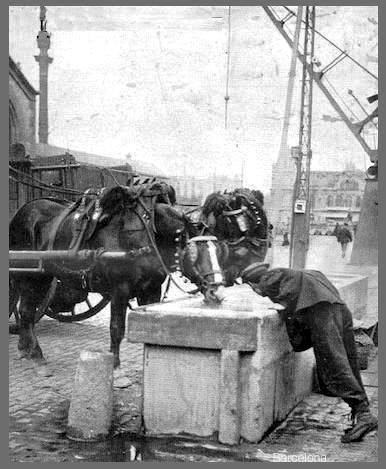
The Poble Sec watering trough, Vilà i Vilà Street near number 77.
The word “watering trough” evokes rural landscapes, but in an industrial city like Barcelona, pack animals were also used to transport goods between factories, trains, and ships. This watering trough, located near the port of Barcelona, was an example of that. Not far from there, Gaudí built the Palau Güell, famous for its stables and, logically, its private watering troughs. They were not the only ones.
Old watering trough next to the Font del Gat. Wikiloc website.
An end-of-degree project
One of Gaudí’s earliest graduation projects was a watering trough designed for a large square located at a crossroads of rural paths. The plans and the corresponding budget have survived. In the lower right corner, you can find the name and signature of the author. Today, this never-built project is preserved in the archive of the Polytechnic University of Catalonia.
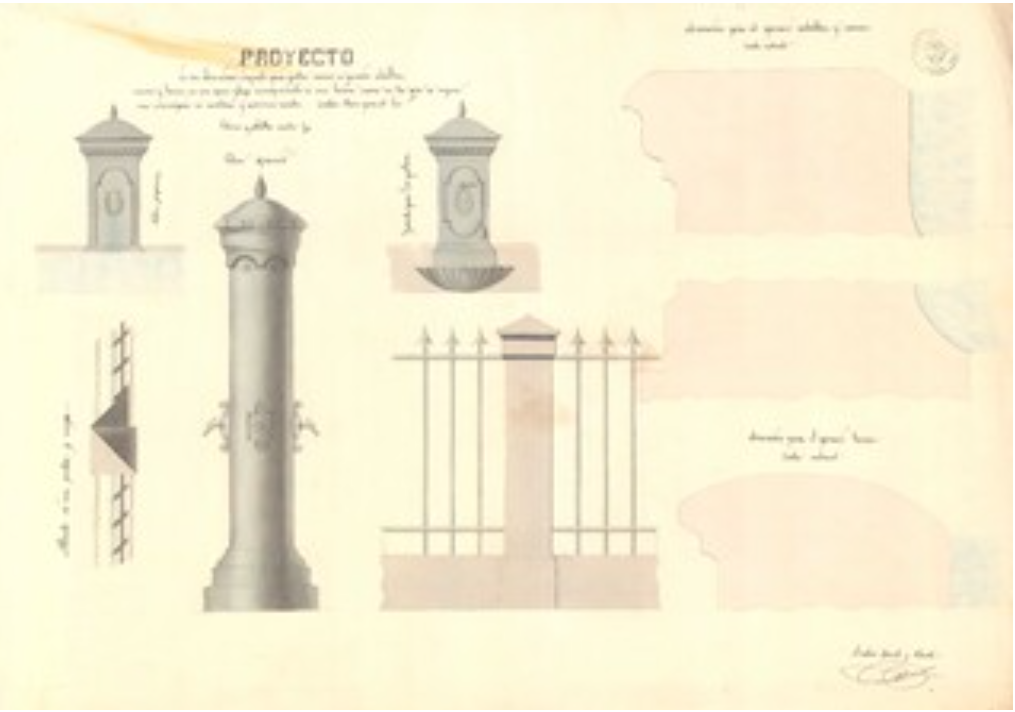
Watering trough project for a large square, signed by Gaudí.
Source: Universitat Politècnica de Catalunya, Càtedra Gaudí.Fuente: Universitat Politècnica de Catalunya, Càtedra Gaudí.
In short, the study of the life and work of the architect celebrated in 2026 reveals not only an era full of innovations but also another that was disappearing.
At Torre Bellesguard, we can perceive both realities: the one emerging and the one fading away.
Come discover them! Come recover them! Come enjoy them!
Notes
(1) Homepage of the Federació Catalana dels Tres Tombs.
(2) Maragall, Pere & Vilar, Esther (15/03/2013), “La Vaca cega”, by Joan Maragall, Biblioteca de Catalunya website.