May 2, 2026
By Ferran Garcés
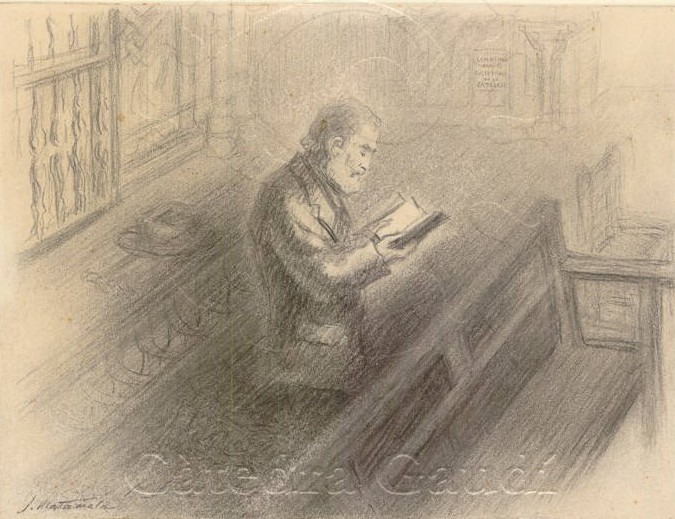
Last week it was Sant Jordi and we recommended some readings related to Bellesguard. Today we will follow the trail of the architect’s books. What did Gaudí read? One of his most famous phrases speaks of the book of Nature: “The great book, always open and which one must strive to read, is that of Nature.” A thought he reiterated with another well-known phrase: “That tree near my workshop: that is my master!” However, Gaudí had other masters, all of them within the religious sphere (see: Gaudí’s spiritual friends), and he also read other books. Would you like to get to know his library?…
1888–1893. Astorga, work and conversations
As we have anticipated, Nature was not Gaudí’s only source of inspiration. He himself expressed it as follows: “I am also amazed by the exquisite tact with which the Church employs all styles and receives the homage of all the arts. The Church makes use of all the arts, both those of space (architecture, sculpture, painting, goldsmithing…) and those of time (poetry, chants, music…). Christian liturgy gives us lessons in the most delicate pure aesthetics” (1).
We can detect one of the earliest signs of this belief in the passionate conversations the architect held with the bishop of Astorga during the construction of the Episcopal Palace of Astorga (1889–1893), León. There, Bishop Joan Grau i Vallespinós, born in Reus and a longtime friend, thoroughly instructed the architect Antoni Gaudí in Catholic liturgy. At that time, the Catholic religion was experiencing winds of renewal thanks to the publication of a kind of highly influential religious encyclopedia: L’Année Liturgique by Dom Prosper Guéranger, abbot of Solesmes, in France. This voluminous work would become, perhaps, the book most consulted by Gaudí. He himself makes an unequivocal confession: “I have read nothing of what Bréhier says (the French historian specializing in Byzantine iconography), in the summae, in the specula, nor in the works of medieval symbolism. I learned living liturgy by following the annual cycle of the Church with the fifteen dense volumes of Dom Guéranger” (2). A book which, incidentally, Gaudí read in French.
Around this time, another outstanding book in Gaudí’s work was The Interior Castle or The Mansions by Saint Teresa of Jesus, a seminal work of Spanish Golden Age mystical literature and the main source of inspiration behind the construction of the Teresian School (1888–1890). Incidentally, Gaudí also held long conversations with Enric Ossó, the promoter of this project and a mutual friend of Bishop Joan Grau. In other words, the architect’s readings were often framed within pleasant gatherings with friends who, at the same time as being mentors, were clients.
1911. Convalescence in Puigcerdà
We know of other readings by Gaudí thanks to one of the most fascinating episodes of the architect’s life: his convalescence from Malta fever in Puigcerdà, in the spring of 1911. At one point, his health condition became so critical that a local notary was called to draw up his will. Fortunately, the dying man recovered little by little, thanks to the care of his friend, Doctor Santaló (see: Gaudí’s illnesses). From that stay, the following accounts have survived.
First account: Saint John of the Cross
Once again, we let Gaudí himself recount the anecdote: “I designed the present façade of the Passion in pain, in 1911, when I was ill in Puigcerdà, where I became so gravely ill that, as they were putting me into the bath, I heard one of the people supporting me say softly: He is gone! The convalescence was long, and I had as a nurse a Castilian Camillian religious, from Old Castile, a compatriot of Saint John of the Cross, whose works he would read to me.
The poetry of the saint, which the religious read so well, not only comforted me, but also tempered my spirit so that I could continue meditating on the portal of the Passion, which I eventually drew on paper. As the convalescence was long, I had time to study and reflect on the said portal” (3).
Second account: Verdaguer, Casanovas, Kempis, Torras i Bages…
Slowly, Doctor Santaló allowed Gaudí’s main friends to visit him, such as Lluís Millet, the musician with whom the architect shared a passion for Gregorian chant, one of the central points of the liturgical renewal mentioned earlier (see: return to musical origins).
This time, the anecdote is told by one of the master’s biographers: “The period of rest also allowed him the luxury of devoting himself to reading. As always, he continued to keep at hand Atlantis and Canigó by Verdaguer, as well as the Roman Missal, the Old Testament, a collection of essays by Ignasi Casanovas, The Imitation of Christ by Thomas à Kempis, and The Science of Suffering by Torras i Bages” (4). The latter author, incidentally, was one of Gaudí’s main spiritual friends, together with Joan Grau and Enric Ossó. The other was Verdaguer, whose work was a constant source of inspiration in Gaudí’s oeuvre, including Bellesguard (see: the poetic garden).
1921. A journalist visits the artist’s workshop
Gaudí kept up with the news and events of the world through his daily reading of La Veu de Catalunya. Well then, a journalist from this publication visited Gaudí’s workshop at the Sagrada Família in 1921 and wrote: “Among the books most readily at hand, mostly liturgical, seen near Gaudí’s table at the Sagrada Família, the Caeremoniale Episcoporum, the protocol code of the Church of Rome, stands out in particular. In this book, published by Pope Clement VIII (year 1600), the entire Roman tradition of ceremonies celebrated with solemn order is collected” (La Veu de Catalunya, 24-XII-1921).
In summary, Gaudí felt a great admiration for the great book of Nature, but it was not the only one. All the same, deep down, liturgy and Nature were the same thing: a manifestation of God. All the master’s readings, often connected with his closest friends and clients, enabled him to create an architecture full not only of admirable forms but also of surprising meanings. In the end, his buildings have themselves become the source of inspiration for countless books!
Notes
(1) Puig‑Boada, Isidre (1980) The Thought of Gaudí. Compilation of texts and commentaries, Barcelona, Publications of the Architects’ Association of Catalonia, p. 201.
(2) Ibid., pp. 218–219.
(3) Ibid., p. 200.
(4) Hensbergen, Gijs van (2002), Antoni Gaudí, Debolsillo, Barcelona, p. 272.