March 14, 2026
By: Ferran Garcés
The laying of the first stone of the Sagrada Família took place on March 19th, 1882, Saint Joseph’s Day. To commemorate this milestone and on the occasion of the centenary of Gaudí’s death, next March 19th, 2026, the Sagrada Família will host the Orfeó Català, “thus highlighting the choral spirit and the bond between both institutions,” as we read on the temple’s website. May it also serve to recall one of Gaudí’s great passions—music—and, at the same time, dispel the stereotype of a solitary man isolated from the world. Quite the contrary: the architect was always surrounded by friends and by members of different associations of his time. In fact, this story—the relationship between the Sagrada Família and the Orfeó Català—begins in a café full of people…
1883–1885: The Beginning of a Long Friendship…
Gaudí took on the Sagrada Família project in 1883, one year after the laying of the first stone. He was 31 years old at the time. This Gaudí was not the one most people picture today. That Gaudí dressed elegantly, enjoyed good restaurants, and never missed the opera performances during the season at the Gran Teatre del Liceu (“from dandy to saint”).
Gaudí of that time also never missed the gatherings at the Café Pelayo, located at the top of La Rambla, when Plaça Catalunya had not yet been defined. This café was a place frequented by intellectuals, artists, and music lovers. Around 1885, a pianist named Lluís Millet i Pagès—future founder of the Orfeó Català—began to play there. The musician and the architect got along from the very first day and would remain close until the end.
1891–1897: The First Fruits
There is no single date to mark the beginning of Modernisme, but all proposed dates fall between the late 1880s and early 1890s. The Orfeó Català, founded by Lluís Millet, was created in 1891. By that time, Gaudí had already completed his first works: Casa Vicens, Palau Güell, and the Teresianes School in Barcelona, and beyond the city, El Capricho, the Episcopal Palace of Astorga, and the Casa Botines.
In 1893 the “Cercle Artístic de Sant Lluc” was founded, bringing together artists of a more religious orientation within the new movement. Gaudí and Lluís Millet became members from the very beginning. Furthermore, in 1897, Lluís Millet—an important composer and tireless promoter—also founded the chapel of Sant Felip Neri in Barcelona. Gaudí became its most famous attendant. Indeed, he would be run over while walking on his way there—but let’s not get ahead of ourselves. For now, let us simply remember that Gaudí went to that church to attend mass, but also to sing and converse with the other singers, some of whom were members of the Cercle de Sant Lluc and mutual friends of Gaudí and Millet. In fact, on some occasions the Orfeó Català itself also took part, and when that happened, Lluís Millet directed the chapel.
1904–1906: The Dream Takes Shape
Curiously, Gaudí’s third residence in Barcelona was at Carrer Montjuïc de Sant Pere, 16—today Carrer Verdaguer i Callis, 16. It is currently one of the streets that leads directly to the Palau de la Música Catalana, the headquarters of the Orfeó Català. However, when Gaudí lived there around 1880, this building had not yet been constructed.
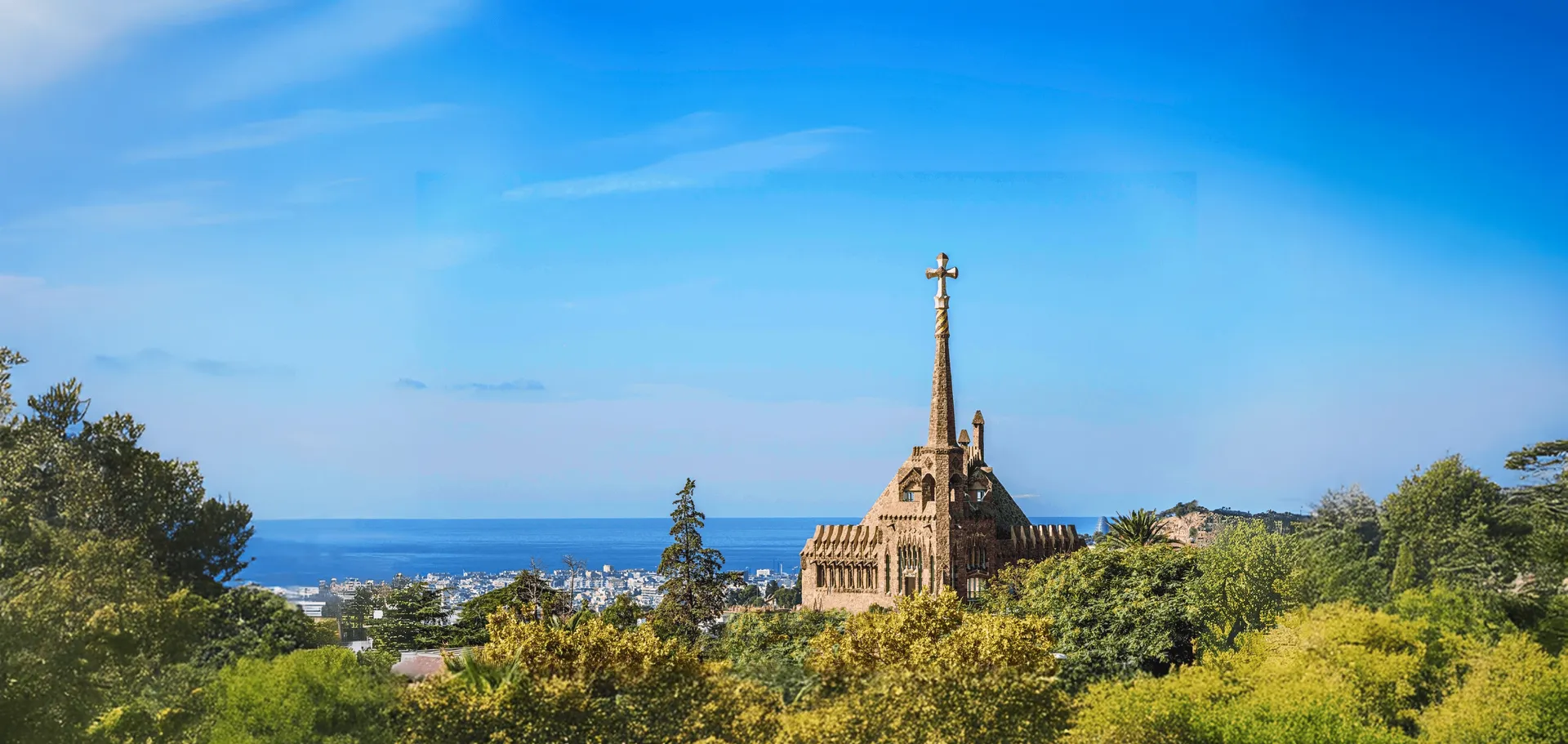
The Palau would be built between 1904 and 1908 under the direction of Domènech i Muntaner, another of the great Modernista architects. The new institution would house the headquarters of the Orfeó Català—the dream of Lluís Millet and an entire generation (“between Wagner and Clavé”). Gaudí, a great lover of music, would be a regular attendee at the Palau. During this period, the architect had completed the main house at Torre Bellesguard and was beginning Casa Batlló and Casa Milà, among many other projects such as Park Güell. Modernisme was then in full effervescence.
1916: A Music Course… or an Architecture Course?
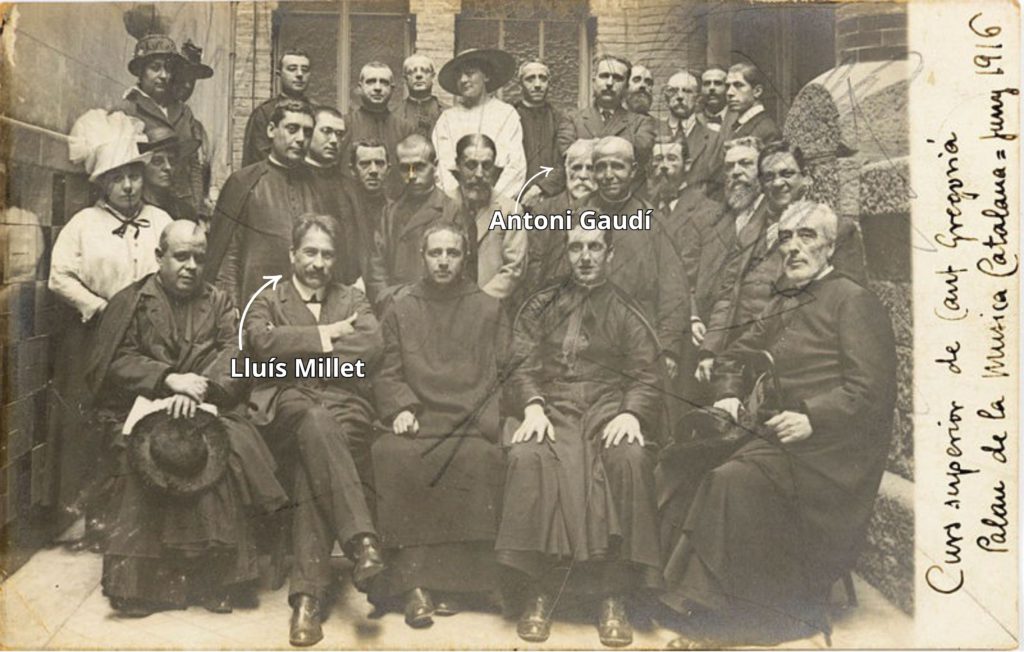
The Palau, home of the Orfeó Català, would not only offer concerts but would also include other activities. In 1908, the year it was inaugurated, it already hosted two significant events: the fiftieth anniversary of the Jocs Florals (“Floral Games”) and a political event of Solidaritat Catalana (“Catalan Solidarity”). It would also organize courses. One very special course was the Gregorian chant course of 1916, which once again brought together the two friends, both passionate about this style as well as about Renaissance polyphony. These were the styles promoted by the liturgical reform led by Pope Pius X, who wanted to restore the purity of early religious music (“return to the origin”). Millet became one of its main defenders in Catalonia, which led, for example, to the revival of the polyphonic works of Tomás Luis de Victoria. Obviously, this was also the preferred musical style at Sant Felip Neri.
During one of the sessions of that course, a heated argument arose among the clergy about chant, the main subject of the reform. To calm things down, Lluís Millet handed the floor to Gaudí, hoping he would help reduce the tension. His friend responded: “Oh, my friend, I do not come here to learn music, but architecture.”
 1920: Two Good Friends…
In two photographs taken in 1920, one can clearly see the close friendship between the creator of the Sagrada Família and the founder of the Orfeó Català—and, let us not forget, also the founder of the chapel of Sant Felip Neri. In one of the photos, Gaudí, who disliked being photographed, hides his face with his hat. At his side, Millet seems amused by his friend’s gesture. In the next photo, teasing again, the architect shows only his profile. The images also allow us to appreciate the state of the Sagrada Família at that time. Around this period, Gaudí was receiving many visitors, whom he personally attended to (“Gaudí, his own tourist guide”). As we said at the beginning, the stereotype of Gaudí as a solitary man is false.
1921: Another Example of Gaudí’s Humor…
The Orfeó—within a short time—became responsible for memorable concerts, giving a voice both to Catalan popular music and to the classical music of Europe. These concerts consolidated the institution and turned it into an ambassador of the emerging Modernista Catalonia. Among its most iconic concerts, one stands out: the premiere of Bach’s St. Matthew Passion on February 27th, 1921, which included the participation of the theologian and organist Albert Schweitzer (“Gaudí’s Mediterranean humor”). Once again, Gaudí attended the concert, and—as expected—his presence did not go unnoticed. Lluís Millet himself recounts the anecdote:“When for the first time at the Orfeó Català we performed Bach’s St. Matthew Passion, I took Dr. Schweitzer to the Sagrada Família, and he was astonished by the work, showing a lively interest in its author—a man so small in stature and of such prodigious genius. Schweitzer, this extraordinary figure and great apostle of the sublime Cantor of Leipzig, wanted to know Gaudí’s opinion of the St. Matthew Passion.
‘Have you heard it?’ he asked him. ‘What did you think?’
Gaudí was taken aback for a moment, then replied:
‘I didn’t think I would like it so much… but,’ he added with an ironic smile, ‘I believe these fellows over here—pointing at me—have arranged it rather well.’
The Passion of Bach had deeply moved him with its solemnity and powerful expression, but it was German art—far from the Mediterranean light—and he looked for reinforcement of his own belief in the interpretation offered by our own people, born under the bright light of the sea that surrounds us. Needless to say, his paradoxical answer made us all laugh.”
June 29th, 1922: An Exceptional Dedication
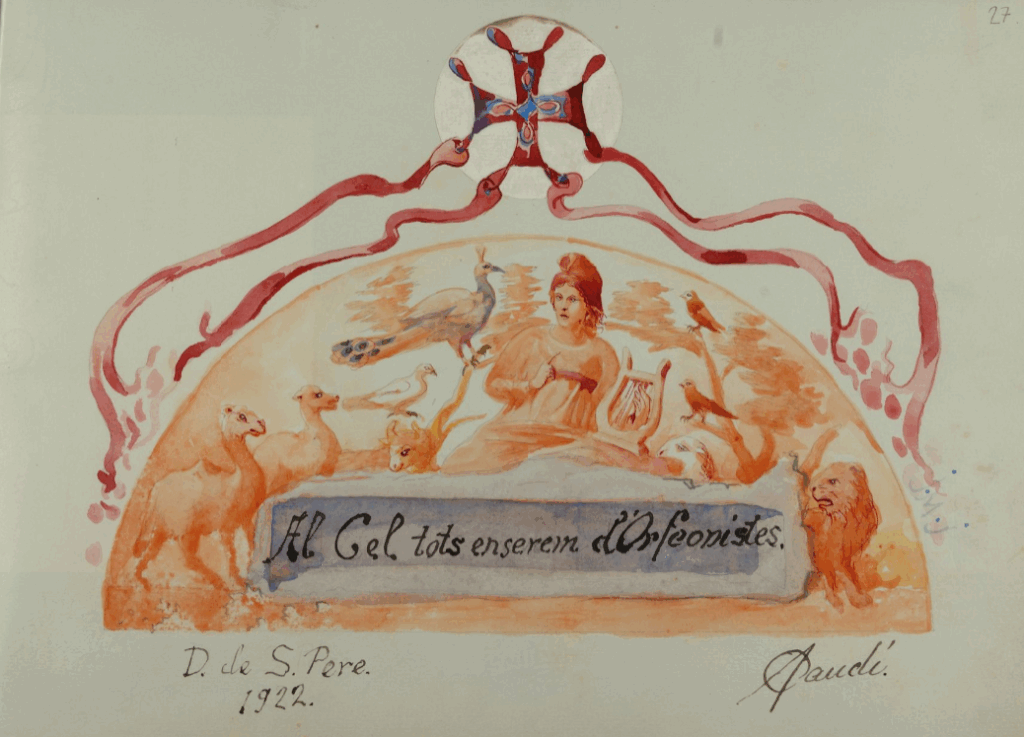
One of the treasures of the Orfeó Català headquarters in the Palau de la Música is the Golden Book. Through its pages have passed the greatest figures of past and present artistic, political, and religious life—a testament to the importance of the institution. On June 29th, 1922, Saint Peter’s Day, the board asked Gaudí to sign it. Although the architect usually declined such requests, on this occasion he accepted, most likely because of his deep friendship with Lluís Millet. Beneath a drawing featuring a Greek cross and an allegory of the myth of Orpheus, one can read:
“In Heaven, we will all be orfeonistes.”
1926: Before Reaching Heaven…
As on so many other evenings, on June 10th, 1926, Gaudí began his walk from the Sagrada Família to the chapel of Sant Felip Neri, where he intended to attend mass and sing his beloved liturgical music. He never arrived. He was struck by a tram along the way.
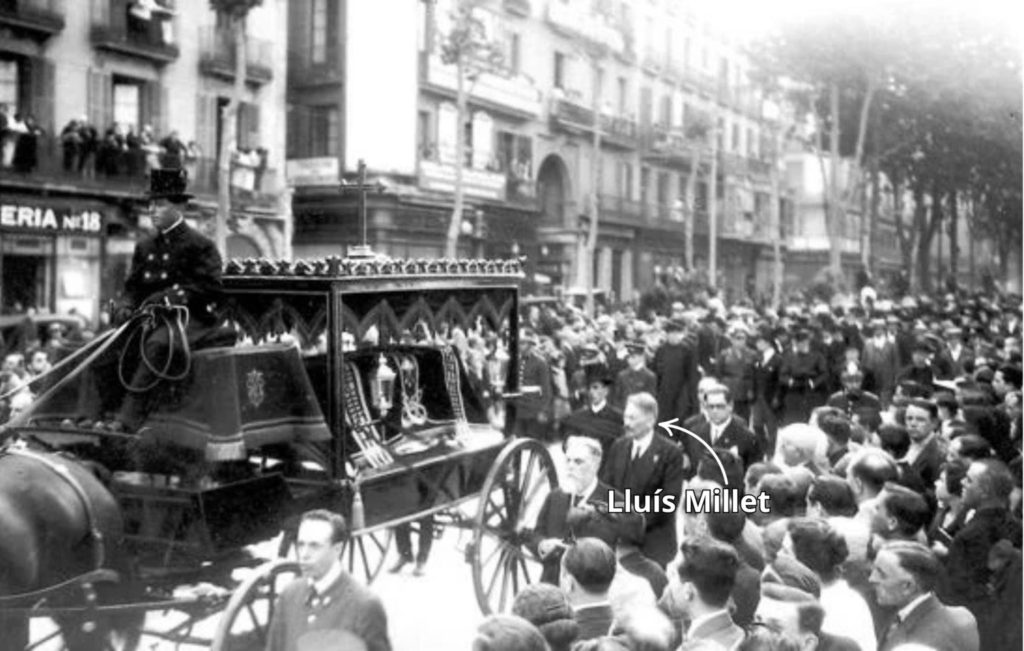
The funeral took place on June 12th, 1926. During the procession through the city center, one of the people holding the ribbons of the coffin was Lluís Millet. When they reached the Sagrada Família, he let go of the ribbon and took the baton to conduct the Officium Defunctorum by Tomás Luis de Victoria—one of the composers, let us recall, favored by both Gaudí and Millet. In short, a long path since those youthful days at Café Pelayo.
Who knows—perhaps Gaudí was right, and now the two of them are orfeonistes in Heaven.