February 21, 2026
By: Ferran Garcés
Today, February 21, International Tourist Guide Day is celebrated. The date commemorates the founding of the World Federation of Tourist Guide Associations (WFTGA) in 1985, and its aim is to recognize the essential work of these professionals in the promotion, dissemination, and preservation of cultural and natural heritage.
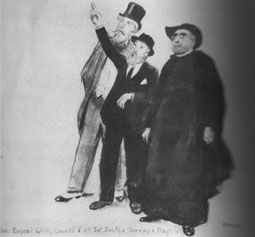
Today is therefore a good opportunity to talk about a little-known facet of Antoni Gaudí: that of the architect explaining his own work. A facet, however, that we can only document toward the end of his life, when he began to be the subject of various photographs due to his growing popularity. Photographs and drawings, such as the one in the header image, show the architect commenting on the Sagrada Família to two of his best friends: Count Güell and Bishop Josep Torras i Bages. The author is Ricard Opisso, the future illustrator of TBO and other publications who, between 1892 and 1904/1906, worked as the architect’s assistant.
Before 1904.
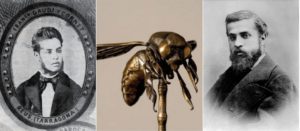
People tend to forget the early Gaudí, or at least the period when he was not yet a renowned architect. From this stage, little more than a couple of photographs have been preserved, and at the time they held no interest for anyone. For example, one is the photograph of his graduation and the other his pass for the Barcelona Universal Exhibition of 1888 (see: portraits of Gaudí, from ages 26 to 52).
Gaudí of that period passed through history in a discreet manner. Only later studies have made it possible to reconstruct his trail. As the architect refused interviews and photographs, little was known about him as a person. He did not join any political party either, and in the associations in which he participated his presence was always discreet. Even so, he had many friends, among his own clients and collaborators as well as among the artistic elite of the time, such as the poet Jacint Verdaguer or the musician Lluís Millet. He was neither a hermit nor a loner; he simply did not wish to be the center of attention. However, toward the end of his life, once he was established, he could not avoid the growing interest in his most emblematic work, the Sagrada Família. At that point, various prominent figures visited him, and given their social importance, the number of photographers around him increased (see: portraits of Gaudí, from ages 52 to 73). As a result, most photographs of the architect date from this final period. One detail is repeated in them: Gaudí is explaining his work, surrounded by people. Without intending to, he became the first guide of himself, although the earliest experiences were not exactly what one would expect from a guided tour today…
First visits: 1904–1906.
Nowadays, the first step in arranging a guided tour is choosing the language. With Gaudí, however, this was not possible. He always conducted them in Catalan, even before King Alfonso XIII at the Sagrada Família when he visited it in 1904. At that time, the temple was little more than the crypt. Even so, it seems the monarch felt satisfied, or at least appeared to be. No photograph of that moment has been preserved. Gaudí was not yet sufficiently popular.
The next visit went worse, even though the visitor had made the effort to learn Catalan before coming. Invited by the Catalan poet Joan Maragall, the Basque writer Miguel de Unamuno visited the Sagrada Família in 1906. Different versions of the “tour” have been given, and almost all agree that the visit was more a misunderstanding than anything else. It went badly from the start. Unamuno arrived late and, after a half-hour wait, the architect returned to his workshop. The tour was short. According to legend, Unamuno said, “I don’t like it! I don’t like it!”, and a few steps behind him, Gaudí repeated, “I don’t like it! I don’t like it!” (1).
The day ended in a strange way. The writer made little paper birds and the architect, upon hearing the Angelus bells, abruptly ended the visit and began to pray. We also have no photograph of this early visit. However, there is a drawing by the aforementioned Ricard Opisso. The fourth person in the image is Josep Pijoan i Sotres, poet, historian, and art essayist.
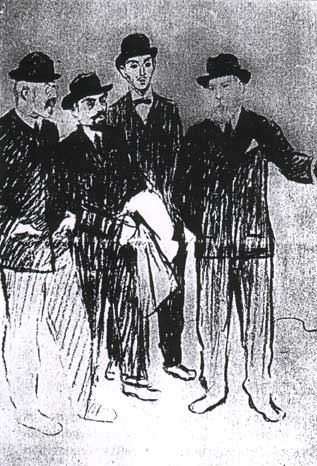
Final years: 1910–1926
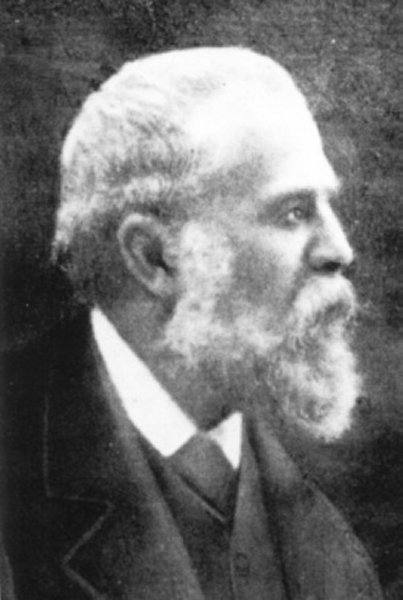
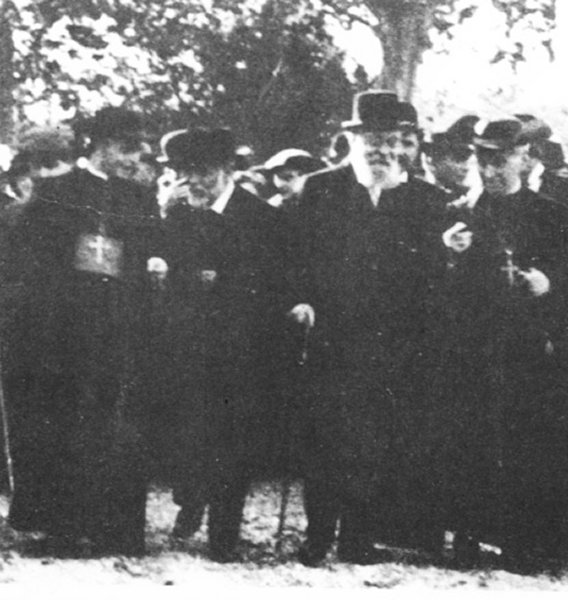
The first “official” photograph of Gaudí was published four years after the meeting with Unamuno, on the occasion of the architect’s first exhibition in Paris. At the end of that same year, he was also photographed for the first time as a “guide.” In it, he is showing the Colònia Güell to Count Güell himself.
From this same year we also have another photograph: Gaudí in the middle of a group of architecture students. They were not the only ones; many other groups of different specialties visited him (2). The photograph, incidentally, is also by Opisso, who moreover added —true to his sense of humor— a curious note: “Gaudí talking with the students of the School of Architecture. Note the immaculate whiteness of his pressed collar,” and indeed, at that time, contrary to today’s stereotype, Gaudí dressed with elegance and distinction (see: the dandy period).
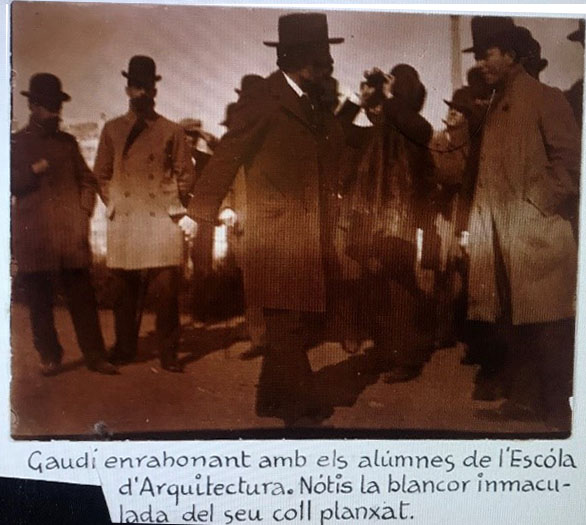
From then on, gradually, photographs of the architect became more and more numerous. These are the images that helped shape the myth of the genius: an elderly man with a white beard with the Sagrada Família in the background. The association with the temple was reinforced because, between 1911 and 1914, Gaudí abandoned all other projects to devote himself exclusively to the “cathedral of the poor.”
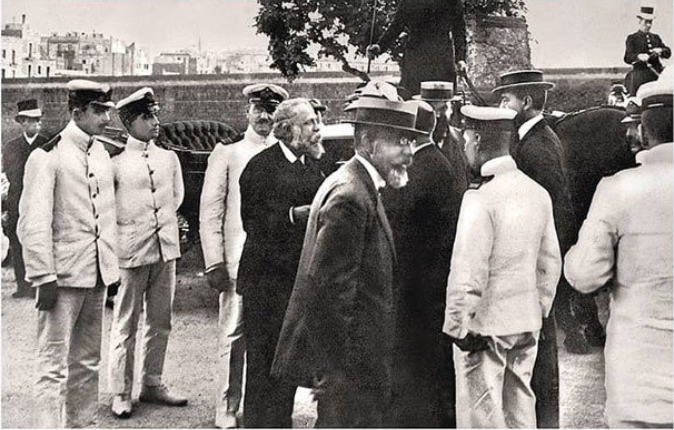
This also generated the false idea that the temple was his last work, but in reality, it was one of his first commissions, in 1883, when he was still a lesser-known young promise. However, three decades later, the architect had become, as we would say today, a true celebrity. In the following photographs from 1911, we see him receiving a delegation of Argentine sailors and Infanta María de la Paz of Bourbon, daughter of Queen Isabella II. These visits were very important for the project. Every show of support was vital to carry it forward. Gaudí took great care in giving a good tour.
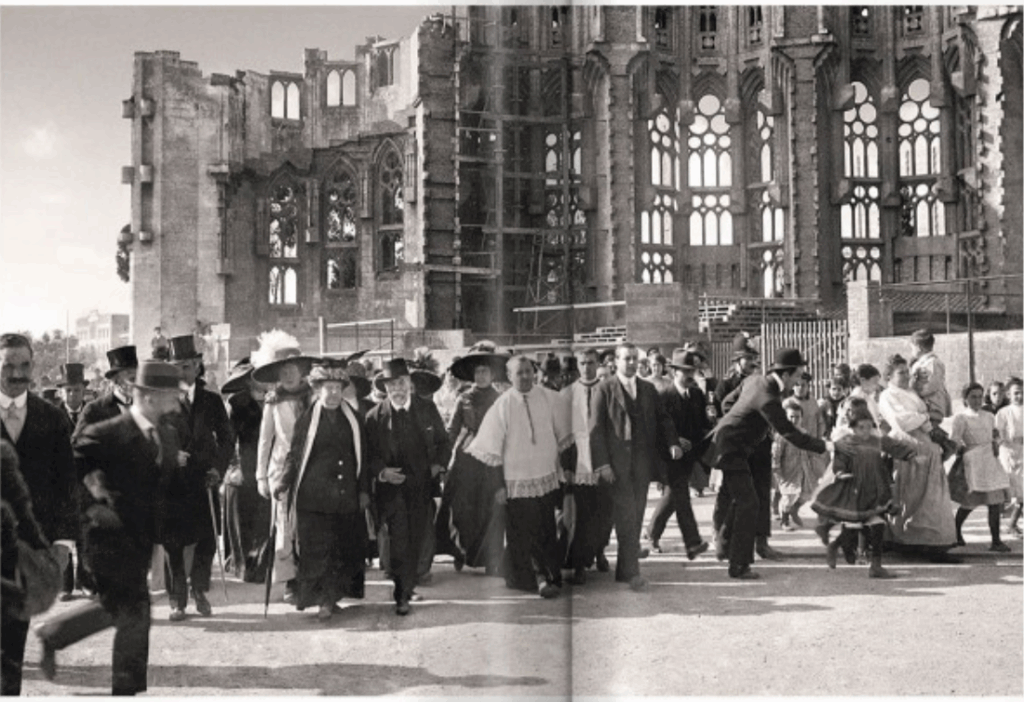 Another example. Here we see him in the company of the president of the Provincial Council of Barcelona, Prat de la Riba, and the city’s bishop, Enric Reig i Casanova, in 1914.
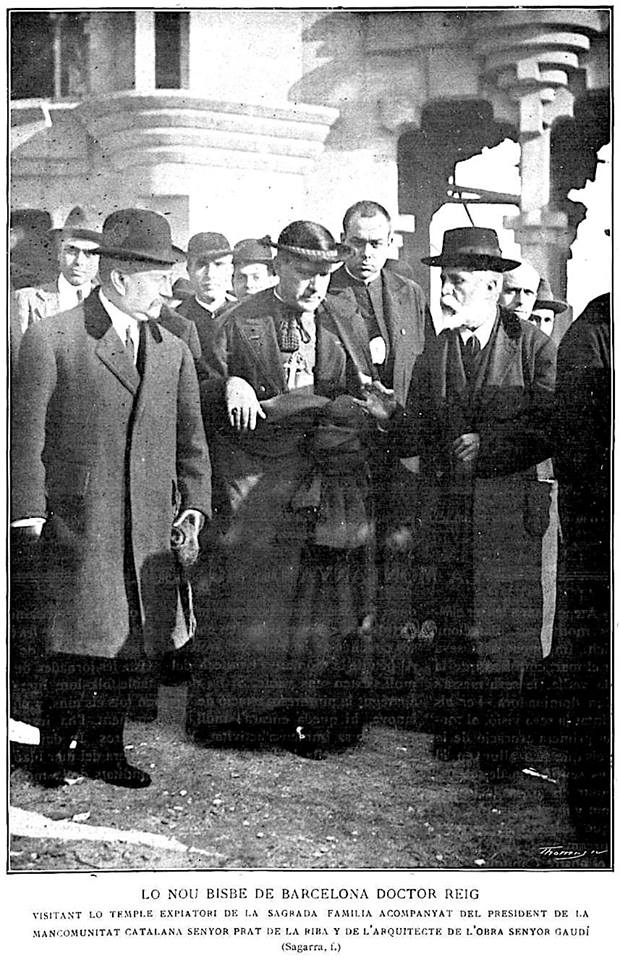
Gaudí showing the Sagrada Família to the Bishop of Barcelona, Enrique Reig Casanova, and to the President of the Commonwealth of Catalonia, Enric Prat de la Riba, November 30, 1914. Source: Wikipedia.
Let’s continue! Now Gaudí shows the Sagrada Família to the Apostolic Nuncio from Rome, Cardinal Francesc Ragonesi, in 1915. On that occasion, the cardinal described Gaudí with a phrase that became famous: “the Dante of Architecture.”
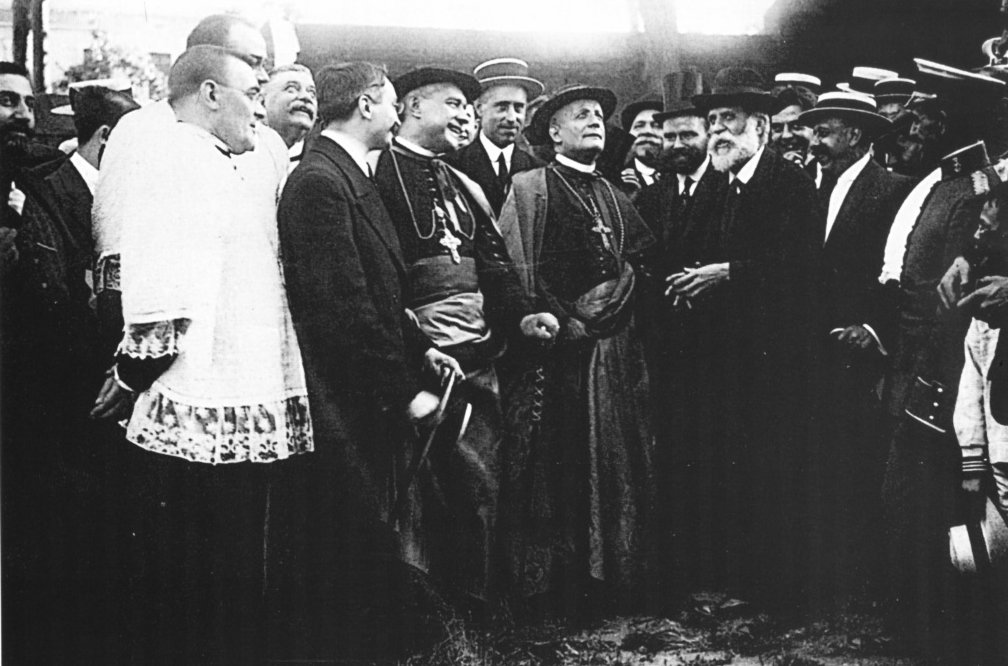
Visit of Nuncio Ragonesi to the Sagrada Família. Author: Josep Brangulí, 1915. Source: Wikipedia.
Having already become, as we can see, a place of pilgrimage during Gaudí’s lifetime, the Sagrada Família’s last visitors were a group of architects, then still very young, who, after the master’s death, would write his first biographies: Josep Francesc Ràfols, Cèsar Martinell i Brunet, and Isidre Puig i Boada. They were the last to enjoy the best tour guide Gaudí ever had: himself!
Notes
(1) See: La Veu de Catalunya, 27/05/1919, p. 11; Cultura, 1/05/1930, pp. 6 and 10
Bastons and Vivanco, C. (1966), “Unamuno y los modernistas catalanes”, Ediciones Universidad de Salamanca. Cuadernos, vol. 31, pp. 5–12
(2) Puig, Armand (2024), Antoni Gaudí, vida y obra, Arpa, Barcelona, notes 22 and 29, p. 373. “It is instructive to see how Gaudí trained them according to each group’s own specialty”: commerce, engineering, Fine Arts, architecture, etc.