June 4, 2026
By Ferran Garcés
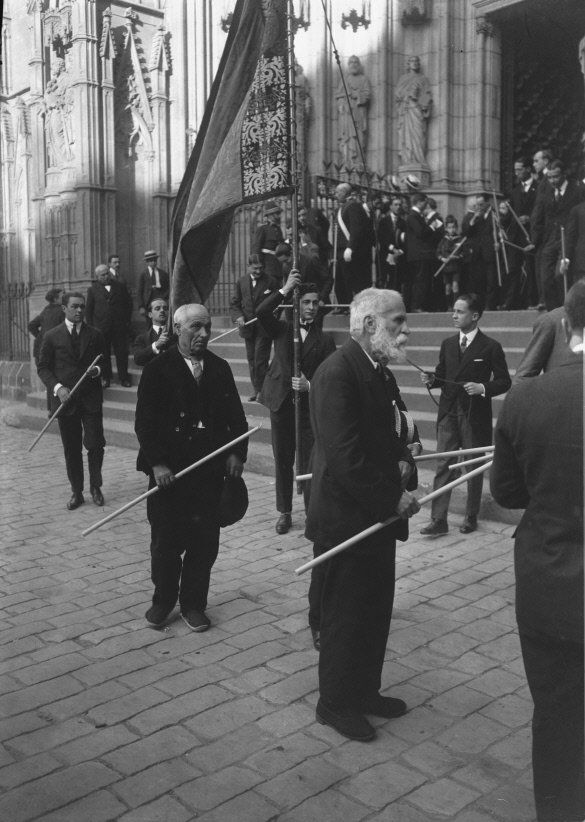
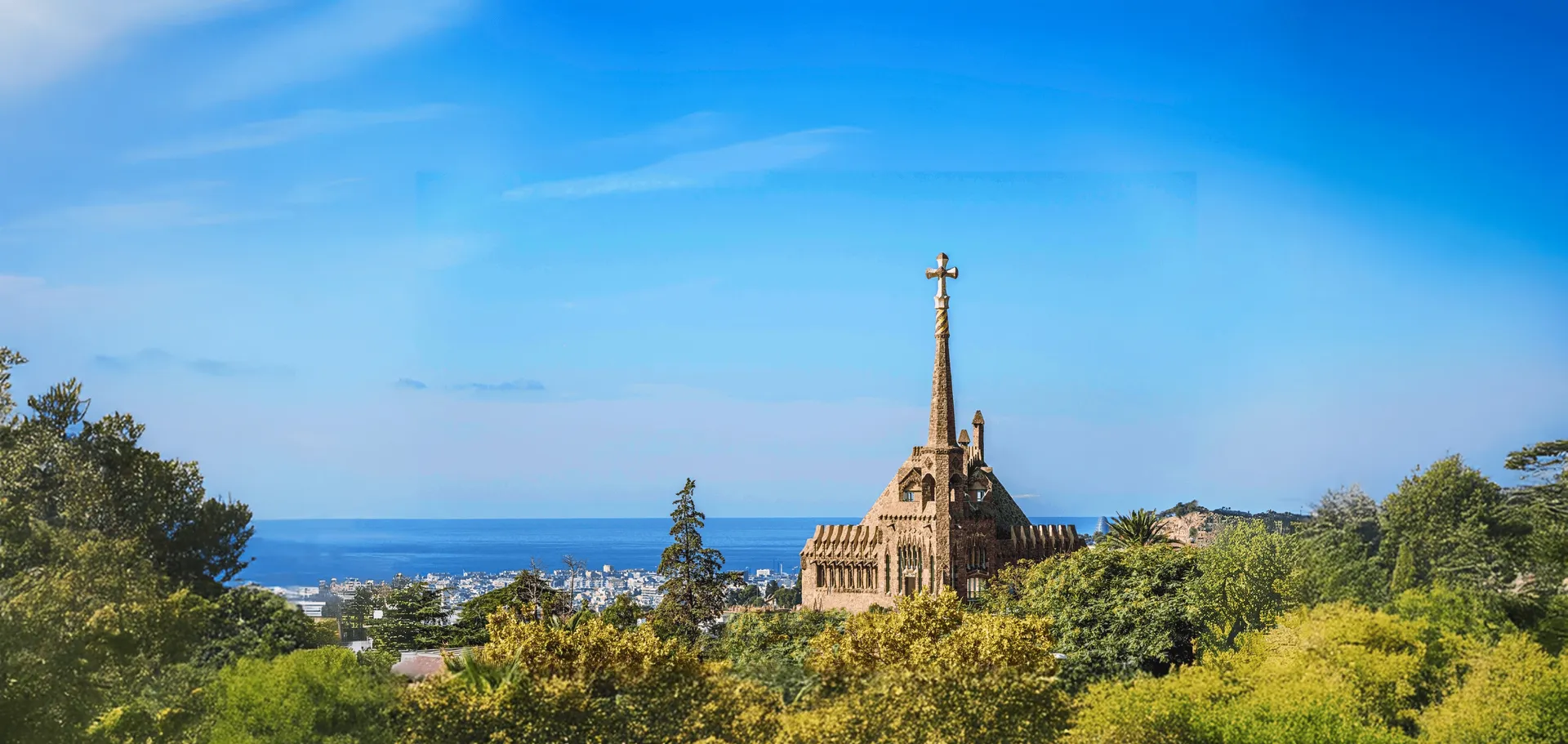
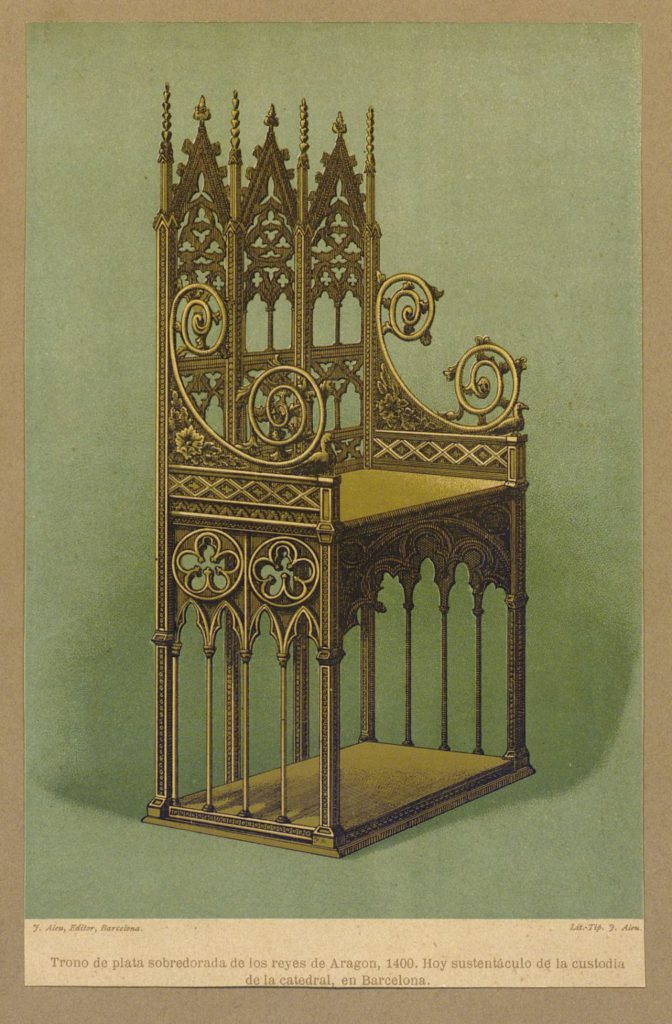
The last photograph of Gaudí shows him waiting for the beginning of the Corpus Christi procession, at the door of Barcelona Cathedral. He is surrounded by acquaintances from the Cercle Artístic de Sant Lluc, a Catholic association of which the architect was a member. That day in June 1924, like today, was a Thursday. During this procession, the monstrance is venerated, which rests, according to tradition, on the throne, or chair, of Martin I the Humane, the king who ordered the construction of the old palace of Bellesguard on which Gaudí based himself to create the current Torre Bellesguard two decades earlier.
Interestingly, Jacint Verdaguer, poet and great friend of Gaudí, in one of his last poems, was also inspired by the legends of Bellesguard to explain the relationship between this throne and the procession that Gaudí was waiting for that Thursday one hundred and two years ago. A throne around which almost all the main protagonists of that ancient palace parade. As ancient as the Corpus feast itself…
Much more than the “ou com balla” and the giants
If you enter any cloister in the city this week, you will not find the quietness and solitude typical of a church, but rather noise and people fascinated by the ou com balla. In the streets there will be even more people, following the giants and other festive traditions, such as carpets and greenery decorations. Needless to say, in Berga, with the Patum, Corpus will reach its most vibrant expression, but wherever it is celebrated, there will be a festive atmosphere.
In the past, however, while remaining equally popular, Corpus was a celebration with a much stronger religious character. In fact, it was established in 1264 to honor the Eucharist, the sacrament through which Jesus Christ becomes present in the consecration of the bread known as the consecrated host. For believers, it represents the body of Christ, the central element of communion. From 1316 onwards, this belief spread throughout Europe thanks to a papal bull and great clerical and secular fervor.
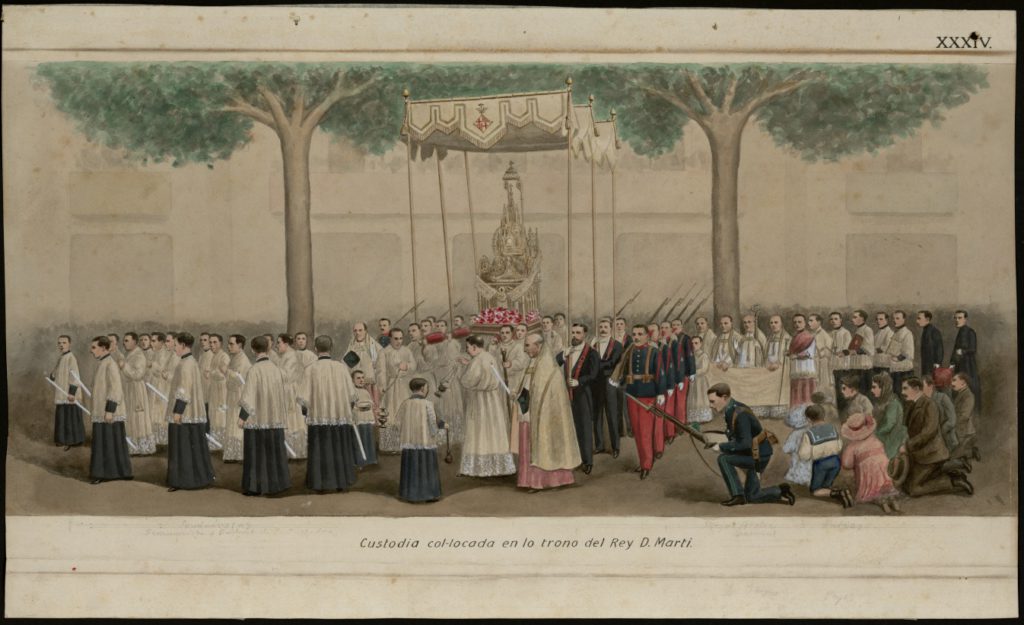
In 1320, Barcelona was the first city in Catalonia to celebrate the new festivity. Since then, the procession has become one of the most important rituals in Barcelona’s festive calendar. Soon, figures from festive imagery (giants, big-heads, dragons, vipers, mulasses or cucaferes), as well as different dances and the ou com balla tradition, were added to the procession. Today, these elements have become the most popular, but in the past, the highlight of the celebration was the procession that Gaudí was waiting for that Thursday in 1924. A tradition with more than seven hundred years.
At that time, the procession of the Monstrance, symbol of the Eucharist, brought together all social classes, reflecting the deeply hierarchical structure of the Middle Ages and later periods. A large number of prints have been preserved through which we can study the evolution of this procession (2). The following is from a period close to Gaudí’s.
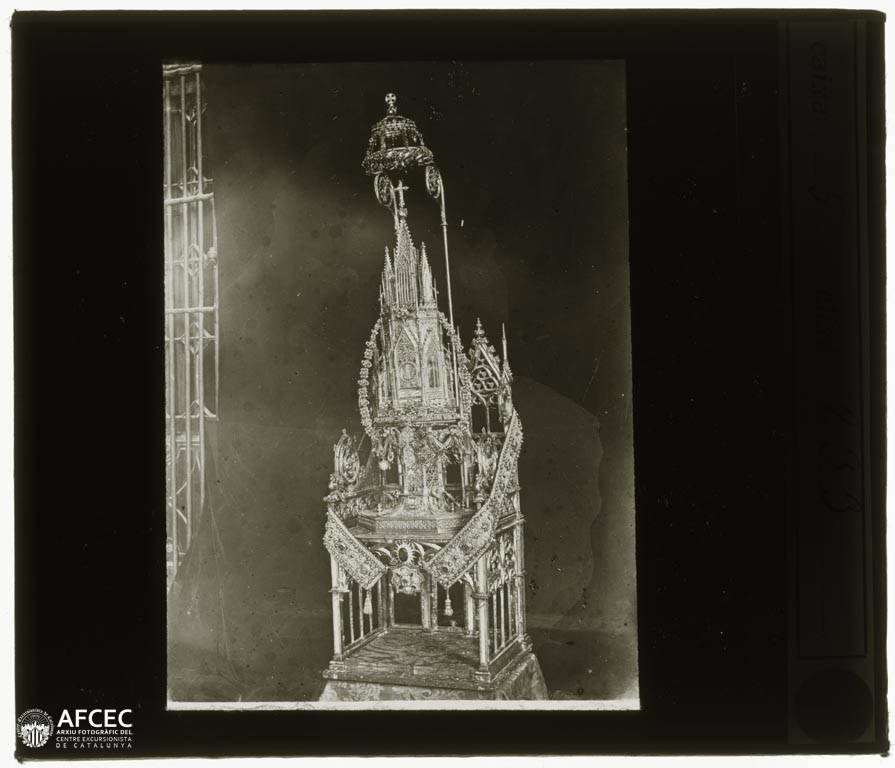
Monstrance with the chair of King Martin from Barcelona Cathedral. Unknown author (Between 1895 and 1916).
The legend, the poem…
The monstrance, also called an ostensorium, is a kind of container made of precious metals, where the consecrated host is kept, and which, on certain occasions, is used to display it to the faithful. According to tradition, the base of the monstrance in Barcelona Cathedral is the chair, or throne, of King Martin. This chair most likely accompanied the monarch in his final days at the old palace of Bellesguard. This is, at least, what Jacint Verdaguer believed, who, in one of his last poems, explained the origin of the tradition. Its title is quite telling: “The Monstrance of the Cathedral of Barcelona” and it was published posthumously in Eucarístiques (1904).
Interestingly, this poem was written around 1900, the year Gaudí accepted the commission for Torre Bellesguard. Today it can also be found in Barcelona, a book that brings together previously known texts about the city and others that are new. Through its verses, all the main figures in the history of Bellesguard appear…
The poem explains how the city commissions its best silversmith to create a golden monstrance for God and a silver throne for the king. The craftsman adorns the monstrance with precious stones and filigree. The object is compared to a tall and strong castle, full of pinnacles and Gothic windows, like the coronelas that, interestingly, Gaudí also used when building his unique recreation of the old palace of King Martin in Torre Bellesguard.
The central part of the poem describes King Martin the Humane’s stay in that palace, famous for the beauty of its garden. “Bellesguard is joyful, green and in bloom / in bloom like Easter, green like April,” we read. However, despite its splendor, Martin is sad after receiving the news of the death of his only son on Saint James’s Day (July 25, 1409). In the midst of his solitude, several young women are presented to him, and his heart finally leans toward Margarida de Prades, daughter of a count and granddaughter of a king. Their marriage is blessed by the last of the Avignon popes while Saint Vincent Ferrer officiates. Unfortunately, the marriage will not bring the desired heir.
The poem then explains how the king leaves Bellesguard because, in the palace, “he was pursued by sadness / that the day of Saint James gave him / the news of the death of his only son.” However, death will soon also come to the grieving father. The poem concludes by evoking the final days of King Martin the Humane in the Valldonzella monastery, an hour from Bellesguard. There we see the last monarch of the House of Barcelona, surrounded by his wife and the knights and ladies of the realm. Pope Benedict XIII arrives to administer the viaticum, and Martin receives the final blessing before dying. It is then, according to tradition, that the king ceded his throne to Jesus Christ, the true spiritual sovereign. More precisely, King Martin, on his deathbed, when asked about his successor, replied that it would be “the one who was being heard” at that moment, referring to the sound of the viaticum bell announcing his final communion.
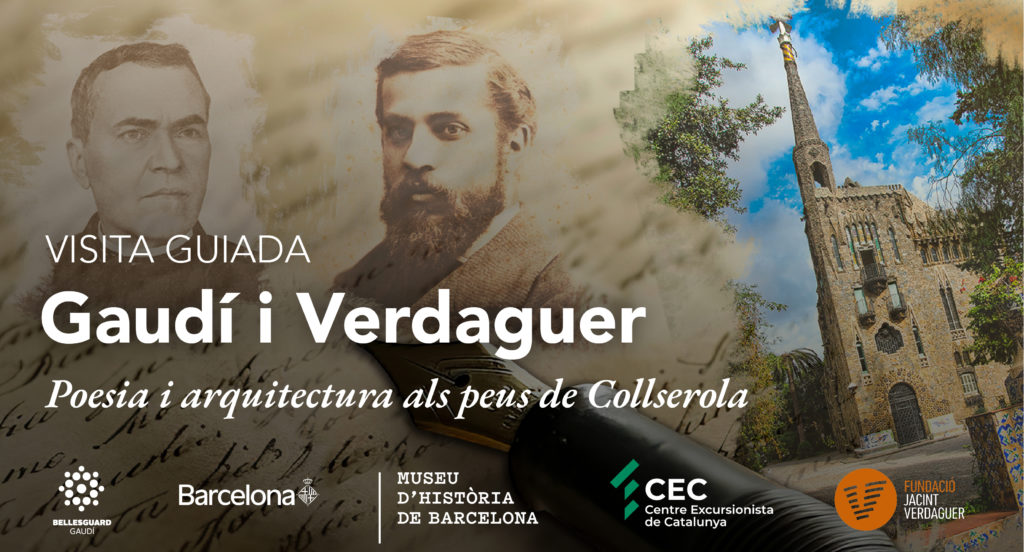
Is the legend real? How does the story continue? If you want to find out the answer and discover other details of this legend and poem, sign up for the new Torre Bellesguard route. We are waiting for you!
Tickets for Verdaguer and Gaudí, poetry and architecture | Clorian