April 2, 2026
By: Ferran Garcés
 Last 21 March was World Colour Day and this Friday, 3 April, is World Rainbow Day—two commemorative dates that, deep down, remind us that spring has already arrived, the season of blossoming and the rebirth of Nature. Today, therefore, we will talk about colour in Gaudí’s work, including white, a very special colour at Torre Bellesguard.
Nature is colour
Before graduating, Gaudí wrote a kind of diary known as The Reus Manuscript (1870–1878). It is one of the few documents written by him. In this document, he demonstrates his knowledge of Egyptian, Greek and Muslim temples. One of the most moving passages is the one in which he recalls the importance of colour, but also the need to accept the patina of time, or in his own words:
“Ornamentation has been, is and will be coloured. Nature presents us with no object that is monotonously uniform. Everything in vegetation, geology, topography and the animal kingdom always maintains a contrast of colour, more or less vivid. And that is why we must necessarily colour, in part or entirely, an architectural element—a colouring that may perhaps disappear, but which the hand of time will take care to replace with another of its own, precious one: that of antiquity” (1)
Later on, Gaudí stopped writing and what we know are phrases preserved by his collaborators. Thanks to them, we know that the architect continued to express opinions about colour. For example, he told Cèsar Martinell, one of his first biographers: “The Greeks, whose temples were made of Pentelic marble—a crystalline marble like sugar, transparent and of a beauty far from ordinary—did not hesitate to paint them; because colour is life and we must not despise this element if we wish to infuse life into our works” (2)
The colours of the mountain
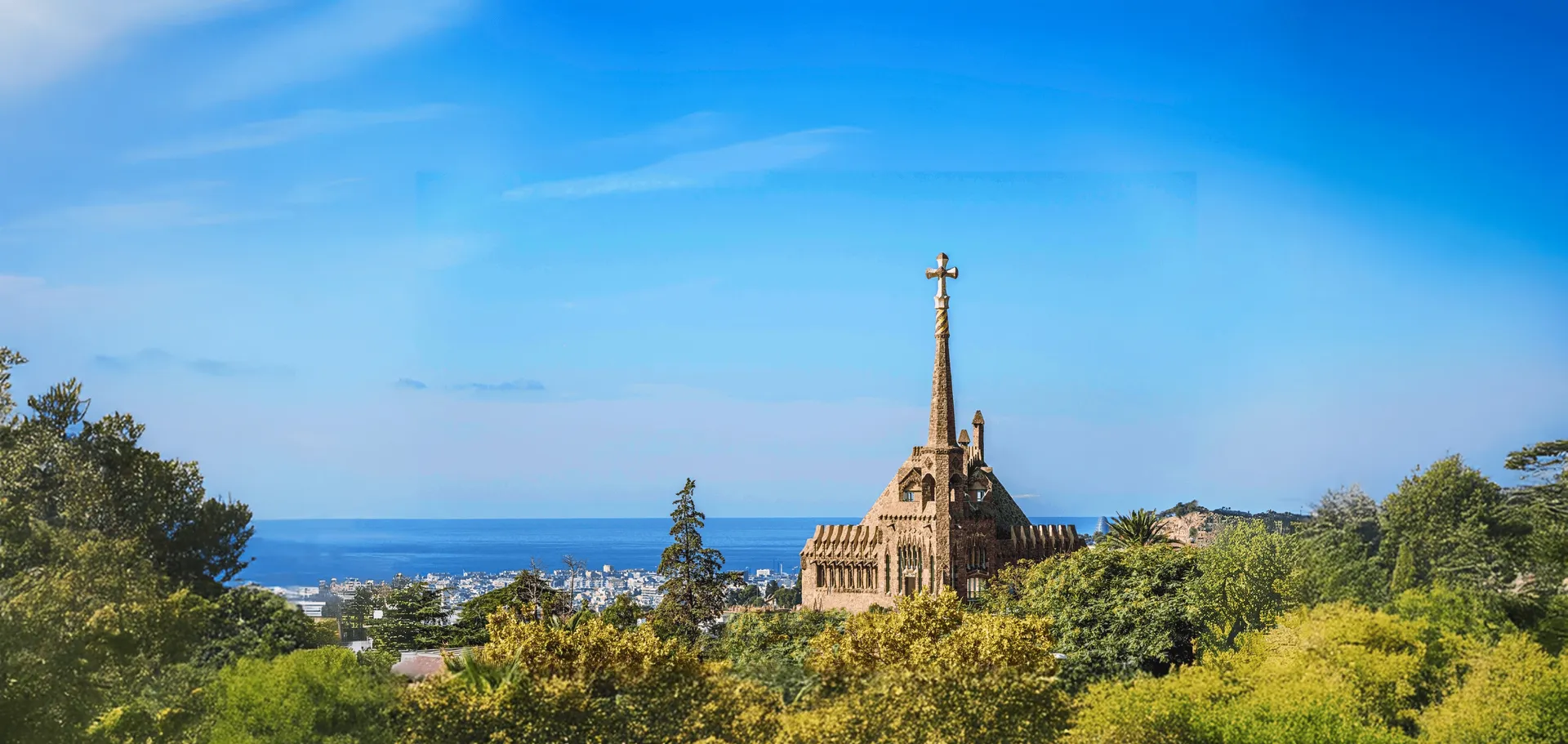
At Torre Bellesguard we have a fine example of Gaudí’s colour palette and the subtlety of its use. For instance, to evoke the splendour of the House of Barcelona in the Middle Ages, the architect used straight lines and ornamental details such as battlements and mullioned windows. However, to break the monotony of the Gothic style, Gaudí designed the façade as a gigantic stone trencadís, full of unexpected geometric shapes. On the other hand, the stone, which comes from the neighbouring mountain range of Collserola, allowed the house to blend in with its natural surroundings.
At least, that was the aim when there were no buildings around. As if that were not enough, the façade appears green, but if we look at it carefully, it is actually made up of fragments of different colours and shades. It was Gaudí himself who distributed them in various shapes and sizes in order to break, as we were saying, the monotony of the façade. Nevertheless, depending on the sunlight—or its absence—these different tones make the appearance of the building warmer or cooler. A lighting effect that, incidentally, at Torre Bellesguard, as in any building located near the Mediterranean, Gaudí considered ideal because “Virtue lies in the middle point; Mediterranean means in the middle of the earth. On its shores, with medium light at 45 degrees—which best defines bodies and reveals their form—is where the great artistic cultures have flourished, due to this balance of light: neither too much nor too little” (3)
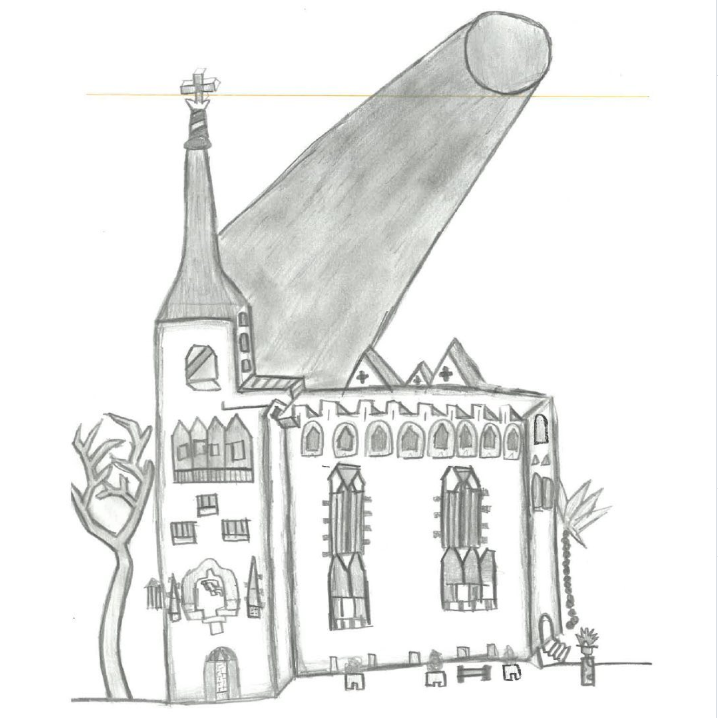
The children of the Tolkien Group and the Agatha Christie Group from Escola Horitzó in Barcelona visited us in March 2023. Afterwards, they made a drawing. One of them perfectly captures the relationship between the building and the sun…
The colours of the sun
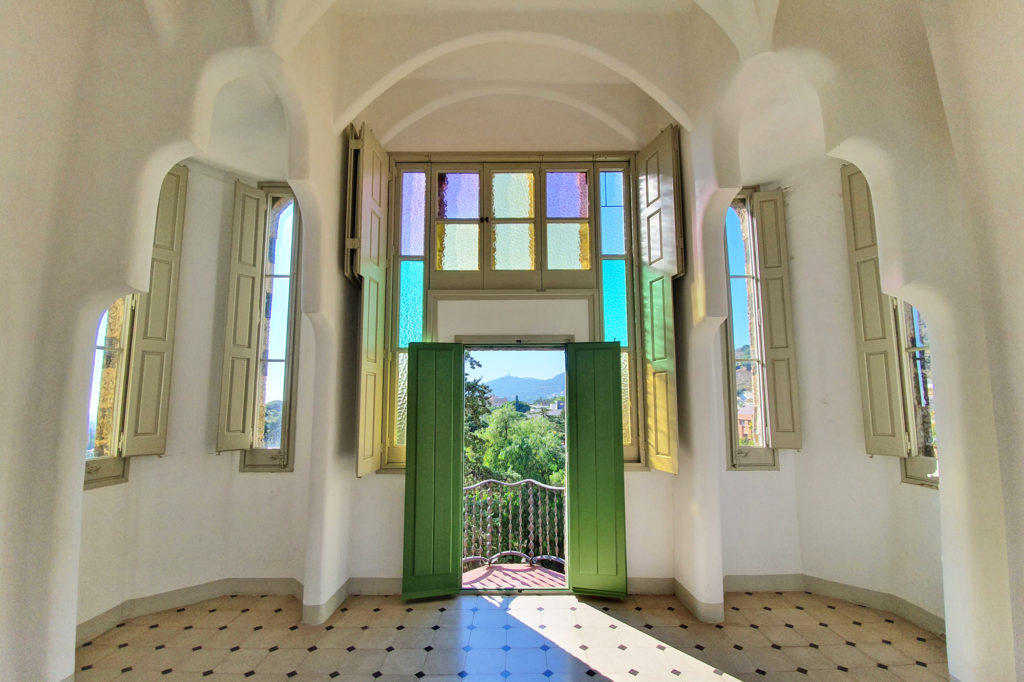
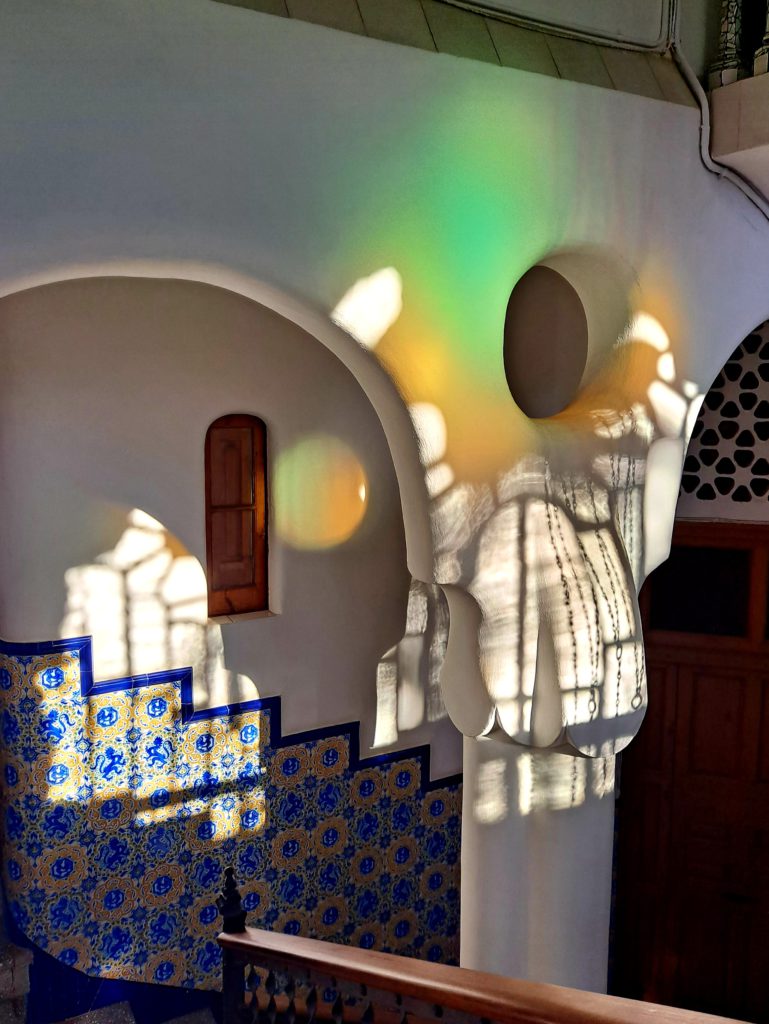
Once inside, we are struck by the shape and colours of the three-dimensional stained-glass window, which represents the Virgin Mary and the Star of the Three Wise Men. It is even more impressive when we learn that on Christmas Day, the sunlight, as it passes through this stained glass, reflects an eight-pointed star around the oculus of the front column of the entrance hall and a circle on the opposite wall. A clear example of mastery of gnomonics—the science that studies the movement of the sun—as well as of Gaudí’s thinking, who defined architecture as “the ordering of light” and these reflections of the sun as “the ephemeral paintings of God” (see: the glory of light).
 White, the spiritual and practical colour
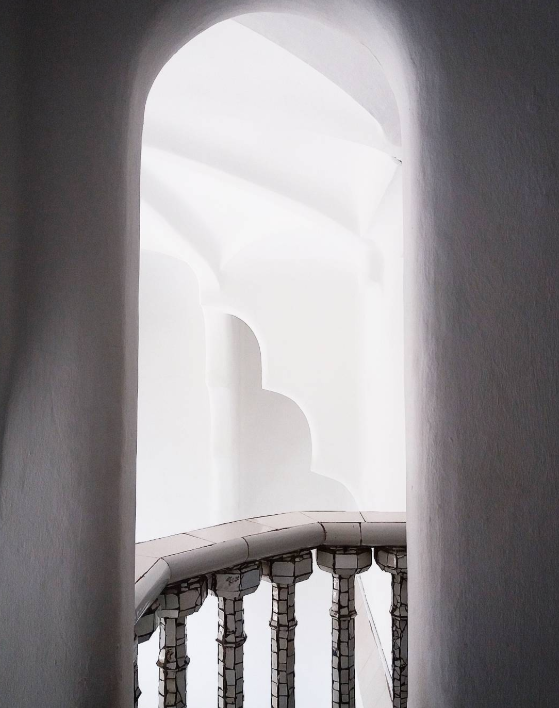
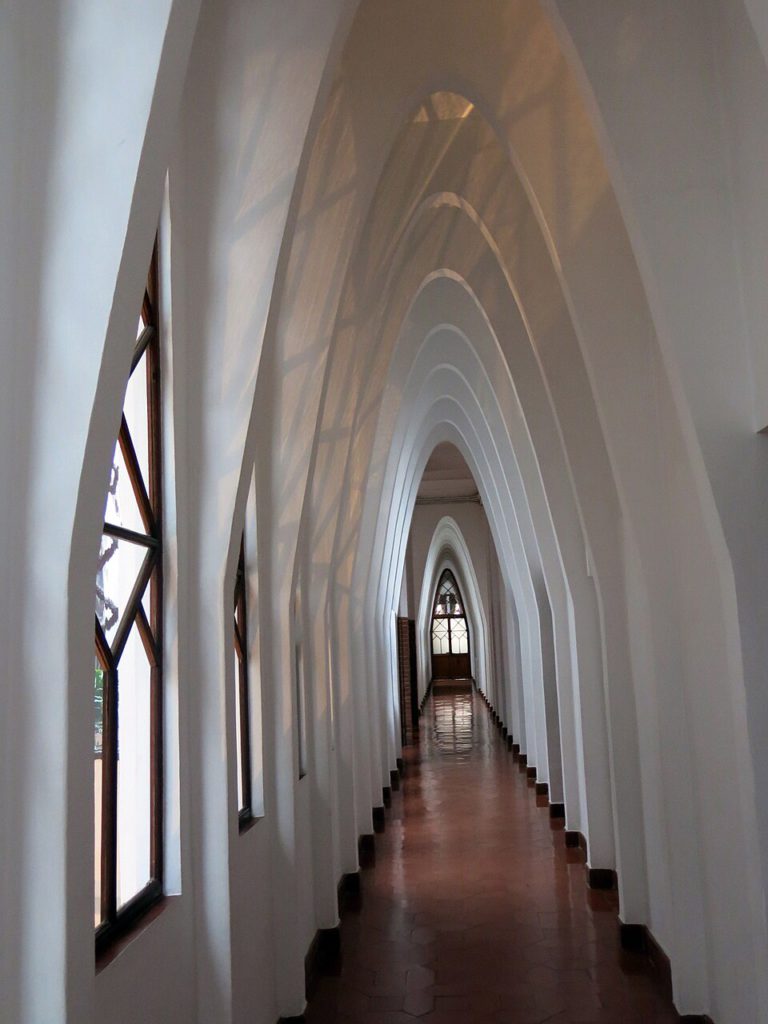
Earlier we mentioned how a young Gaudí recalled the importance of colour among the ancient Greeks, to the point that they painted Pentelic marble. Over time, however, the study of light led Gaudí to develop a highly distinctive use of the colour white. We begin to see this at the Teresian College, the site of one of his most praised works: the gallery of white parabolic arches, where the interplay of light and shadow reinforces the spiritual symbolism of the building, inspired by the mysticism of Saint Teresa of Jesus. “Glory is light; light gives joy, and joy is the happiness of the spirit” (4), said the architect of God, as he is often called, and added: “light is harmony, it gives relief, it decorates” (5)—an objective he achieves through original courtyards and skylights to make the most of natural light, but also in combination with white surfaces.
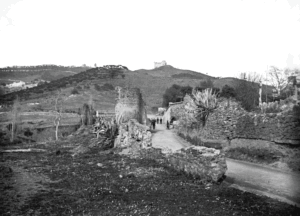
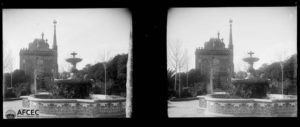
 We also see this at Torre Bellesguard, designed in such a way that both outside and inside, the sunlight—the great painter of Nature—changes according to the time of day and the season. At the same time, the purity of the colour white highlights the arches and sinuous forms of Gaudí’s distinctive style in his most mature period. It should be clarified at this point that the current mosaics, predominantly blue in colour, were added later by Domènec Sugranyes, one of his collaborators. Nevertheless, Gaudí wanted the presence of the colour white, as we can see in this old photograph.
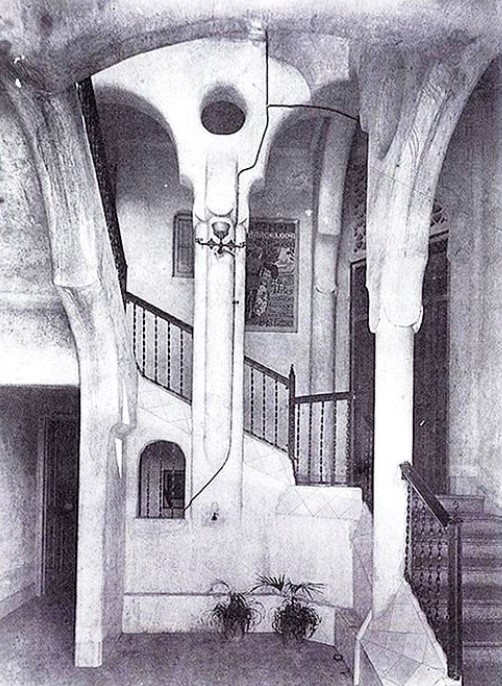 In short, a façade and an entrance conceived for the enjoyment of subtle plays of light and shadow, as well as the colours of the stained glass. To conclude, a quote from Galdric Santana, director of the Gaudí Chair, commissioner of the Gaudí Year and conservation architect of Torre Bellesguard. When asked why Torre Bellesguard should be visited, he replied, among other reasons, “and obviously its plastic quality, its interiors, this effect of light on the surface that creates cavity, light, cavity, light, cavity… these effects of Mediterranean light, which here, moreover, you see in a direct line” (6)
Notes
(1) Puig-Boada, Isidre (1980) The Thought of Gaudí. Compilation of texts and commentaries, Barcelona, Publications of the Architects’ Association of Catalonia, p. 33
(2) Ibid., p. 103
(3) Ibid., pp. 91–100
(4) Ibid., p. 226
(5) Ibid., p. 210
(6) Palmer, Jordi (17/10/2024) “Galdric Santana: If you like Gaudí, Bellesguard is a must-see visit”, El Nacional.