November 22, 2025
By Ferran Garcés
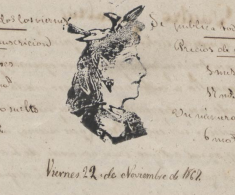
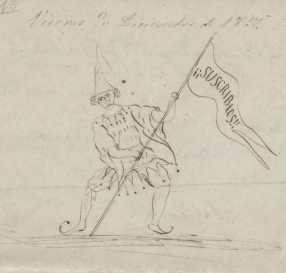
The earliest example of Gaudí’s artistic talent is a pair of drawings made one hundred and fifty-eight years ago. The transcendent, but unnoticed moment took place around November 22, 1867, the day three friends published a school magazine. In the first copy we see a stamp in the shape of a woman’s head that is attributed to Gaudí, although without sufficient documentation. The second drawing appeared not long after, on December 2 of that same year, and, this time, it is considered certain that the author was Gaudí. As interesting as the value of the images is their social background because they become the oldest testimony of Gaudí’s private life, as well as, although it may seem contradictory, the initial example of one of his main characteristics until his last years: shyness.
A school magazine and amateur theater (1867-1868)
Gaudí moved to Barcelona in the autumn of 1868. The previous year, he was one of the students at the Piarist School of Reus. There he had befriended Josep Ribera and Eduard Toda. The first would become a prestigious surgeon and the second a fascinating figure unjustly forgotten today, but, so as not to stray from today’s topic, we will only say that he was a diplomat, Egyptologist, and historian. He was also a prolific writer and, unlike Gaudí, who rejected photographs and the press, Toda collaborated in numerous publications. Thanks to his testimony, we know some details of Gaudí’s youth. So let us allow him to speak about it himself.
“While we were studying for the baccalaureate […], Ribera, Gaudí and I published, during 1867 and 1868, a weekly magazine, all handwritten (nothing printed) whose title was ‘The Harlequin’, the price of each copy being two quarters. I keep a complete collection, probably the only one, which will go along with so many other papers of mine to the Barcelona archive at the Casa de l’Ardiaca. In the only twelve issues we published, Gaudí never wrote: he was the author of the drawings with which we intended to illustrate the publication. / Gaudí followed our life as boys. We gathered a group of theater enthusiasts and formed an amateur company that performed in courtyards, warehouses, attics, wherever we could in our homes, and from where, frankly, we were usually thrown out very soon because of the disturbances we caused. Gaudí followed our group as the painter of the decorations, which were made of newspaper. He never acted” (1)
To be more precise, the publication, titled El Arlequin, developed in two stages. The first, consisting of nine weekly issues published between November 22, 1867, and January 31, 1868, carried the subtitle “serious-burlesque periodical.” The texts had a playful and cultural tone, often accompanied by romantic or humorous poems. The second stage appeared after the September Revolution. Also known as “La Gloriosa,” it meant the dethronement and exile of Queen Isabella II of Bourbon and the beginning of the period called the Democratic Six-Year Term (2). At that time, the magazine only included three issues, published between October and December of 1868, but this time without Gaudí’s participation, who had just moved to Barcelona. During this period, “The Harlequin” changed radically and the contents became politicized with an anticlerical and anti-Bourbon line. The subtitle also changed, becoming: “periodical of whatever tone it pleases.”
Next, we will show the two covers made by Gaudí before the September Revolution (to see the complete copies, see: Simurg. Digitized collections of CSIC. The copies of El Arlequín are currently preserved in Madrid, at the Tomás Navarro Tomás Library). The cover with the woman was published, as we have said, on November 22, 1867, being, for now, Gaudí’s first artistic display. The next is the cover with the harlequin motif and dates from December 2 of that same year.
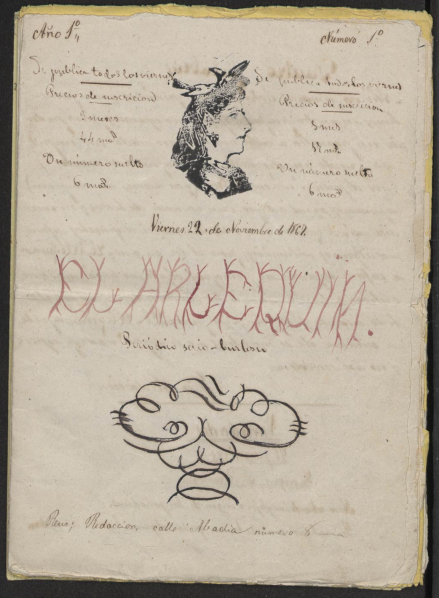
“El Arlequín: Periódico serio-burlesco”, 1867-1868 Simurg. Fondos digitalizados del CSIC
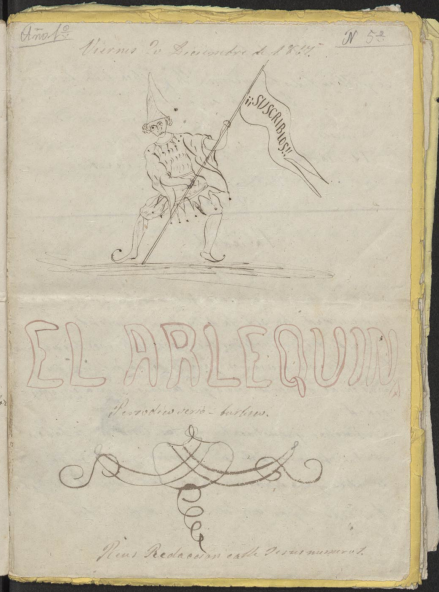
“El Arlequín: Periódico serio-burlesco”, 1867-1868 Simurg. Fondos digitalizados del CSIC
Nothing about writing, but many excursions
Once again, thanks to Toda, we know a little about those youthful years. On June 21, 1936, a few weeks before the start of the Spanish Civil War, the Barcelona newspaper El Matí published a “Tribute Supplement to Antoni Gaudí,” on the occasion of the tenth anniversary of the architect’s death. The publication included another collaboration by Eduard Toda in which the former schoolmate and adventurer recalled his youthful relationship with the future architect, Gaudí, and surgeon, Ribera.
“Our common school life was quite varied. I must say, first of all, that the three boys were good pupils, in the opinion of the teachers […]. But in our particular hobbies we often differed. While Ribera and I loved writing verses, or prose we thought literary, we never saw Gaudí write even a line. When we wanted to go hiking through the beautiful ravines and sunken paths around Reus, in search of places evocative of our romantic feelings, Gaudí preferred instead to go to the ruins of the Roman kilns on the Morterols road, to the priests’ aqueduct, to corners, in short, where art dominated nature” (3)
Poblet: a utopian project (1870)
From the shared passion for historical excursions arose a project even more ambitious than the magazine and the plays. We are talking about the restoration of the Poblet monastery, at that time abandoned and in ruins. Again, Ribera and Toda took on the most visible part of the project, and Gaudí, true to his shy character, reserved for himself the architectural part and the drawings of the site plan and its coat of arms. The project, for various reasons, never went ahead. At least, we keep the following illustrations.
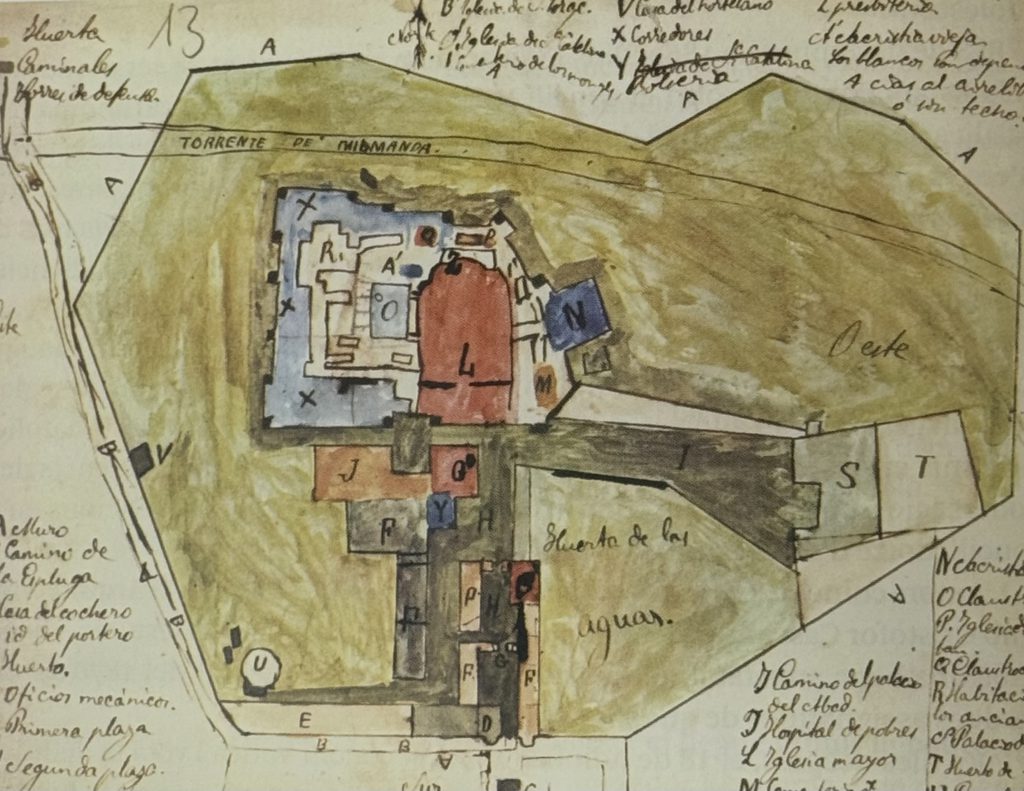
Plan of the Poblet Monastery, Gaudí. It appears in the manuscript of Eduardo Toda, “Poblet, data and notes”, dated 26-VII-1870.
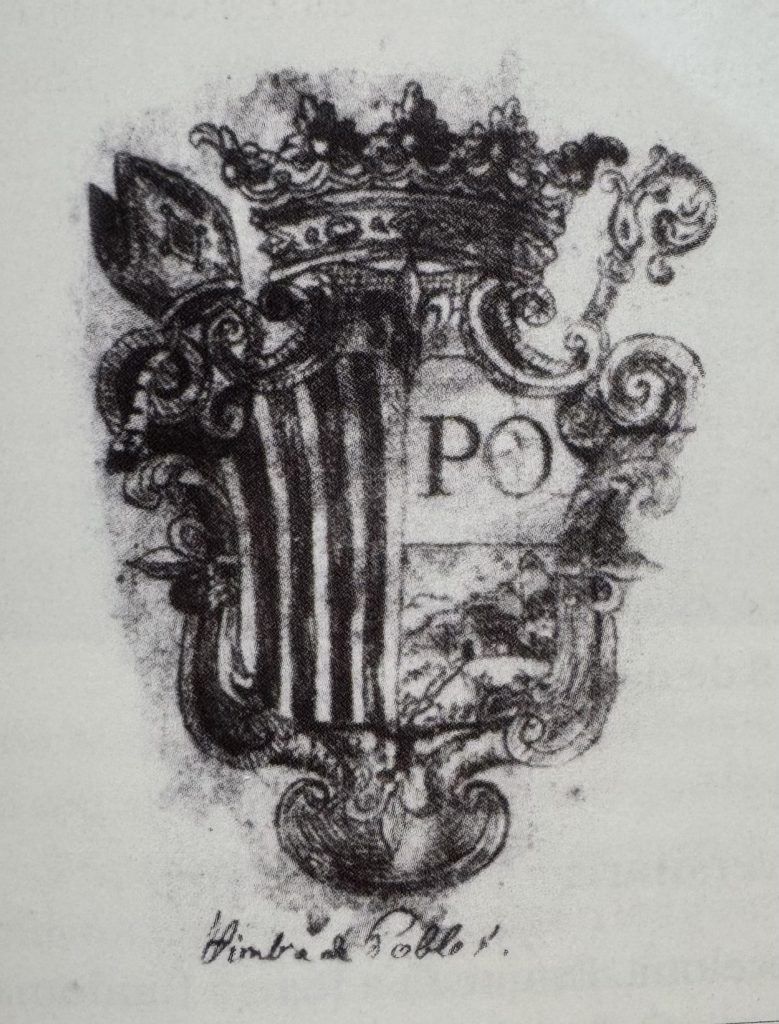
Coat of arms of Abbot Miquel Cuyàs, of the Poblet Monastery. It appears in Eduardo Toda’s manuscript, “Poblet, data and notes”, dated 7/26/1870
Soon after, the three high school friends separated due to their different professional careers. Nevertheless, all three exchanged correspondence for years. In the end, only Toda, when he was already over eighty years old and his friends had died, contributed to the restoration of the Monastery of Santa María de Poblet. In another article we will talk in more detail about his relationship with Gaudí, as well as the relationship of Poblet with Torre Bellesguard, which turns out to be much more surprising than one might think. Now, as a closing, we will collect a small reflection on Gaudí’s personality.
A shy genius, young and old
In 2002, on the occasion of the Gaudí Year celebrated then, Ana María Férrin, author of two biographies of the architect, wrote an exclusive article for the magazine Historia 16. The subject of the article was the passion Gaudí felt for music and, especially, for Gregorian and polyphonic chant. We, by the way, have also addressed this topic in several articles (4), but now we only want to rescue a paragraph by Ana María Férrin, where the author explains one of the main traits of the future architect’s personality: his shyness, already evident in the times of those first drawings and years as a theater enthusiast.
To better understand this paragraph, we will clarify the last sentence. Once in Barcelona, Gaudí became a great lover of religious music, but not only as a listener but, above all, as a participant. For this reason, rather than theaters, as an adult, the architect sought places where he could sing the Mass. One of them was San Felipe Neri, the church he was going to the day he was run over, following a routine of years. For Gaudí, always a good walker, it did not matter to cross the city to reach it because there awaited him several attractions such as meeting acquaintances and the pleasure of escaping in the midst of the group of singers.
“Polyphonic music was made to measure for the shy Gaudí: to participate, but hidden among the community, a practice exercised since his school days; to draw the sets of a play, paste them on a reed frame, organize the scenery, and then observe from the wings the actors’ protagonism; to design and collaborate in the children’s magazine Harlequin but not appear in any credit. Because of this trait of his, attending a sung Mass held at the other end of the city had several attractions” (5)
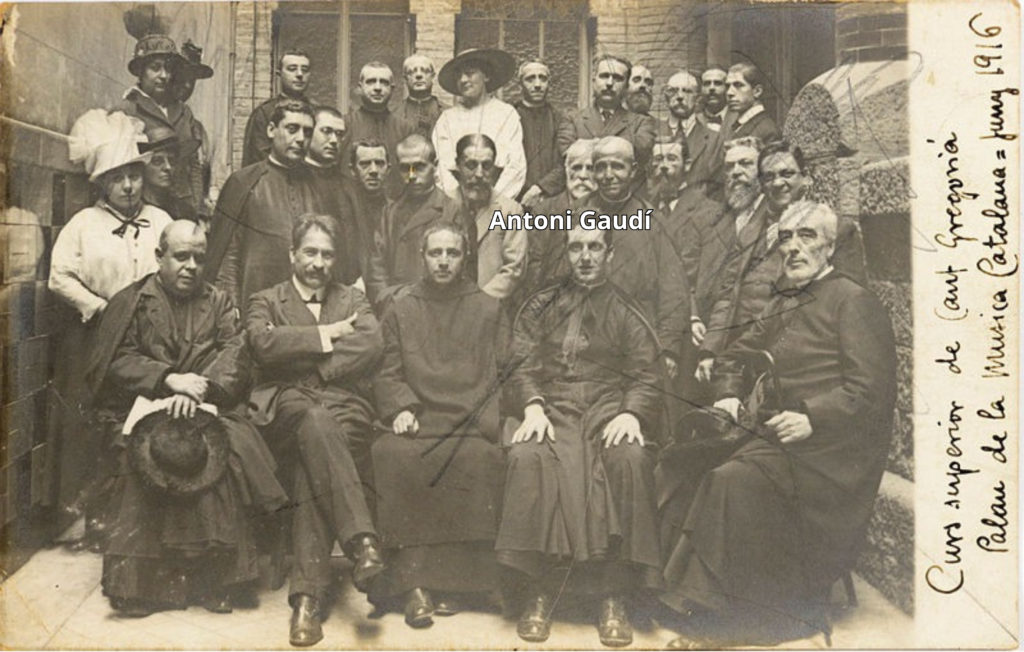
We find more signs of this shyness of Gaudí in his refusal to be photographed and the different strategies he developed to avoid appearing in the foreground, the few times he was forced to be part of a group photo (see: “Gaudí, portrait by portrait. From 52 to almost 74 years”). For example, the following image where Gaudí hides among his fellow Gregorian singers, as he had done as a child in the adventures with his first friends.
Notes
(1) Toda, Eduard (1929), “Calendario Josefino para 1929”, published in: Bonet i Armengol, Lluís (2001), La mort de Gaudí i el seu ressò a la revista “El Propagador de la Devoción a San José” Editorial Claret, Barcelona, p. 239
(2) To learn more about the atmosphere in Reus during that time, see: ANGUERA, P. (2003): Reus en els anys de formació de Gaudí, Centre de Lectura de Reus, Reus. See also: Massó Carballido, J. (2016), “Eduard Toda i Antoni Gaudí, una amistat perdurable”, in: Massó Carballido, J., ed: Eduard Toda i Güell (1855-1941): de Reus al món, Institut Municipal de Museus, Reus, pp. 23-42.
(3) See a digital copy of this article at the following link: El Matí, Suplement 1926
Regarding the archaeological hobbies of young Gaudí, see: Massó Carballido, Jaume (2020), “Antoni Gaudí i l’arqueologia del Camp de Tarragona”, Estudis de Constantí, 36, p. 95-102
(4) Garcés, Ferran (12/06/2025), “Did you know? Music in Gaudí’s time: return to the origin”, Blog Torre Bellesguard.
Garcés, Ferran (19/06/2025), “Did you know? Gaudí’s Mediterranean humor”, Blog Torre Bellesguard.
(5) Férrin, Ana María (2002), “Gaudí’s hidden passion”, Historia 16, Madrid, p. 11