October 24, 2025
The year 2026 will be dedicated to commemorating the Catalan architect Antoni Gaudí i Cornet, coinciding with the centenary of his death on June 10, 1926. However, the celebration will begin on October 31, with joint and individual activities at each building. We will soon announce those planned for Torre Bellesguard.
It is well known that Gaudí died from multiple injuries after being hit by a tram. Less known is the fact that, prior to that, he came close to dying at least a couple of times. Today we will talk about these “other possible deaths” and the friends who cared for him. To conclude, we will recall an even more overlooked aspect: the architect himself as a caregiver to his sick friends.
Early Encounters with Death
Gaudí’s first scare came as soon as he entered the world. He was the youngest of five children born to Francesc Gaudí and Antònia Cornet. Only three reached adulthood: Rosa, the eldest daughter; Francesc, the next; and Anton, as he was called. The other two died shortly before Gaudí’s birth—Maria, before turning five, and another Francesc, at age two. Anton’s pregnancy was difficult, and the birth traumatic. His life was feared for, and “to save the soul of the child, he was rushed, just hours old, to the church of Sant Pere Apòstol” (1).
Rheumatic Fevers
As a baby, Gaudí developed slowly. Around age six, he began suffering from rheumatic fevers. Because of this, he stopped attending school and playing with other children. Instead of the classroom, his “school” became the landscape surrounding Mas de la Calderera, his parents’ home in Riudoms. There, isolated, according to a well-known biographical tradition, Gaudí developed a habit of closely observing nature—a habit that would later become a constant source of inspiration. However, some authors—such as Juan José Lahuerta Alsina, director of the Gaudí Chair from 2016 to 2022—believe this episode is part of the idealized anecdotes woven around the architect (2). In any case, rheumatism returned to affect Gaudí’s health in his later years.
More Premature Deaths
The year 1868 is famous for “La Gloriosa,” a revolt that led Queen Isabella II of Spain to abdicate and flee. That same year, a young Gaudí packed his bags and moved to Barcelona, where his brother Francesc was already studying medicine. Shortly after, to support their sons, the parents sold their few possessions in Reus and moved to the Catalan capital, living in various rented apartments (see: Gaudí’s homes).
To earn a living while studying, Gaudí worked as a draftsman in the studios of well-known architects. In his free time, he visited libraries, explored the city’s monuments, and frequented artisan workshops in the Barri Vell. In one of these, he formed a close friendship with Llorenç Matamala, who made clay and plaster figures. With him, Gaudí learned to work with these materials. Later, Matamala would become head sculptor of the Sagrada Família and one of the creators of the famous plaster models Gaudí used to visualize his works in three dimensions. He would also become one of Gaudí’s closest friends.
In 1876, fate began to deal harsh blows to the promising architect. First, his brother Francesc, newly graduated, died suddenly at just twenty-five from hemoptysis. Their inconsolable mother followed him to the grave shortly after, at sixty-three. Tragedies often come in clusters. In 1879, it was his sister Rosa’s turn, at thirty-five. She left behind a three-year-old daughter, Roseta Egea i Gaudí, but her widower—a musician and alcoholic—abandoned her. The child was then cared for by her grandfather Francesc and uncle Anton. The three lived together for the next three decades. Gaudí may have been single, but he always lived with family.
Risk of Fatal Fall
Around 1892, Gaudí wanted to complete the apse of the Sagrada Família. After finishing the first pinnacle, he climbed up with Llorenç Matamala and the foreman to inspect the work. Once at the top, he slipped, and his companions grabbed his clothes and pulled him back onto the plank. Back on the ground, visibly shaken, he said: “Today Saint Anthony gave us a warning, protecting us. We must give thanks. From now on, I won’t climb the scaffolding. Since I get distracted, I’ll avoid the danger.” And he kept his word (3), though the scares didn’t end there…
Risk of Starvation
During Lent in 1894, Gaudí nearly died of starvation due to his growing religious fervor. One of his closest friends, Bishop Torras i Bages, saved him with a powerful argument: God’s plan for him was different—to dedicate himself body and soul to the Temple of the Sagrada Família (4). A young apprentice of the master, Ricard Opisso—later a graphic chronicler of Barcelona—left us an image of this pivotal chapter in the architect’s life, though, as was typical of the illustrator, with a humorous tone.
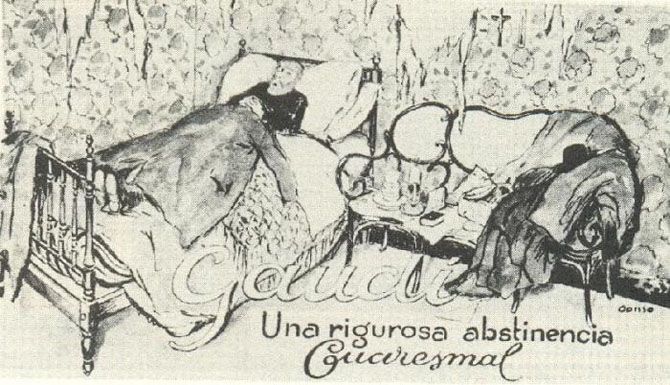
Gaudí. A Rigorous Lenten Abstinence”, 1894. Drawing by Ricard Opisso. Source: Astorga editorial.
Cerebral Anemia or Nervous Depression
Around 1910, Gaudí had become a renowned architect. He had just completed Torre Bellesguard, alongside Casa Batlló, and was working on Casa Milà, Park Güell, Colònia Güell, and the Sagrada Família. That year, an exhibition of his work was held in Paris—the first outside Spain—and shortly after, another in Madrid. On the surface, everything seemed to be going well. Seemed…
On one hand, progress on the Sagrada Família was slow due to lack of funding, and the construction of Casa Milà (La Pedrera) had led to conflicts with its owners. On the other hand, in 1906, his father had died, and around that time, his niece had developed a drinking habit and suffered frequent attacks. Additionally, the social situation in Barcelona was bleak, following events like the Tragic Week of 1909. Finally, the accumulated exhaustion from previous, highly productive years led the master to suffer a severe crisis. The exact cause is unknown, but it has been attributed to cerebral anemia or nervous depression. Once again, the architect was barely eating.
Eventually, he had to take a break. He did so in Vic, the city where his close friend Bishop Torras i Bages served. Despite staying in one of the most luxurious mansions—the Rocafiguera family home—Gaudí, true to his increasingly ascetic nature, chose the most modest room and insisted on maintaining his simple lifestyle.
Brucellosis or Malta Fever
The rest did not have the desired effect, and in the spring of the following year, the architect relapsed. This time, it was due to brucellosis, or Malta fever—a bacterial disease usually transmitted from sheep or goats to humans through milk or cheese. To recover, he went even farther, to Puigcerdà, a small town in the Pyrenees, accompanied by another close friend, Dr. Pere Santaló, whom he had met around 1878.
During the first weeks, the architect was bedridden and, believing his final hour had come, wrote his will on June 9, 1911. Roseta was left in the care of a maid and nearby nuns, the Carmelites of Sant Josep de la Muntanya. At first, Dr. Santaló prohibited visits and personally reported on the patient’s condition. Later, when signs of improvement appeared, close friends like his patron Eusebi Güell came to visit (5).
In the autumn, once his strength returned, he went back to Barcelona. Many successes awaited him, but also new hardships. To begin with, his niece’s condition worsened rapidly. She passed away at the beginning of 1912 at the age of thirty-six. The cause has been debated, but it appears to have been tuberculosis, complicated by alcoholism and high doses of laudanum used to relieve her pain (6).
An Empty House, Two Loyal Friends
In his final years, Gaudí was a celebrity, often visited by people who came to Barcelona and didn’t want to leave without seeing the progress of the Sagrada Família. Sadly, many of his friends had begun to pass away, as had his last close relatives—his father and niece. For the first time, he was alone at home. Until then, he had always lived with family.
Then, two loyal friends—among the few still alive—offered to keep him company: sculptor Llorenç Matamala and Dr. Santaló. Taking turns, they accompanied him home and stayed with him overnight. At that time, Gaudí was working on Park Güell, where he had a house, Colònia Güell, and the Sagrada Família. However, resources were dwindling. Sometimes, the architect himself went out to beg for alms to continue the works (7). In 1916, his great mentor Bishop Torras i Bages died in Vic, and two years later, Count Güell, his main patron, also passed away. From that moment on, Gaudí focused solely on the Sagrada Família, more on preparing models and trying to complete at least one façade—the Nativity façade—with the hope that it would serve as a guide for future generations.
From Being Cared For to Caregiver
Shortly before the accident that ended his life, Gaudí had the chance to return the favor to his loyal friends. First, by taking care of Llorenç Matamala at his home when he was diagnosed with nasal cancer (8). Later, by visiting them when they were bedridden due to illnesses we’ll soon mention. In the following photograph, we see the architect receiving communion at the Sagrada Família on Good Friday, 1924. Behind Gaudí, leaning in to kiss the Holy Christ, stands a man with his nose covered by an antiseptic patch. That man is Llorenç Matamala.
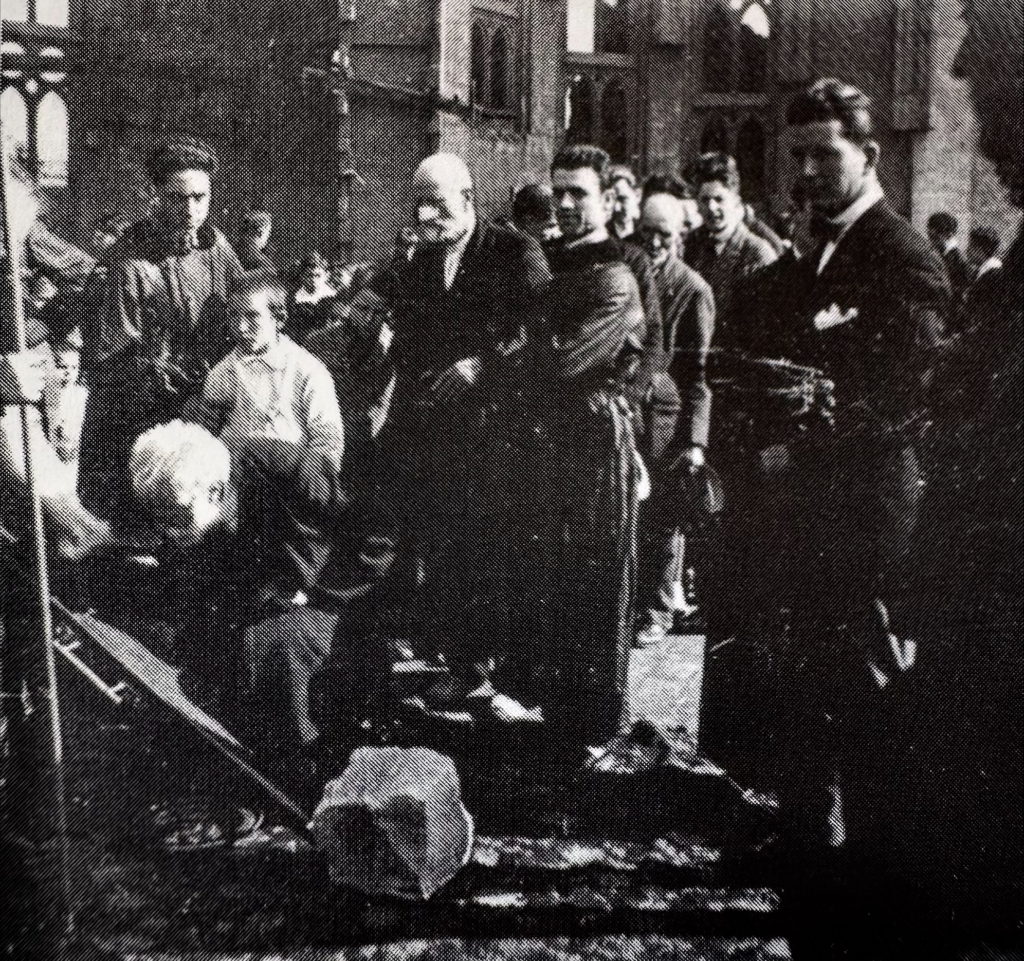
Gaudí Receiving Communion on Good Friday, 1924, alongside Llorenç Matamala
In January 1925, in addition to cancer, Llorenç Matamala suffered a stroke and was left bedridden in the apartment where his family lived, near the temple. Gaudí then left his house in Park Güell and began spending nights in the Sagrada Família workshop, from where it was quicker to visit his ailing friend.
In early 1926, Dr. Santaló underwent prostate surgery at a clinic in the Tres Torres neighborhood. Gaudí also visited him regularly. Before his operation, it was Santaló who often accompanied the architect on his walks to Sant Felip Neri. For this reason, on that fateful day—June 7, 1926—when Gaudí was struck by a tram, he was walking alone. Witnesses recall how both friends were surprised that Don Anton hadn’t come to visit them (9). Neither of them knew what had happened. By the time they received the news, the funeral had already taken place.
Llorenç Matamala lived one more year, and Dr. Santaló lived five.
Notes
(1) Van Hensbergen, Gijs (2002), Antoni Gaudí, Plaza & Janés, Barcelona, p. 33
(2) Lahuerta, Juan José (2021), Gaudí, Museu Nacional d’Art de Catalunya, pp. 39–44
(3) Tarragona i Clarasó, Josep María (2016), Gaudí. L’arquitecte de la Sagrada Família. Biografia breu, Torsimany Books, Barcelona, pp. 151–152
(4) Ibíd., pp. 161–166
(5) Van Hensbergen, Gijs, Op. Cit., p. 272
(6) Torres Domènech, Joan (2018), El Gaudí que no ens han explicat, Cossetània Edicions, Barcelona, pp. 94–95
(7) Tarragona i Clarasó, Op. Cit., pp. 289–298
(8) Bassegoda Nonell, Joan (2002), El mestre Gaudí, Pagès editors, Barcelona, pp. 168–174
(9) Testimony of Dr. Santaló: Redacció, “Pere Santaló i Castellví. Biografia”, Galeria de Metges Catalans website.
Testimony of Llorenç Matamala: Bassegoda Nonell, Joan, Op. Cit., p. 174