September 11, 2026
By Ferran Garcés
Catalonia’s National Day (La Diada), a commemoration first celebrated on this day in 1886, coincides with Gaudí Year 2026, which marks the centenary of the death of the Catalan architect. To pay tribute to both celebrations, we propose a journey through a symbol representative of these two anniversaries: the senyera, the Catalan flag.
The motif of the four red stripes appears in many of Gaudí’s works, although not in all of them. Significantly, it begins to appear from 1900 onward, marking the start of the architect’s most creative period and also the consolidation of political Catalanism, with events such as the creation of the Lliga Regionalista, the political party with which Gaudí showed the greatest affinity, although he never actively collaborated with it.
Lampposts for the Barcelona City Council (1878)
The first time we see a senyera in one of Gaudí’s works is as part of the coat of arms of Barcelona on the shaft of a design for lampposts intended for the city’s squares and promenades. Only two examples were built in Plaça Reial, another two in Plaça del Palau, and a further pair at the entrance to the Barceloneta National Promenade. They were created around 1878, the same year Gaudí obtained his university degree.
We soon discover that the symbols associated with the four stripes are just as important as the flag itself. In the case of the lampposts, the chosen symbol is Mercury’s winged caduceus, the god of commerce, which was Barcelona’s main economic activity.

Hercules Fountain at the Güell Estate (1884)
Between 1884 and 1887, Count Güell commissioned Gaudí to design the gatehouse pavilions for his summer estate in Pedralbes. They are famous for the dragon that forms the entrance gate. The entire ensemble refers to the mythological origins of Barcelona, inspired by Joan Verdaguer’s poem Atlantis, but the four stripes are not found there.
To discover them, one must venture into the gardens. There, at the beginning of the works and hidden in such a secluded corner that it remained forgotten for years, Gaudí designed a small fountain. Like the pavilions, the fountain is dedicated to the Greek hero Hercules and the dragon he fought against, but unlike them, it includes a stone coat of arms of Catalonia carved into the basin where the water flows.

Palau Güell (1886-1890)
Shortly after the construction of the summer estate, Count Güell commissioned the young architect not only to create a gatehouse and an ornamental fountain, but an entire palace. Thanks to the complete freedom granted by his patron, Gaudí was able to develop his creativity through a truly original interpretation of the Catalan coat of arms.
Instead of appearing on a flat surface, the senyera is represented on a cylindrical body where the four stripes rise in a spiral, or helical, form. To distinguish the colors without using paint, Gaudí devised a mesh of hollows and reliefs. This remarkable coat of arms is crowned by a helmet upon which rests a phoenix with its wings spread. Both the spiral and the phoenix are symbols of resurrection and, consequently, of the Renaixença, the cultural movement that sought to revive Catalan identity during that period.

Casa Calvet (1898-1900)
Built between the end of the nineteenth century and the beginning of the twentieth, Casa Calvet was Gaudí’s first work in Barcelona’s Eixample district. It was designed to serve both as business premises on the lower floors and residential accommodation above. The lower part of the façade revolves around a large bay window filled with symbols referring to the prosperity of both the family and the city. At its base can be seen the shape of a cypress tree, an allegory of hospitality, a coat of arms of Catalonia, and the letter “C”, referring to the client’s surname.
 Inside the entrance hall stands an innovative mechanical feature: an elevator. Before reaching it, above a semicircular arch, visitors discover curious senyeres painted in the form of ribbons accompanied by a phrase honoring the Virgin Mary: “Ave Maria Puríssima, sens pecat fou concebuda” (“Hail Mary Most Pure, conceived without sin”). This is the same greeting that Gaudí would later use in his next project, Bellesguard House.

Torre Bellesguard (1900-1909)
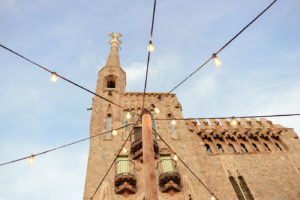
Modernisme also embraced Neo-Gothic architecture as a means of recreating an idealized Catalan past. In the case of Bellesguard, however, its medieval appearance reflects what could be called a “justified nostalgia.” Five centuries before Gaudí, the site had indeed been home to a real castle belonging to King Martin I the Humane, the last ruler of the House of Barcelona. In fact, Gaudí’s project included preserving the scarce remains of that castle. The entire complex serves as a tribute to this monarch and, by extension, to Catalonia itself.
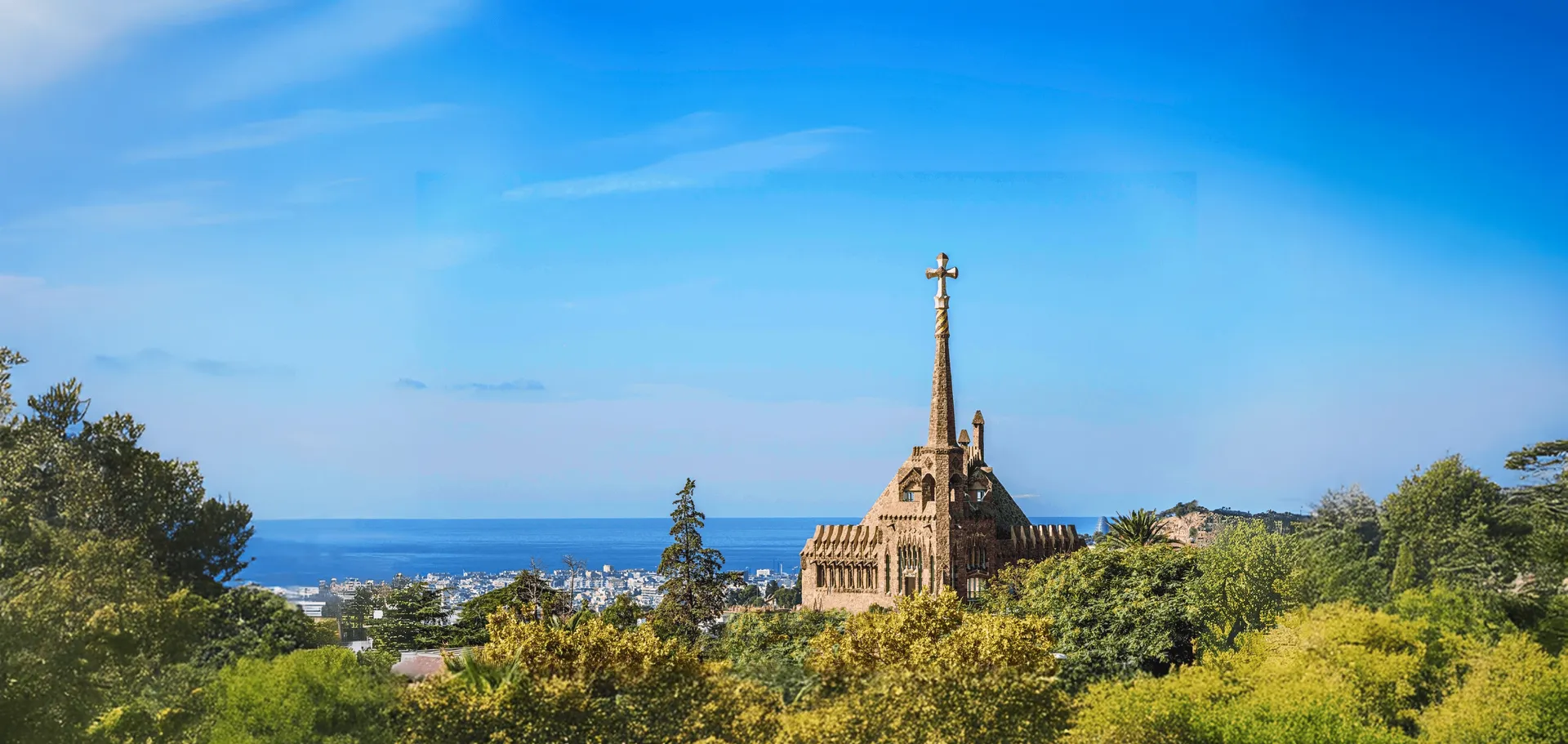
Above the rooftop, surrounded by battlements, rises a striking pinnacle crowned by the senyera, once again presented in a spiral or helical form as in Palau Güell. This time, however, it was designed using colorful trencadís glass mosaics so that sunlight could make the four stripes shine brilliantly. The symbols accompanying them include a historical reference, the king’s crown, and a religious one, Gaudí’s characteristic four-pointed cross.
 It should also be noted that during the Franco dictatorship, the senyera had to be covered. Its restoration took place during the early years of democracy.
As if this were not enough, another senyera appears at ground level in the garden, this time carved in stone. It is located above the semicircular doorway leading to the barbican that incorporates the remains of the medieval castle. On either side of the coat of arms, Gaudí connects the estate’s past with his own era through two dates: MCCCCIX (1409), when Bellesguard became both a royal and papal residence, hosting Benedict XIII, “Pope Luna,” and MCMIX (1909), when Gaudí completed his intervention.
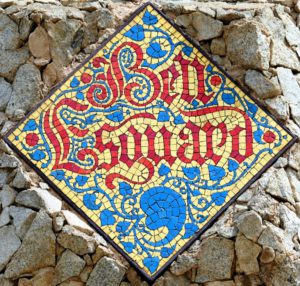
 The architect also created an allegorical composition featuring a rising half-sun on the upper right, symbolizing prosperity, and a blindfolded face on the opposite side, symbolizing decline. Later, his collaborator Domènec Sugranyes added further Catalan coats of arms to the garden benches’ mosaics, making Torre Bellesguard the building with the greatest number of senyeres in all of Gaudí’s work. In total, five. In the two entrance mosaics, the senyera refers to Catalonia’s historical hegemony in the Mediterranean.


Standard of Mercy (1900)
The year 1900 also brought another senyera, this time in the form of a banner: the Standard of Mercy, designed to celebrate the pilgrimage to the Sanctuary of Our Lady of Mercy, patron saint of Reus. Made of embossed leather, the banner displayed the coat of arms of Barcelona on the reverse side and, on the front, Isabel Besora, the sixteenth-century shepherdess to whom the Virgin who gives the sanctuary its name is said to have appeared.


Park Güell
On the iconic staircase of Park Güell stands what is perhaps Gaudí’s most famous senyera. Created using the trencadís mosaic technique, it is accompanied by the head of a serpent, a feature that has inspired various interpretations. One of them associates the serpent with health, much as it appears in pharmacy symbols, reinforcing the idea of the park as a healthy environment.
In any case, it once again demonstrates Gaudí’s ability to merge Catalan identity with a wide range of historical and religious references.

The Mystery of Glory, Montserrat (1903-1907)
The first commemoration of Catalonia’s National Day was held in 1866 at the church of Santa Maria del Mar. It consisted of a memorial mass honoring those who had fallen during the Siege of Barcelona in 1714. The canon responsible for the ceremony was Jaume Collell, one of Gaudí’s closest friends, along with other figures connected to the architect, such as the poet Jacint Verdaguer and Josep Torras i Bages, the bishop who became one of the leading theorists of religious Catalanism at the time. It was he who famously stated: “Catalonia will be Catholic, or it will not be.”
It was also Jaume Collell who, in 1893, proposed the construction of a monumental rosary linking the Monastery of Montserrat with the Holy Cave, financed, like the Sagrada Família, through private donations and religious confraternities. The project envisioned fifteen sculptural groups, one for each Mystery of the Virgin.
Gaudí was commissioned to direct the First Mystery of Glory, representing the Resurrection of Christ, which was to be funded by the Spiritual League of Our Lady of Montserrat, founded by Josep Torras i Bages, Gaudí’s other bishop friend. In the spring of 1903, the architect presented his proposal to the League, where Christ’s resurrection was also intended to symbolize the resurrection of Catalonia.
Unfortunately, due to financial difficulties, work did not begin until the spring of 1907, and only for a short period. That same year, new economic problems halted the project. The ensemble would eventually be completed between 1913 and 1916 by another architect, Jeroni Martorell, who modified Gaudí’s original design.
During the Spanish Civil War, the Mystery suffered considerable damage, and restoration efforts only began after the conflict had ended. Nevertheless, the most extraordinary part of the project was never built: a gigantic senyera.

The Most Visible Senyera Never Built
Joan Bergós, Gaudí’s first biographer, tells us about a senyera that was never realized. It was intended to crown the architect’s Montserrat project.
Before discussing it, however, a brief explanation of the setting is necessary. The most emblematic rock formation in the Montserrat mountain range is a needle-like peak known as Cavall Bernat, standing on the boundary between the municipalities of Monistrol de Montserrat and Marganell.
With that context in mind, it is worth letting Gaudí describe his vision in his own words, as recorded by Joan Bergós:
“On top of the slender peak of Cavall Bernat, I would have placed a large crown of wrought iron and glass, topped with a star and supporting an enormous bell whose chimes of the Angelus could be heard throughout the surrounding lands. The crown, accessible by a staircase winding around the rock, would also have served as a comfortable lookout point for hikers. On the broad rock face below, I would have placed a coat of arms of Catalonia twenty meters high, made of mosaic, which would have been visible from as far as ten kilometers away.”
(Gaudí: The Man and the Work, 1954)
He also explained:
“Above the First Mystery of Glory there was to be a mosaic coat of arms of Catalonia more than twenty meters high, clearly visible from Monistrol. A monumental bell was to be placed within the rocky opening, financed by a public subscription from all Catalan lands, to ring the Angelus three times a day. Furthermore, Cavall Bernat was to be crowned by an enormous crown surmounted by a star, a monument to the Blessed Virgin. This crown would have been accessible and would have functioned as a viewpoint.”
(Conversations of Gaudí with Juan Bergós, 1974)
This ambitious proposal would have combined architecture, religion, landscape, and national symbolism on an unprecedented scale. Although never built, it remains one of the most spectacular visions conceived by Gaudí: a monumental senyera visible across much of the Montserrat region, embodying both spiritual devotion and Catalan identity.