December 4, 2025
By Ferran Garcés
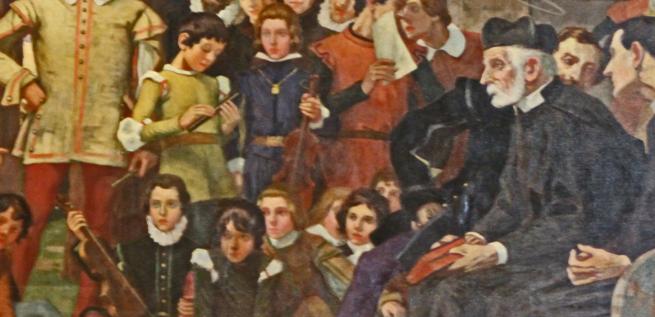
Joan Llimona: “Deo Gratias”. Saint Philip Neri giving catechesis on the hill of Saint Onofrio, in Rome, 1902. Painting in the Church of Saint Philip Neri.
Last Sunday, 30 November, the Liturgical Year began. An event that was used to talk about the influence of the Catholic religion on Gaudí’s life and work (see: the other source of inspiration). Today we revisit the topic to recall the main people who accompanied Gaudí on this long journey. For this reason, the header photo shows a curious image of Gaudí. In it, the architect represents Saint Philip Neri, surrounded by people, in a painting by his friend Joan Llimona, with whom the architect used to end the day surrounded by other parishioners at the church of Saint Philip Neri (see: “the most venerable bearded man”), where they enjoyed attending Mass, singing Gregorian music and chatting before saying goodbye.
In the words of Gijs van Hensbergen, one of his main biographers: “The common image of Gaudí as a grumpy hermit does not exactly match the ease with which he forged a circle of loyal friends who admired him” (1). Indeed, all of them were constant friendships, even when things were going badly (see: Gaudí’s illnesses and the friends who cared for him). Gaudí was religious, but never a hermit.
Providence?…
Around 1878, the year Gaudí obtained his university degree, the architect came into contact with artists with strong religious convictions. Among others, we could mention Lluís Milet, a musician with whom, years later, Gaudí studied Gregorian chant (see: return to the origin), or Joan Llimona, whom we have already mentioned. One of his professors, Joan Martorell, specialised in religious architecture, and it was he who introduced the young architect to the promoter of the Sagrada Família, the devout bookseller Josep M. Bocabella.
Not surprisingly, the main entity to which Gaudí was affiliated was the Circle of Saint Lluc, a conservative artists’ association under whose auspices most religious works of that time were managed. Likewise, Gaudí befriended the leading religious figures of the Catalan Renaixença. Some of them were even his clients…
- Joan Grau Vallespinós, who was from Reus. When he was only the canon of Tarragona, he commissioned Gaudí’s first work, the altar of the church of the Sanctuary of the Sacred Heart, and years later, around 1888, when he was bishop of Astorga, the episcopal palace of this town in León. He also bought the land at Bellesguard, before Gaudí began work on the current tower (see: Bishop Grau). During Gaudí’s stays in Astorga, the bishop instructed him thoroughly on Catholic liturgy, as we will see at the end of the article. Grau also served as a bridge between Gaudí and Enric d’Ossó, the next spiritual influence and client of Gaudí.
- Enric d’Ossó, an ecclesiastic and promoter of the Teresianas School, with whom Gaudí delved into the mysticism of Saint Teresa’s “interior castle”. As the budget was limited, the architect’s clashes with the priest over financial matters are famous. Nevertheless, both felt deep respect for each other.
- Joan Campins, the bishop of Mallorca who entrusted him with the restoration of the island’s cathedral, following quite innovative liturgical approaches that both shared. Of this reform, Gaudí explained that he had followed his experimental method based on spending “a year observing and noting all the deficiencies that the incorrect arrangement of liturgical furniture caused in the ceremonial of episcopal functions, depriving them of meaning and splendour”.
This anecdote shows that, as in so many other matters, the liturgy followed by Gaudí was not the result of blind obedience but of an inner process of study and constant personalisation.
- Josep Torras i Bages, bishop of Vic considered the spiritual patriarch of Catalonia. He exerted enormous influence on the Artistic Circle of Saint Luke, mentioned earlier, and another association of which Gaudí was also a member, the Spiritual League of Our Lady of Montserrat. His main merit was leading the adaptation of the church to the new society that emerged from the industrial revolution and, at the same time, being the most prominent spiritual reference of conservative Catalanism. Gaudí held him in high esteem, and only he could convince him to abandon the radical fasting we mentioned earlier, during Lent in 1894. Among Gaudí’s projects was a monument dedicated to Torras i Bages, which was to be linked to the Passion façade.
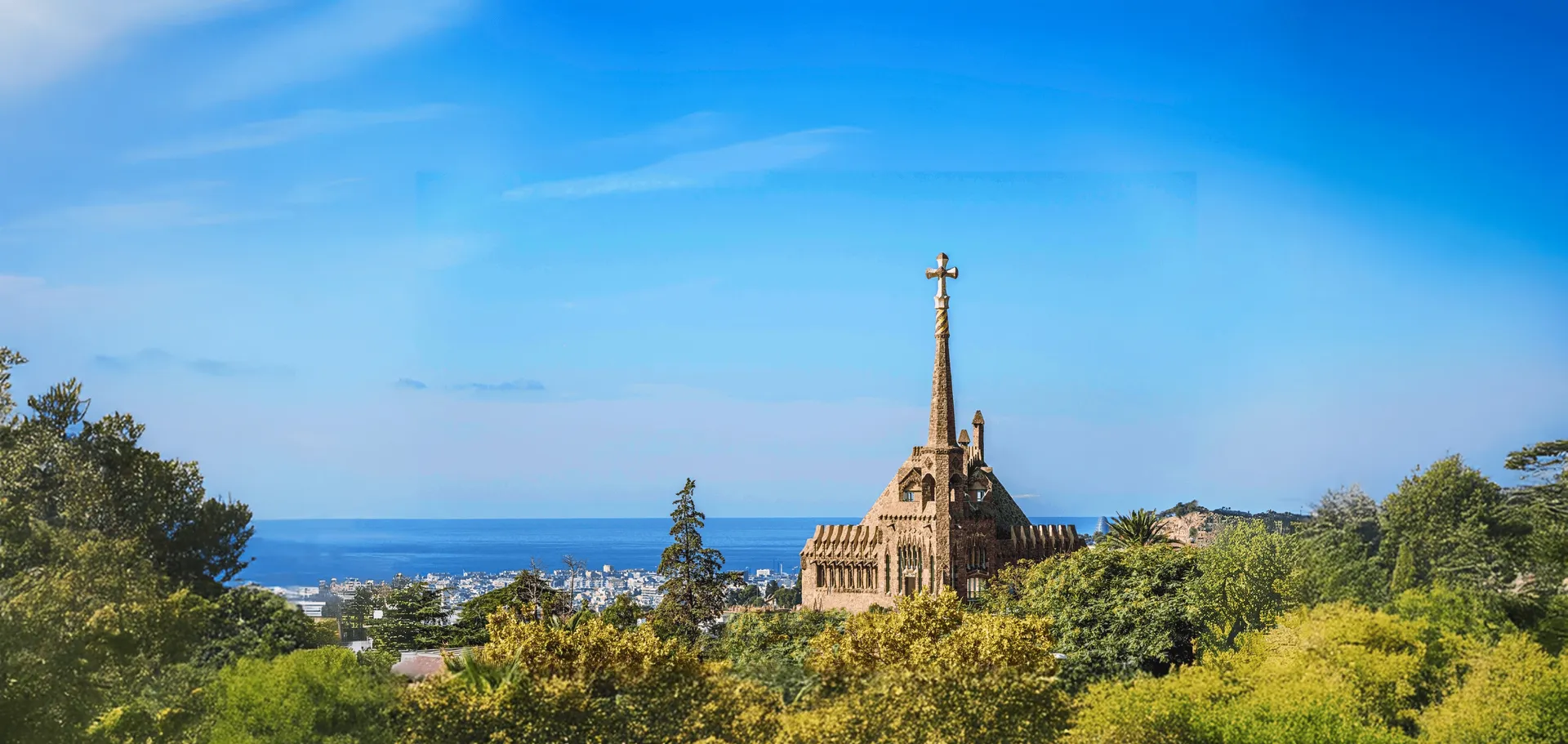
- Jacint Verdaguer, priest and the leading poet of the Renaixença. Two of his poems, La Atlàntida and Canigó, are among the most highly regarded in Catalan literature. Gaudí met Verdaguer because both were part of Count Güell’s social circle. Shortly before his death, and precisely when Gaudí was building Torre Bellesguard, Verdaguer spoke of the medieval past of this place (see: a poetic garden).
- Joan Maragall. Although he was never ordained as a priest, another important religious and literary friendship of Gaudí was this poet, who, like Verdaguer, was among the most famous of his time. He was the one who began writing about the Sagrada Família in 1900, with a highly influential article: “The temple that is born”.
- Ignasi Casanovas, Jesuit known for his lectures and writings exalting the value of sacrifice to draw closer to God, as well as the need for mortification, principles that Gaudí embraced fervently in the last years of his life.
- Lluís M. de Valls, Gaudí’s confessor and father of the Oratory of Saint Philip Neri, a place where, in the last years of his life, Gaudí went to pray and sing Gregorian music. Always in company. Let us recall the image with which we began this article, where Gaudí appears surrounded by people, a work by his friend, the painter Joan Llimona. One of his many friends…
Notes
(1) Hensbergen, Gijs van (2002), Antoni Gaudí, Debolsillo, Barcelona, p. 204