November 30, 2025
By Ferran Garcés
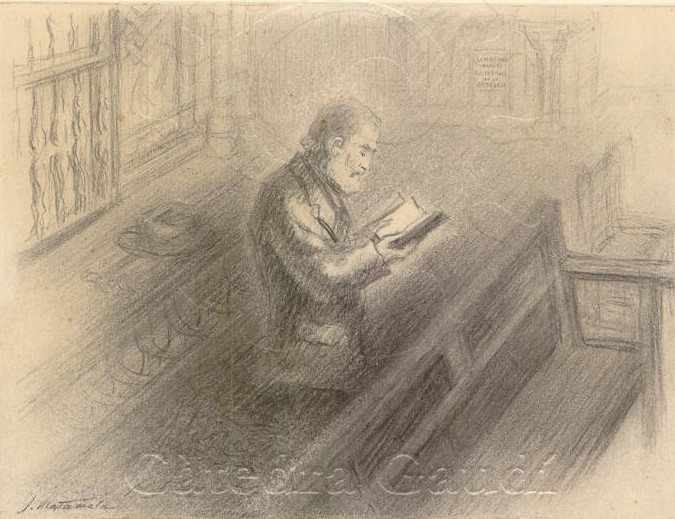
Antoni Gaudí at the Sagrada Família, drawing by Juan Matamala, Gaudí Chair, UPC
Gaudí is well known for the influence of his study of nature on his work, as well as for his Catalan identity. However, Gaudí embraced another source of inspiration: Catholic liturgy. We will talk about it, taking advantage of the beginning of the Liturgical Year, which, as tradition dictates, starts on the first Sunday of Advent and, this year, falls on Novembrer 30, that is, today.
The origin, functioning and development of the Liturgical Year, as well as the peculiar way in which this cycle, full of movable days, combines with our agendas, is a complex subject. In short, our calendar actually follows “two years.” One, the secular year, which begins on January 1, and the other, the liturgical year, which starts, as we have said, on the first Sunday of Advent. Christmas is its first “station.” It should also be noted that the Liturgical Year is determined both by the history of Christ and his mother, Mary, and by that of the saints. Gaudí knew a lot about this subject. Galdric Santana, curator of this Gaudí Year commemoration, director of the Gaudí Chair at UPC and restorer of Torre Bellesguard, stated in a recent interview:
“(Gaudí) was a person who went to the depths of everything, and in this sense he also delved deeply into liturgy. In fact, he was an expert in liturgy above the specialists of the seminaries of his time. I believe that even today he would surpass many current specialists.” (1)
A gradual vocation
Gaudí’s religiosity was not the result of a sudden conversion but of a progressive process that began at the Piarist Schools of Reus, where he studied high school. In the maturity of life, in 1916, he was visited by a group of boarders from the Escolapios of Sarrià, in Barcelona and, on that occasion, he confessed to them: “At the Escuela Pia, my first years passed, and in it my first prayers were the psalms and verses contained in the little golden book of my liturgical devotion; and in its classrooms I learned the holy fear of God” (2).
However, during his formative years in Barcelona, biographers speak of a Gaudí fond of worldly life, elegant in appearance and not yet dominated by the spiritual extremes of his later years. Some even speak of a certain anticlerical attitude, although not all agree with this statement (3). In any case, something begins to change around Lent of 1894, although the cause remains a matter of debate. What we do know for sure is that, that year, Gaudí undertook such an extreme fast that he put his life at risk (see: Gaudí’s illnesses). One of his great friends, and main religious mentors, Bishop Torras i Bages, was the one who saved him with a powerful argument: God’s design for him was another: to dedicate himself body and soul to the temple of the Sagrada Família, a project he had started in 1883.
Another crucial moment in Gaudí’s life and work was his convalescence in 1911 in Puigcerdà, after contracting Malta fever. During this time, he took the opportunity to study and meditate on the Passion façade, a work marked by pain and sacrifice on the one hand, and great creativity on the other (4). In fact, it is considered Gaudí’s best artistic moment (see: “one of the first works? One of the last?”)
Apel·les Mestres, a multifaceted modernist artist, claimed that Gaudí, during this time, had a surprising inner debate. If he received a secular commission, he first had to ask permission and guidance from the Virgin of Montserrat. Fortunately, joked Apel·les, the good Virgin always capitulated and allowed Gaudí to accept civil works. However, after Torre Bellesguard, Casa Batlló and La Pedrera, that is, those built between 1900 and 1912.
“The great paradox” of Gaudí…
Joan Bergós, Gaudí’s closest disciple and author of his first biography, writes how in these last stages of his life, the architect and Christian lyricist became a “voluntary poor man,” renouncing new clients and dedicating his savings to the work and worship of the temple. He would not only exalt poverty but would come to find pain necessary, even penury, to counterbalance artistic blindness. On the other hand, the progressive death of all his family members and friends plunged him into complete melancholy (5).
However, as we have seen, we should not think of this period as a time of artistic crisis, but rather the opposite. Gijs van Hensbergen, one of Gaudí’s main biographers, considers that, from this moment on, the architect’s work reflects his greatest paradox: “The more he moved away from the idealism of youth and the more strictly Catholic he became, while also anti-liberal, pessimistic and obsessed with suffering, the more splendid his architecture became” (6).
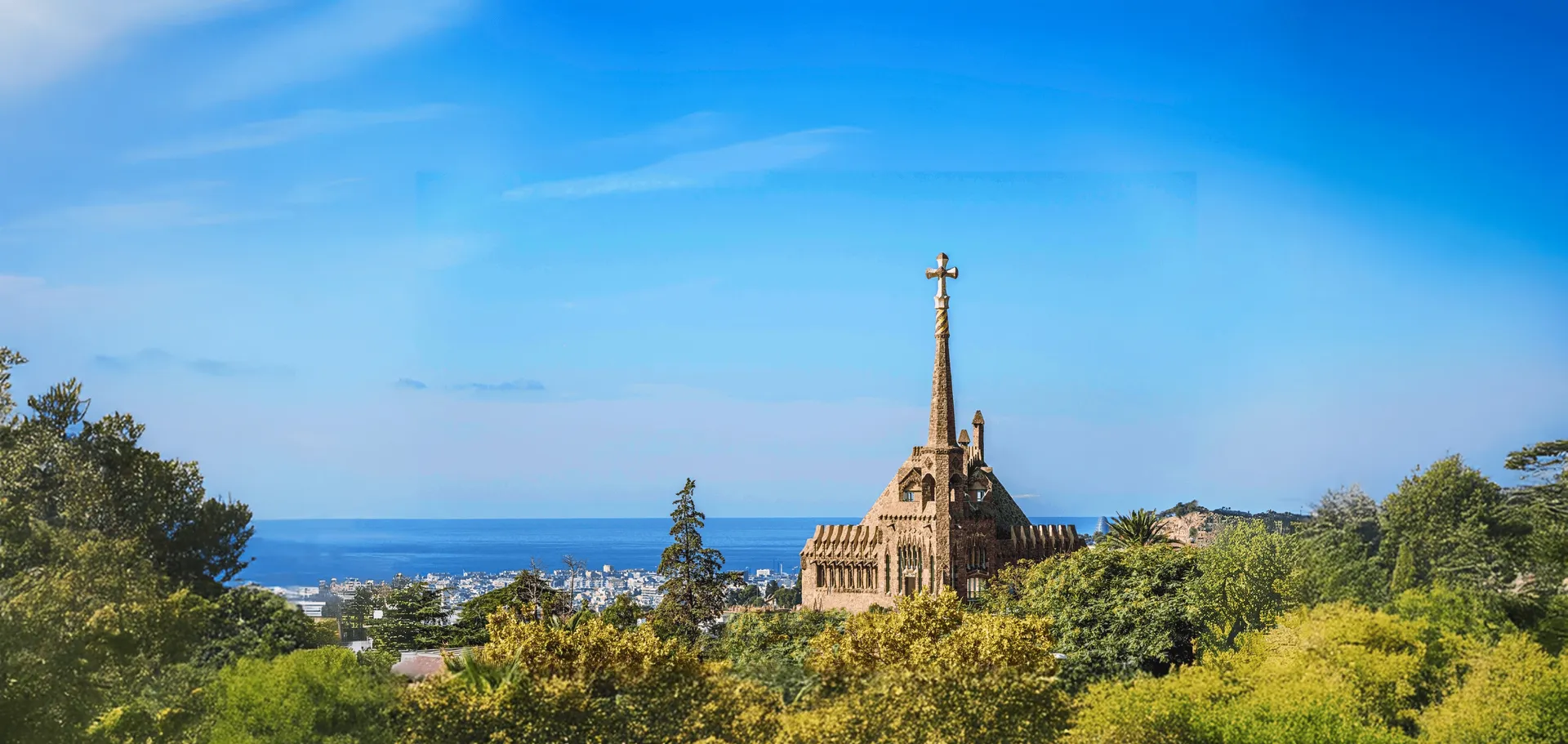
Joan Torres Domènech, another renowned biographer, even says: “If Gaudí had died in 1894, he would surely be found within the triad of the great Catalan modernist architects, but as just one more; not with the strength he has taken in recent times ahead of the others. His current recognition is based mainly on the works he built from 1894 onwards” (7). The common denominator of these last buildings is the influence of Catholic liturgy in them, even if they are civil. A sign that is repeated in all of them is the four-armed cross, exclusive to the architect, as a kind of signature. Torre Bellesguard, with its slender pinnacle, is one of them (see: the crosses of Bellesguard)
Next Friday, once the Liturgical Year has begun, we will see which people—and books—accompanied Gaudí on this paradoxical path.
Notes
(1) Galdric, Santa (8/11/2025), “Reus was key in Gaudí’s intellectual and artistic training”, Diari de Tarragona, p. 11.
(2) Tarragona i Clarasó, Josep Maria (2016) Gaudí, the architect of the Sagrada Família. Brief biography, Torsimany Books, p. 33. See also: Bassegoda, Joan (2002), Antoni Gaudí, Edicions 62, Barcelona, pp. 30-31
(3) Torres Domènech, Joan (2018), The Gaudí they didn’t tell us about, Cossetània edicions, Valls, p. 56-60
(4) Puig-Boada, Isidre (1980) Gaudí’s thought. Compilation of texts and comments, Barcelona, Publications of the College of Architects of Catalonia, p. 200.
(5) Bergós i Massó, Joan (2011), Gaudí. The man and the work, Lunwerg, Barcelona pp. 45
One of the architect’s quotes remembered by Bergós is an authentic celebration of pain, from an ascetic point of view: “so that the artist does not lose balance, with the elevation of art, he must endure pain or misery. So that discipline does not fail, discipline is indispensable: the only way not to be disturbed.”
(6) Hensbergen, Gijs van (2002), Antoni Gaudí, Debolsillo, Barcelona, p. 176
(7) Torres Domènech, Joan, Op. Cit., p. 78