January 30, 2026
By Ferran Garcés
Today we will talk about the women closest to the architect’s life, and next Friday about his clients. The subject of both articles is an unusual approach to the study of Gaudí, so there is very little information available. Logically, our article does not pretend to mend this omission, but to collect some of the scarce testimonies that exist. Still, may it serve as inspiration for a more detailed study.
Year 1879. Roseta, niece and almost daughter
Antoni Gaudí obtained his architecture degree in 1878. A good piece of news overshadowed by a difficult personal period. Before graduating, in a short time, he had buried almost all of his family members. Among others, his grandmother, on 8 November 1875; his brother, eight months later, on 1 July 1876; and his mother, not long after, on 8 September of the same year. Finally, after his graduation, on 17 October 1879, it was the turn of his sister Rosa, who left behind a three‑year‑old daughter, Roseta Egea i Gaudí. Sadly, her husband, an alcoholic musician, abandoned the girl. Thus, the orphan was left in the care of the only living members of the family: Gaudí himself, a bachelor, and his father, a widower.
At first, the little girl was sent to the convent school of the Jesús María nuns in Tarragona, in a building that, at that time, was being enlarged with a chapel. Important events would follow from this, because Gaudí then met the priest Joan Grau, spiritual father of the school and future close friend of the architect. Moreover, Grau initially asked him to design the altar and other liturgical elements of that chapel, and, years later, the Episcopal Palace of Astorga. Joan Grau, by the way, could have been the client of Torre Bellesguard had he not died unexpectedly (see: un bisbe per les ruïnes d’un castell)
When she reached adulthood, Roseta returned to live with her uncle and grandfather. The three lived together until 1906, the death of the father, and 1912, the death of the niece. Roseta’s passing caused great discouragement in the architect, who had, in practice, considered her like a daughter. On the other hand, Roseta suffered greatly in her final years due to tuberculosis and the remedy of the time: ever‑increasing doses of laudanum, a medicine composed of alcohol and morphine, substances that made her quite dependent (1).
Shortly before, Joan Matamala Flotats, son of Llorenç Matamala, a close friend of Gaudí and the first sculptor of the Sagrada Família, drew a portrait of the Güell family. The lady at the door with a tray was called Vicenta and was the housemaid. Unfortunatly, very little or nothing is what we know about Vicenta.
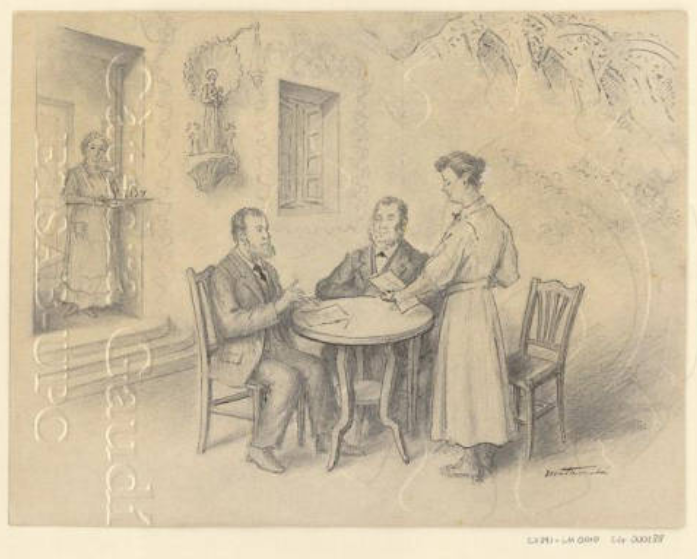
Matamala Flotats, Juan. Antoni Gaudí’s family in the dining room of their home at Park Güell. UPC, Càtedra Gaudí.
Year 1884. Pepeta, the impossible love
In 1878, Gaudí graduated and immediately came into contact with an innovative project: the new headquarters of the Cooperativa La Obrera Mataronense, an industrial complex infused with utopian socialism that included social facilities and housing for cooperative members. However, from the whole complex designed by Gaudí, only the so‑called “Nau Gaudí”, built in 1883, has been preserved.
The following year, 1884, the architect designed the society’s standard, a very common ceremonial object of the time used to preside over festivities and solemn acts. The image was so overloaded with details and filigree that the embroiderer wrote him a letter complaining about how difficult it was to sew the design. That embroiderer was called Josepa Moreu i Fornells, now better known as “La Pepeta”. She was a red‑haired woman, ahead of her time, who read anticlerical newspapers and taught French to the workers’ children. Gaudí fell in love with her.
For about four years, the young architect frequently visited Pepeta’s family home, often bringing along his niece Roseta, who had already returned from the convent school to live with her uncle and grandfather. But the day Gaudí finally decided to declare himself to Pepeta, the answer was not what he expected. The embroiderer of the standard was already engaged to another man and rejected him, showing him her fiancé’s engagement ring. Gaudí never saw her again.
Much has been speculated about how this rejection marked the rest of the architect’s life. Did this heartbreak push him toward introspection or even mysticism? That is what some of his biographers seem to say. For example, Gijs van Hensbergen writes: “Resigned to celibacy, Gaudí assumed with fatalism his barren love life. Later he would choose, like so many mystics of the Spanish Golden Age, the ‘llama de amor viva’, the spiritual pilgrimage that leads toward God and promotes the negation of the self and the renunciation of the flesh. He turned his back on female companionship to become, according to Lluís Permanyer, a misogynist who reprimanded his assistants if they visited cafés of dubious reputation or were seen walking in the company of women” (2).
Year 1904. The women of his friends
The creator of the Sagrada Família never formed his own family apart from the one he shared with his father and niece, but he lived closely with the families of some of his closest friends. Especially that of Pere Santaló i Castellví, a doctor he met the year he graduated and who remained by his side until the end. The architect regularly visited his friend’s home. The Santaló family also spent a couple of weeks every summer in Montserrat, and the Gaudí family often went up to visit them. One of the most famous photos of Gaudí was taken during one of those excursions, in 1904. However, it is usually published cropped, showing only the architect. In the complete photograph, we can see Gaudí’s family in the foreground —including Roseta— and the women of Doctor Santaló at the top of the image.
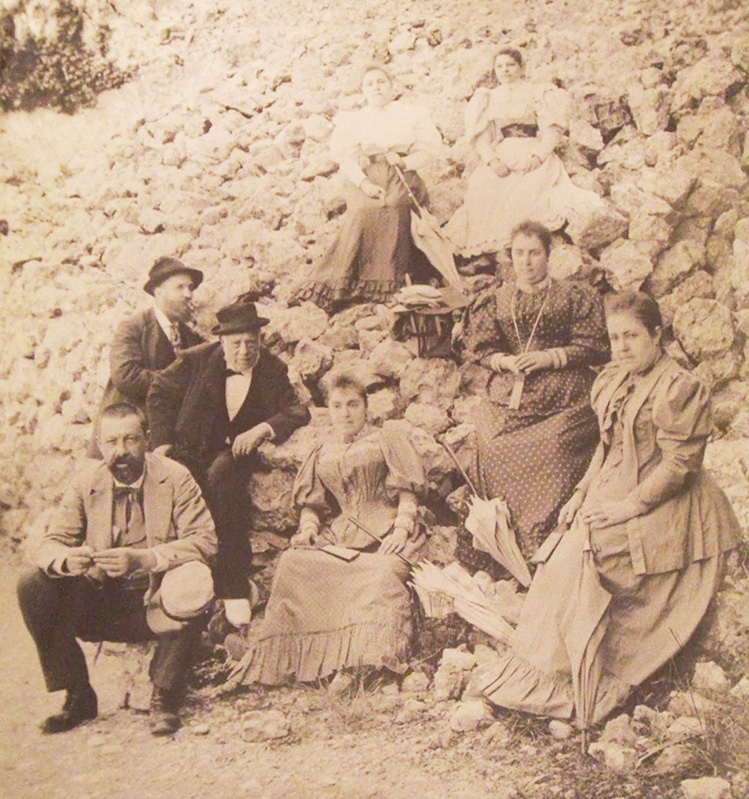
Unfortunately, we know very little about the occasions in which Gaudí interacted with the wives and daughters of his friends. Even so, a relatively famous anecdote from Gaudí’s visits to the Santaló family has been preserved, one that does not portray the architect favourably. Below is the version given by Joan Bassegoda, one of Gaudí’s main biographers.
Other times Gaudí had visited Santaló in his house on Conde del Asalto Street, and on one occasion, while the two friends were talking in the sitting room, Francisca, Santaló’s daughter, suddenly entered, and Gaudí expelled her with some violence, telling her not to be a busybody and that young people should not interrupt adults’ conversations. The girl was very offended and years later, after Gaudí’s death and the petition by mossèn Manuel Trens and others in the architect’s circle requesting his beatification, Francisca Santaló said: “They will make Gaudí a saint, patron of the hot‑tempered” (3).
Year 1904. A secret youthful adventure?
Among the architect’s greatest friends and defenders was the poet Joan Maragall, author of an influential article calling for financial support for the Sagrada Família in the Diario de Barcelona in 1905. He is also the author of a short story titled “Calaverada” (adventure of youth). He wrote it the year before the article, that is, in 1904, a period of great creative activity, as we have seen.
In this story, Maragall recounts a gathering of friends, all of them artists, in which each tells a “calaverada”. Among them is an architect. He is the last one to speak and describes a platonic love he had in his youth and which he still remembers (4).
From Maragall’s story a legend has emerged: this enamoured architect would in fact be Antoni Gaudí. Furthermore, it has been suggested that this love story inspired the three poems forming the cycle “Haidé” (5). In them, as in the story, there is a friend who confesses an old love. The cycle forms part of the poetry book Les disperses, also written in 1904. Is this legend true, or, as the saying goes, “Se non è vero, è ben trovato”?
1959. Engràcia, the last and the first…
The protagonist now is the last woman associated with Gaudí because her name does not appear until after the architect’s death, and she is the first because she was the midwife who brought him into the world: Engràcia Llorens Pellicé (1821‑1897).
During Gaudí’s life, the debate about where he was born was never raised. This controversy belongs to the time of his first biographies (see: Les arrels d’un geni). Among the arguments in favour of Riudoms, one of the most influential is the testimony of Engràcia’s granddaughter, who, incidentally, was also called Engràcia. According to her, in her family it was always said that her grandmother had assisted Gaudí’s mother in Riudoms. Josep Maria Tarragona dates this declaration at the Riudoms courthouse on 26 September 1959, shortly before the granddaughter’s death (6).
Notes
(1) Tarragona i Clarasó, Josep Maria (2016). Gaudí, el arquitecto de la Sagrada Familia. Biografía breve, Torsimany Books, pp. 94–95
(2) Hensbergen, Gijs van (2002). Antoni Gaudí, Plaza&Janés Debolsillo, pp. 95–96
(3) Bassegoda i Nonell, Joan (1998). “La relació de Gaudí amb el doctor Pere Santaló i Castellví”, Revista d’Història de la Medicina i de les Ciències de la Salut, Vol. 30, pp. 29–36
(4) “Una Calaverada” – Biblioteca de Catalunya (in Catalan)
(5) Serrahima, Maurici (1953). “D’on va sortir l’Haidé de Maragall”, Butlletí de la Societat Catalana d’Estudis Històrics, nº 2, pp. 33–40
(6) Tarragona i Clarasó, Josep Maria (16/10/2006). “Engracia Llorens i Pellicé, llevadora de Riudoms”, web antonigaudi.org
See also: Torres Domènech, Joan (2018). El Gaudí que no ens han explicat, Cossetània Edicions, Valls, p. 38