November 14, 2025
By Ferran Garcés
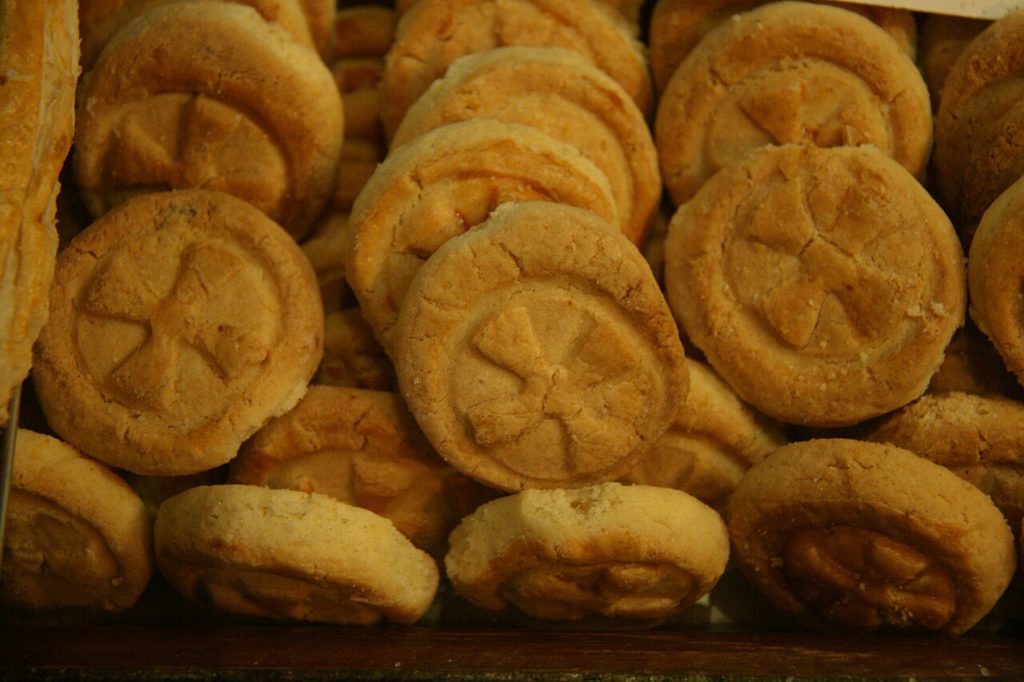
Gaudí had a special fondness for a particular food. Gijs van Hensbergen, one of the main biographers of the architect, mentions it when commenting on his habits: “Or, perhaps, he would take quick bites of dry pastries, the breads of Saint Anthony, which he always carried with him in small bags that he offered to others while keeping for himself those subtly seasoned with roasted cumin” (1).
The choice could not be more consistent with the beliefs of the so-called architect of God, because the popular name for these rolls is “bread of the poor”, or “saint’s bread”. Their origin is explained by different legends related to the miracles and charity of Saint Anthony Abbot, patron of animals, farmers, and carriers. However, Gaudí had other curious habits both in terms of food and philosophy of life.
Health and diet, according to Gaudí
A couple of weeks ago we discussed Gaudí’s illnesses, some so serious that he imagined the worst (see: the “other deaths” of the architect). At that time, for reasons of space, we did not develop the topic of his peculiar lifestyle. We do so today. It was a method followed by both the architect and his father, who seems to have been the first to adopt it (2). This system was inspired by the “Kneipp cure”, named after its creator: Sebastian Kneipp, a German priest and doctor. Interestingly, the method arrived in Catalonia at the same time as the founding of the naturalist company Santiveri, in 1885, the Vegetarian League of Catalonia, in 1908, and the company Danone, in 1919.
However, instead of explaining this cure and similar ones, we thought it more engaging to let Gaudí himself speak about it. However, it should be clarified that the following phrases were never written down by him but correspond to the testimony of third parties. Indeed, in the last years of his life, Gaudí was surrounded by a number of followers who, shortly after his death, published the first biographies of the master. One of them, the architect Isidre Puig-Boada, is the author of the main collection of Gaudí’s phrases and this is the main source we have followed to prepare this article. At the end of each phrase, we indicate the page number (3). We hope you find it useful or, at least, interesting.
Poverty and sacrifice
“Poverty should not be confused with misery. Poverty leads to elegance and beauty; wealth leads to opulence and complication, which cannot be beautiful. For the artist not to lose balance, with the elevation of art he must go through pain or misery. For discipline not to fail, discipline is indispensable: the only way not to be disturbed. Progressing slowly but inexorably on this path of mortifications, he exclaimed: ‘It is good for both body and soul to endure heat in summer and cold in winter’. And also, ‘One should eat only to avoid dying’ (p. 175).
He comments: ‘the mortification of the body is the joy of the spirit, as rightly says Dr. Torras i Bages, and the mortification of the body is continuous, persistent work; this is the most powerful aid against temptations’. He wisely strives to perfect himself through the experience of setbacks: ‘You are not well until you have fallen and suffered a blow; the blow is the door to conviction’; and he, who had been so proudly sure of his own strength, confesses: ‘Every fall is the result of having trusted oneself’ (p. 177).
Sun, cold and food
Balance
One must be busy all day, intellectually and manually, walking and exercising, all in proportion to one’s strength. Thus, one sleeps through the whole night, and this is balance, the compensation of life (p. 186).
Natural stimulant: the sun
The sun is the stimulant of life; alcohol, coffee, etc., do not stimulate but whip the organism. And the sun is as stimulating in summer as in winter, and we must get used to taking it (Ibíd).
Usefulness of cold
One must eat, sleep and dress only as necessary and until one feels the need. Cold activates circulation and is therefore healthy to endure cold, as long as it is not excessive, and it is better to combat it with movement (which regularizes circulation) rather than with a load of clothing that is never sufficient by itself” (Ibíd).
Footwear for cold, a geometry lesson…
The following phrase is especially relevant if we remember that, due to the chronic rheumatism he suffered in his last years, Gaudí had deformed and very sensitive feet. Consequently, Isidre Puig-Boada writes:
Gaudí wore, lately and in winter, double socks and espadrilles, and justified it thus: the sole of the espadrille is hemp arranged helically and, therefore, is a spring. The thick wool socks (helical threads tied helically) are another spring; the inner socks, of fine wool, are another, smaller spring. All these are elements for the balance of the skin’s forces, which thins with age, and since life lies in balance, one must ensure it exists in every detail (p. 187-188).
Food (4)
“Those who eat more than necessary are sewer-fillers who squander their energy and compromise their health; one must eat to live and not live to eat. One must eat and sleep just to subsist.
Lettuce and endive are the simplest and most perfect way to take oil, prepared thus for its emulsion; it is a mistake to think that milk with fruits, including citrus, is poorly digested, as it is quite the opposite: the skin of fruits is the best intestinal regulator. Everything I eat I accompany with bread and never drink even if I have eaten nothing but dried fruits; I always finish with a crumb of bread, which acts as a cleaning sponge for the teeth, and then I drink a little water.
Abstaining from toxic stimulants and spices sharpens my senses and allows me to perceive the finest smells and tastes; the most exquisite fruits I have eaten are freshly picked Mallorcan apricots, a masterpiece of aroma combined with taste, and there is no way to make them retain these qualities for long. I know if the fruit has been stored, even in a cold chamber, by the decrease in its smell and also by the loss of taste. When I have no fresh fruit, I spread a little honey on bread; I do not use sugar (p. 187).
Notes
(1) Hensbergen, Gijs van (2002) Antoni Gaudí, Plaza & Janés Editores, Barcelona, p. 163.
(2) Domènech, Joan Torres (2018) The Gaudí they haven’t told us about, Cossetània editors, Valls, p. 63. In summary, for the Gaudís, father and son, the cure was based on a vegetarian diet, long walks, water baths (hydrotherapy) and sleeping all year with the windows open.
(3) Puig-Boada, Isidre (1981), Gaudí’s Thought. Compilation of texts and comments, Publications of the College of Architects of Catalonia, Barcelona, pp. 177-178 and 186-188
(4) This topic can be read with slight variations in: Martinell Brunett, Cesar (1967), Gaudí. His life, his theory, his work, College of Architects of Catalonia and the Balearic Islands, Barcelona, p. 108.
(5) Bergós Massó, Juan (1974), Gaudí, the man and the work, Polytechnic University of Barcelona, p. 31-33