November 20, 2026
By: The Bellesguard Team
During visits to Torre Bellesguard, we are often asked where the information we share comes from and which bibliographical sources can be consulted to learn more about the history of the building and the site. Today, we would like to highlight two fundamental studies, published following the opening of the house to the public in 2013 and the creation of the Torre Bellesguard Research Group, which made it possible to develop the content for the visits.
Through these two works, we can understand Bellesguard not only as a work by Antoni Gaudí, but also as the setting for some of the most significant episodes in the history of Catalonia. In addition, both publications offer valuable visual material, including old photographs of the house, maps and various documents that help us better imagine its past and its symbolism.
First, it is worth highlighting the work of Josep M. Vall i Comaposada, a member of the Torre Bellesguard Research Group and author of Bellesguard: origen, esplendor, decadència i transformació. Published in 2017, based on a previous thesis, this work remains an essential reference for tracing the different transformations of the building, from the farmhouse that preceded the palace of Martí l’Humà to the construction of Casa Figueras by Antoni Gaudí. The book also explores the structural and symbolic features of the architect’s work, as well as the subsequent transformations of the property, which came to serve such different purposes as an orphanage during the Spanish Civil War and an oncology clinic and maternity hospital run by the Guilera family, the owners who formed the Torre Bellesguard Research Group.
- Vall Comaposada, Josep M.. Bellesguard: origen, esplendor, decadència i transformació. Doctoral thesis, Universitat Abat Oliba CEU, 2017. [ dialnet.unirioja.es ]
- Vall Comaposada, Josep M.. Bellesguard: origen, esplendor, decadència i transformació. Book edition based on the doctoral research. [ dialnet.unirioja.es ]
Second, it is worth mentioning the doctoral thesis by historian Esteban Galindo López, who was also associated with the Torre Bellesguard Research Group. His research, presented at the Universitat de Barcelona in 2020, is entitled Anàlisi del paisatge històric a la zona nord del Pla de Barcelona, segles XV al XVIII: Bellesguard. Galindo’s work reconstructs the evolution of the area surrounding this unique building and addresses, among other issues, disputes over the control of water, which was very abundant in the area in the form of both underground water channels and streams; population growth and the resulting pressure on the territory; the arrival of the affluent bourgeoisie; and the transformation of the landscape in favour of vineyards, which, until Gaudí’s time, dominated the landscape in front of Bellesguard.
- Galindo López, Esteban. Anàlisi del paisatge històric del nord de Barcelona, segles XV al XVIII: Bellesguard. Doctoral thesis, Universitat de Barcelona, 2020. [ diposit.ub.edu ], [ ub.edu ]
A medieval palace and some Roman coins…
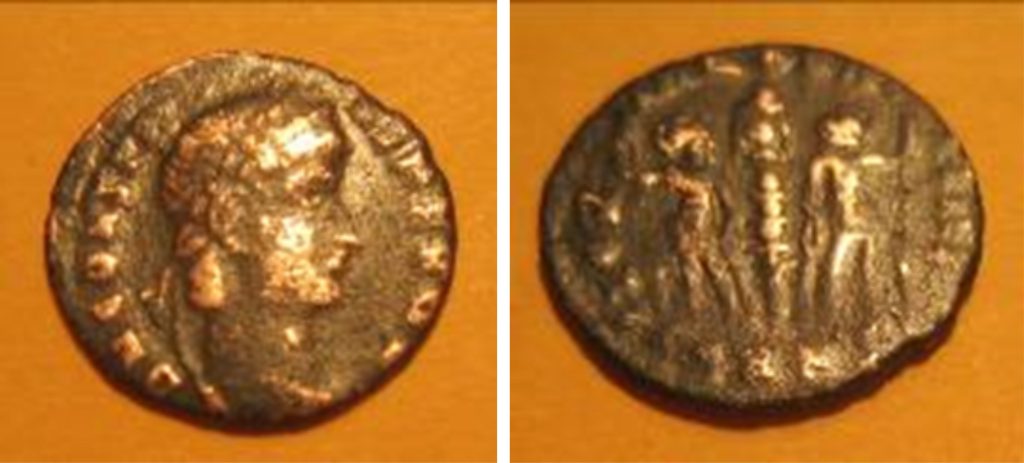
At the beginning of the 20th century, Bellesguard’s documented past seemed to date back essentially to the time of King Martí. However, with the opening of the house to the public in 2013 and the subsequent formation of the Torre Bellesguard Research Group, historical and archaeological studies have helped broaden our knowledge of the origins of the site. One of the most significant discoveries has been a series of Roman coins, which provide evidence of human presence and activity long before the construction of the medieval palace (see “Capítol X: Apèndix documental” in Galindo’s thesis). At the end of the article, we reproduce photographs of some of these pieces. This discovery reminds us that we are still far from knowing the full history of this remarkable place. What other surprises might Bellesguard research have in store for us?