July 24, 2026
By Ferran Garcés
 One of the most distinctive elements of Gaudí’s architecture is an area that, in most other buildings, is usually considered “secondary”. We are referring to the rooftop. For most architects, a building simply ends there and, as a result, they do not design any special features for it. In Gaudí’s works, however, the rooftop becomes a surprise, open to both experience and imagination. In other words, rather than being a full stop, it becomes an ellipsis…
A Special Feature That Lives Up to the Name…
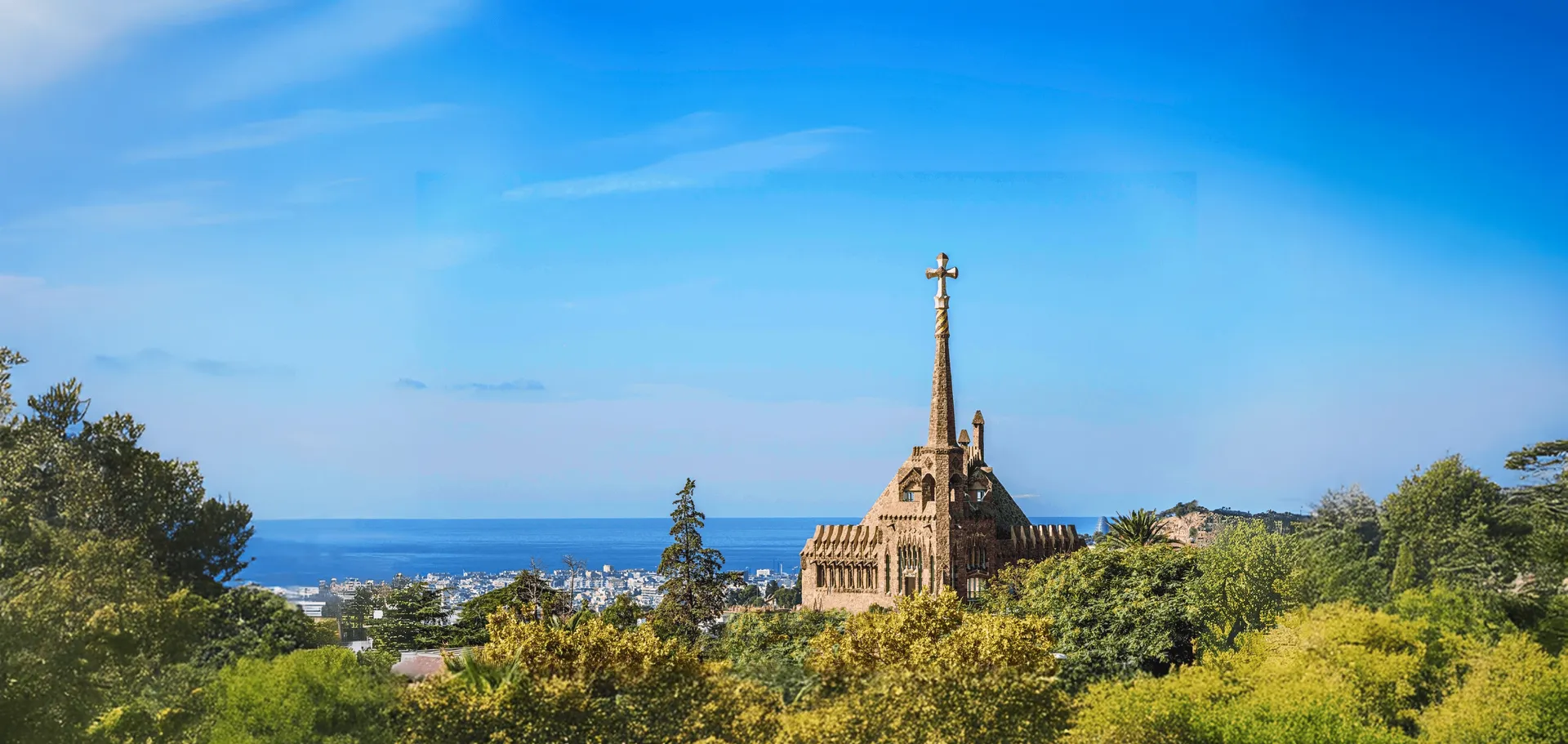
In the case of Bellesguard, which means “Beautiful View,” its rooftop makes this distinctive Gaudí feature even more evident. Indeed, when you visit Torre Bellesguard, from the terrace you will enjoy a 360° view of the Barcelona plain and the slopes of the Collserola mountains—in other words, the sea and the mountains. Yet within the rooftop itself, you will also find an ideal place for a stroll, almost like a small labyrinth…
A Rooftop with Four Paths
Josep Maria Figueras i Bas, a descendant of Gaudí’s clients, devoted the final years of his life to writing a book about his family. Unsurprisingly, his testimony comes from someone who was very close to the house, and perhaps no one has described the rooftop of Torre Bellesguard better than he did.
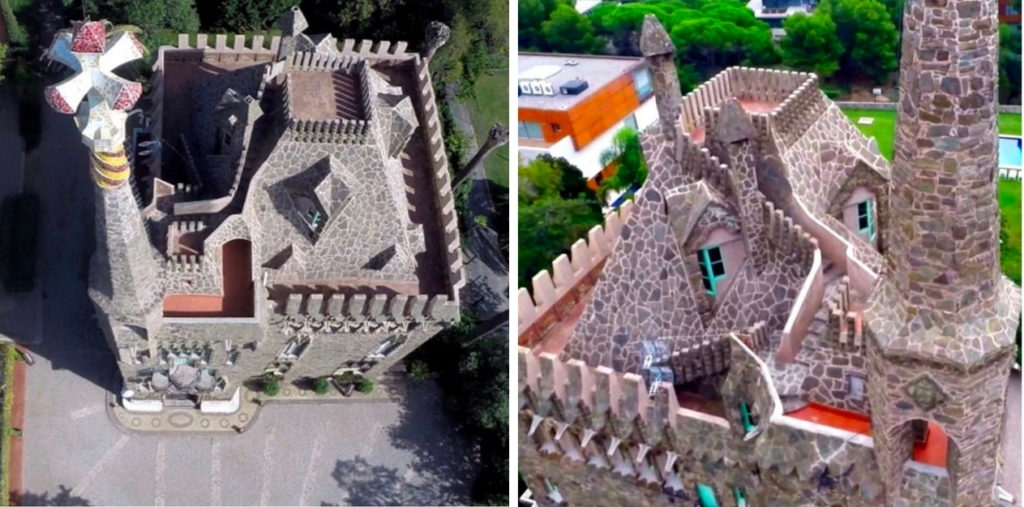
“Bellesguard has a parapet walkway like those found in ancient castles; it follows the contour of the building, lined with the battlements so typical of medieval constructions. There is another path leading to the viewpoint beneath the spire, which is crowned by the four-armed cross.
A third path leads to a small terrace which is, in fact, the roof of the charming dovecote, where the feeding and nesting structures for pigeons have been preserved.
Finally, the fourth path ascends to the large terrace, the roof of the second attic level. From this viewpoint, surrounded by small battlements decorated with slate trencadís mosaics, visitors can enjoy a magnificent panoramic view of the entire city of Barcelona.” (1)
Four Paths and a Dragon…
As if that were not enough, all these paths are arranged around a façade whose shape resembles a dragon’s head. No surviving evidence allows us to state that this was Gaudí’s intention. However, given his well-known fascination with the legend of Saint George, the idea is certainly tempting. Moreover, Gaudí began work on Bellesguard in 1900 and, four years later, on Casa Batlló, another building famous for its rooftop concealing a dragon. A mere coincidence?
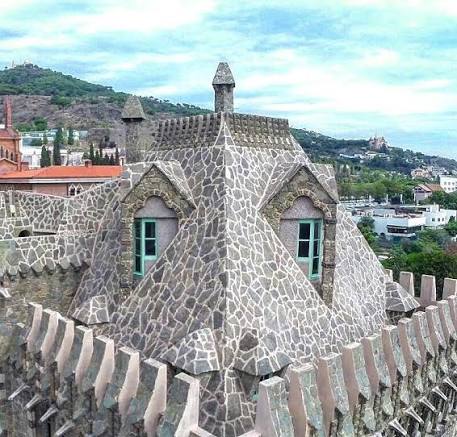 In any case, Bellesguard’s rooftop offers even more symbolic elements, no less surprising than the possible dragon. Let us once again give the floor to Josep Maria Figueras i Bas:
“Perhaps the most representative symbol of Bellesguard is its slender spire, which evokes the pinnacles of Gothic cathedrals and is topped by a cross formed by four three-dimensional arms pointing toward the four cardinal directions. At the top of the spire are helical red and yellow bands representing the Catalan flag. At the base of the cross stands a crown, the crown of King Martin I the Humane.” (1)
Four paths, battlements, attics, a dovecote, a possible dragon, and a spire rich in religious and historical symbolism… Gaudí’s rooftop is less a farewell than an invitation to return. With every subtle change in the weather, the experience becomes different. Whether in sunshine or rain, heat or cold, a visit to Bellesguard is not only a visit to a building, but also to the landscape of an entire city.
Let us remember that Bellesguard means “Beautiful View.” We invite you to enjoy it.
Notes
(1) Figueras i Bas, Josep M. (2016), The Figueras Family: The Lords of Bellesguard, self-published work, Barcelona, p. 68.