September 3, 2026
By Ferran Garcés
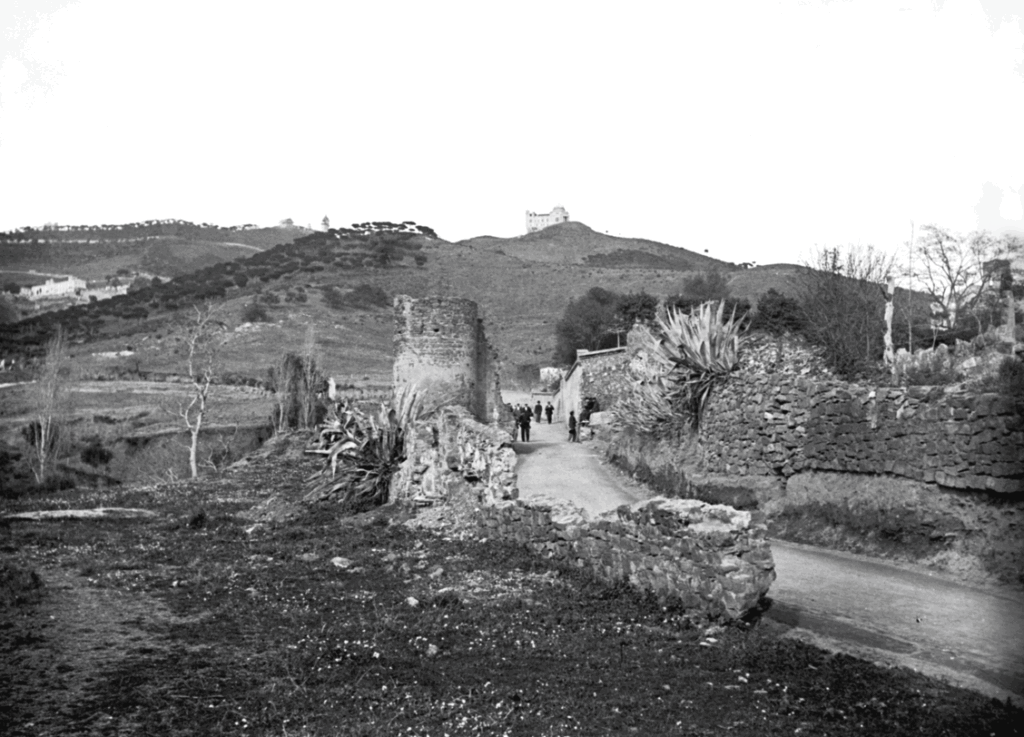
Grup de gent camí cap al castell i casa Bellesguard, Josep Maria Armengol i Bas, entre 1899 i 1909. AFCEC.
Before becoming a paved street, Bellesguard was a dirt path that ran alongside a stream and led to the springs of the mountain and the estate itself, when it was still in ruins. In the earliest photographs of the area, we can see some of the walkers who used to travel along it, such as those shown in the image at the top of this article. However, these human figures were not always leisurely passers-by…
Last Friday we already gave a “spoiler” for today’s article: after a period of prosperity, with no conflicts other than occasional disputes over water rights, from the 17th century onwards the abundance of this element would become a curse for the inhabitants and buildings of the area, including Bellesguard…
The Fountain Stained with Blood
Indeed, beginning with the Thirty Years’ War (1618-1648) and the Segadors (Reapers)’ War (1640-1652), Catalonia, a borderland between Spain and France, suffered a succession of increasingly severe conflicts. Barcelona, as the principal city, repeatedly became the scene of military confrontations. Bellesguard, like the entire slope of Collserola, offered an excellent strategic view over the city plain and a terrain overflowing with water. Naturally, the lines of trenches and camps of invading armies spread throughout the area, often turning it into a battlefield (1). Thus, the presence of water, as we anticipated, became a curse.
In a notarial document dated 17 May 1662, the tower of Bellesguard is described as being “entirely ruined and uninhabitable due to the ravages of war, together with all its buildings, vineyards, fields, orchards, woods, lands and possessions, both cultivated and barren, near and far from said tower” (2). The destruction most likely took place around the end of the Reapers’ War, ten years earlier. Yet the protagonist of this notarial document was about to change the fate of Bellesguard, or at least attempt to do so…
The Reborn Fountain
Fortunately, before the Siege of 1714, a prominent Barcelona family owned the estate, and its last member, Joan de Gualbes i Copons, inherited the property “entirely ruined and uninhabitable.” He rebuilt it, transforming it into a stately residence once again surrounded by a splendid garden. Within this renewed paradise, he hosted the Academy of the Distrustful (Acadèmia dels Desconfiats), a gathering place for nobles united by their classical learning and anti-Bourbon spirit. Sadly, this rebirth was short-lived. After the fall of Barcelona to the Bourbons in that fateful year of 1714, the estate once again fell into abandonment…
The Fountain of Nostalgia
Nevertheless, Romanticism’s fascination with ruins turned Bellesguard into a picturesque site that attracted both artists and photographers. For the first time, thanks to them, we have an image of Bellesguard, even if only of its remains (3). Moreover, the interest in the settings of Catalonia’s past glories ensured that the name Bellesguard was not forgotten. In 1845, Pascual Madoz, in his famous dictionary, referred to the “royal palace or site” as a “pleasant and delightful place.” In 1883, Jacint Verdaguer, the great poet and friend of Gaudí, published his Ode to Barcelona and wrote: “Only perfumes remain from Bellesguard.” Furthermore, two new customs would draw the people of Barcelona to this place…
The Fountain of Festivity
The growing popularity of hiking and the tradition of the so-called fontades (excursions to springs and fountains) made the outskirts of the city fashionable. This time, instead of soldiers, the new “invaders” were walkers enjoying their day off. The excuse of the fountain and its surrounding landscape provided an opportunity to spend time outside the city and enjoy a social gathering point. Beside the hypnotic sound of the spring, after a picnic snack, adults chatted, children played, and some people even improvised a dance. Before heading home, visitors often filled their water jugs.
In 1946, Josep Maria Riutort wrote a nostalgic book that has become the definitive reference work on Barcelona’s fountains and fontades. Speaking about the Bellesguard fountain, he wrote:
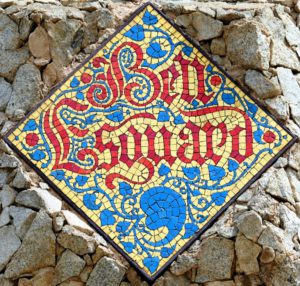
“Leaving Bonanova Square by the path bordering the church, one reaches Bell Esguart (as it was written in the time of King Martin) in eight minutes. It was a royal site where the Kings of the House of Aragon resided and where Antipope Luna lived for a time. Within this residence there was a fountain whose waters, renowned for their purity and abundance, were accessible to the public in the middle of the century. Later, the fountain was closed to the public, giving rise to protests from those who had made a habit of picnicking there on Sunday afternoons.” (4)
These protests were doomed to fail, although there was ultimately no need to maintain the prohibition. Urban expansion gradually concealed the streams, water mines and fountains, as well as the troughs used by animals, which we also discussed in an article published on the feast day of the patron saint of animals and muleteers (see: Saint Anthony). Before long, that world of ruins, fields and fountains disappeared. Joan Maragall, a close friend of Gaudí, was still able to experience it and, in one of his poems, wrote:
At the hour when the sun sets,
drinking from the stream of the fountain,
I have savoured the secrets
of the mysterious land.
Notes
(1) Vall i Comaposada, Josep M. (2014), Bellesguard: From the Residence of Martin the Humane to Gaudí’s Tower, Duxelem Editorial, pp. 80-87.
(2) Ibid., p. 82.
(3) Ibid., pp. 87-93.
(4) Riutort, J.M. (1946), History and Legend of the Urban and Rural Fountains of Barcelona, Librería Milà, Barcelona, p. 57. The author also mentions another fountain located near Bellesguard:
“Bethlem Fountain. In the institution for mental patients belonging to the Hospital of the Holy Cross, known as ‘Bethlem,’ situated ten minutes from Bell Esguart (the old spelling of the name), halfway up Mount Tibidabo, there was an abundant spring of exquisite water that enjoyed great renown despite not being public.
However, because it belonged to a mental asylum, people later attributed rather unflattering properties to its waters. Thus, it became common to say of someone whose behaviour did not appear entirely sane: ‘This person has drunk water from the Bethlem Fountain.’”