August 29, 2026
By Ferran Garcés
Summer is coming to an end. As every year, the demand for water has been strongly felt in recent weeks, along with the search for a cool place to escape the heat. In the past, temperatures may not have been as extreme as they are today, but the need to combat the heat was much the same. However, instead of beaches, mountains were once the main attraction, and rather than seawater, it was spring water that drew people in. Fortunately, Barcelona boasts not one but two mountains, in addition to several hills, all of them rich in springs and streams.
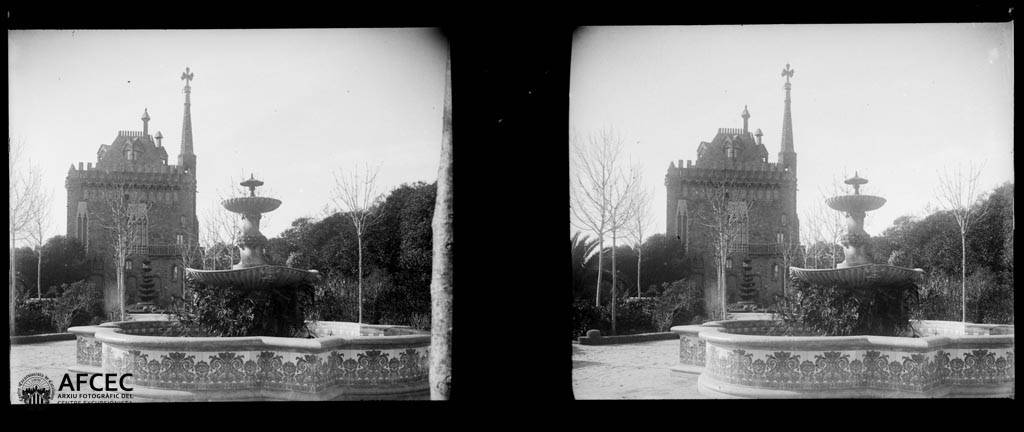
Sadly, many of those springs and streams have disappeared beneath the gradual urbanization of the landscape surrounding Barcelona and Bellesguard. For example, in the photograph that accompanies this article we can see a lost fountain designed by Domènech Sugrañes, a collaborator of Gaudí, around 1916 in a section of the gardens that can no longer be visited today. The picture was taken in the early 1950s. It stands as a nostalgic reminder of those springs that we will remember today. At the same time, it illustrates how the history of Bellesguard has always run parallel to that of the life-giving element of water.
The First Spring, the First Mention
“Bellesguard’s relationship with water goes back a long way,” writes Esteban Galindo, a member of the Torre Bellesguard Research Team (1). So far back, in fact, that the earliest known mention of the site appears in a legal document from 1361, referring to a dispute and an agreement regarding access to water from its spring, although the place did not yet bear the name Bellesguard.
The document also mentions farmland, especially vineyards and fruit trees, as well as an aljibe (a word of Arabic origin meaning a cistern or large water reservoir) that collected water from a stream known as Torrent del Mal and later as Torrent de Betlem, today’s Carrer Bellesguard.
Another interesting detail in the document, Galindo explains, is that this stream, called del Mal because of the severe damage it caused during heavy rains, and later known as Betlem, marked the boundary between the parishes of Sarrià and Sant Gervasi. “In medieval documentation, Torre Bellesguard is sometimes described as belonging to one settlement and sometimes to the other” (2). In addition to the stream, there was also a spring and an underground water mine.
A King’s Spring
In other words, the waters of Bellesguard were both surface and underground waters. Later interventions by Gaudí and his assistant Domènech Sugrañes included works relating to all these water systems (see: The Secret Protagonist of Bellesguard: Water). As a result, the lands of Bellesguard have always been described as fertile, with references to gardens, orchards and vineyards. In the summer of 1408, King Martin the Humane spent several days in a manor house located beside, and above, these abundant waters. At that time, the estate was known as Vallblanch and belonged to Eufrasina, wife of Joan Fivaller, one of the most renowned councillors of Barcelona. The king was so impressed by the property that he decided to purchase it immediately. Fivaller himself acted as the king’s representative in the acquisition. Soon afterwards, extensive renovations were undertaken to transform the estate into a royal residence. The new complex included not only the castle but also magnificent gardens and orchards, complete with their own well. The views from the palace were so remarkable, and the palace itself so splendid, that the king named it Bellesguard, meaning “Beautiful View.”
A City’s Spring
The waters surrounding Bellesguard continue to flow through a story that blends history and legend. The legendary part once again centers on Joan Fivaller, the councillor mentioned above. According to tradition, this distinguished citizen discovered a water mine while hunting on his lands in Collserola near Bellesguard. He then channeled the water to the Fountain of Sant Just Square, regarded as one of the oldest fountains in Barcelona.
Some sources date its construction to 1367, while others place it in 1427. In any case, its current neoclassical appearance is the result of a renovation carried out in 1831, and not everyone accepts Fivaller’s involvement as historical fact. Nevertheless, the story of the Sant Just Fountain highlights the importance of water in the Bellesguard area. The oldest known description of the royal estate of Bellesguard dates from the late sixteenth century. It was written by the Barcelona humanist Dionís Jeroni de Jorba in a book published in 1585 entitled Descripción de las excelencias de la muy insigne ciudad de Barcelona (Description of the Excellence of the Most Illustrious City of Barcelona). Naturally, the account includes yet another reference to water:
“Near the monastery of Pedralbas (Pedralbes), there are many towers belonging to noblemen and a castle known as Bellesguarte (Bellesguard), formerly owned by the Kings of Aragon. It is enclosed by walls and towers, with a large courtyard, a fountain and cistern, a very beautiful orchard and a gallery with columns and royal emblems of the Kings of Aragon; a chapel, two galleries with twenty-four windows from which Barcelona and the sea may be seen, an armoury, prison, chapel, clocks; and it is a very healthy place.” (See original in Google Books, pp. 14–15.)
Another sixteenth-century reference to the waters beneath Martin I’s palace is explained by Josep M. Vall Comaposada, another member of the Torre Bellesguard Research Team: “The abundant flow of water led the city councillors, in 1588, to propose channeling water from the Bellesguard mine to Barcelona” (3). He also writes: “It was during this period that the city councillors unsuccessfully attempted to purchase the estate in order to secure its source of pure and abundant water” (4).
A Spring in Dispute
We have already seen that a legal dispute over water occurred in 1361. It was not the last one. A notarial document dated April 1, 1612 mentions another conflict concerning the Bellesguard spring. The lawsuit lasted until December 12, 1617. As a result, a small enclosed structure was built together with a system of pipes to distribute the water (5). There were more lawsuits, but for reasons of space we will stop here. We will continue next Friday.And here is a small spoiler: in the next chapter, the abundance of water in the area becomes a curse for its inhabitants and buildings, including Bellesguard itself…
Notes
(1) Galindo, Esteban (30/04/2015), “L’aigua de Bellesguard” (The Water of Bellesguard), Diari el Jardí magazine.
See also: Galindo López, Esteban (2020), Analysis of the Historical Landscape of Northern Barcelona, 15th–18th Centuries: Bellesguard.
Available at: University of Barcelona Repository
(2) Ibid.
See also: Mestre Campi, Jesús (08/11/2016), “La riera de Bellesguard” (The Bellesguard Stream), Diari el Jardí magazine.
(3) Vall i Comaposada, Josep M. (2014), Bellesguard: From the Residence of Martin the Humane to Gaudí’s Tower, Duxelem Editorial, p. 48.
(4) Ibid., p. 78.