October 6, 2026
By: Ferran Garcés
 The World Animal Day began to be celebrated on March 24, 1925, at the initiative of writer and activist Heinrich Zimmermann. Shortly afterwards, in 1931, the date was moved to October 4 to coincide with the feast day of Saint Francis of Assisi, the patron saint of animals. We would like to join this celebration with an anecdote from Gaudí’s life and work, which highlights the curious interaction that can develop between animals and humans through art. After all, the existence of some seems impossible without the existence of the others. A good reason, therefore, to celebrate days such as today.
Nature as Inspiration
Gaudí’s interest in studying nature and the constructive solutions that could be derived from it is well known. Equally well known is the example of the honeycomb cells built by bees, which inspired the architect’s hexagonal paving tiles, as well as the catenary arches, one of the most characteristic architectural solutions of his style, inspired by the suspended chains formed by worker bees. The first place where Gaudí used catenary arches was the Cooperativa Mataronense, an early work of the architect, on which he worked between 1878 and 1885. What is less well known is the biographical detail that took place a little earlier…
Two Brothers, One Shared Interest
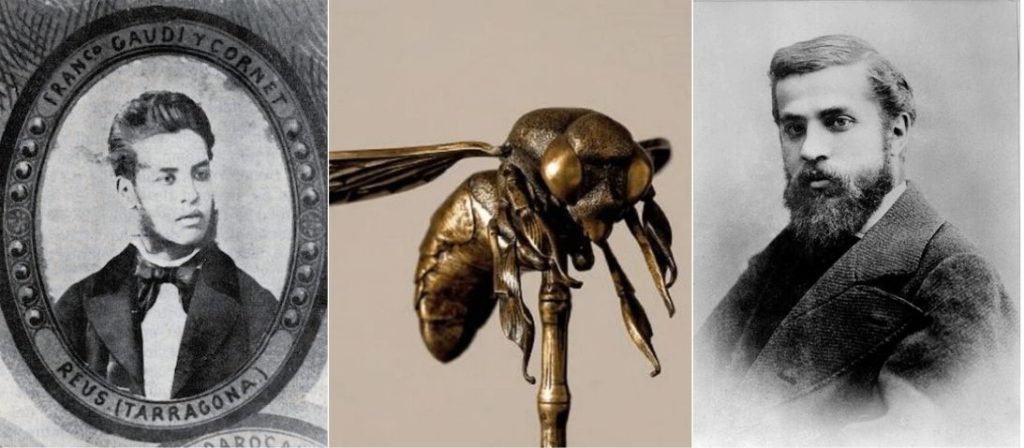
Francesc Gaudí i Cornet (1851–1876) was the elder brother of Antoni Gaudí i Cornet (1852–1926). Born in Reus, he studied Medicine in Barcelona and graduated in 1875. A little earlier, on August 21, 1870, at the age of nineteen, he published an informative article about bees in El Eco del Centro de Lectura, a magazine founded in Reus in 1859. The article reveals a shared interest with his brother: biology and, specifically, the study of bees.
At that time, Antoni had also moved to Barcelona to study architecture, and both brothers lived together in a small apartment in Ciutat Vella. Sadly, Francesc died prematurely in that apartment in 1876, at the age of twenty-five, due to haemoptysis (the coughing up of blood caused by a pulmonary haemorrhage).
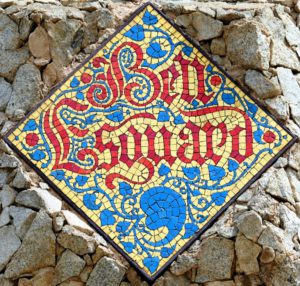
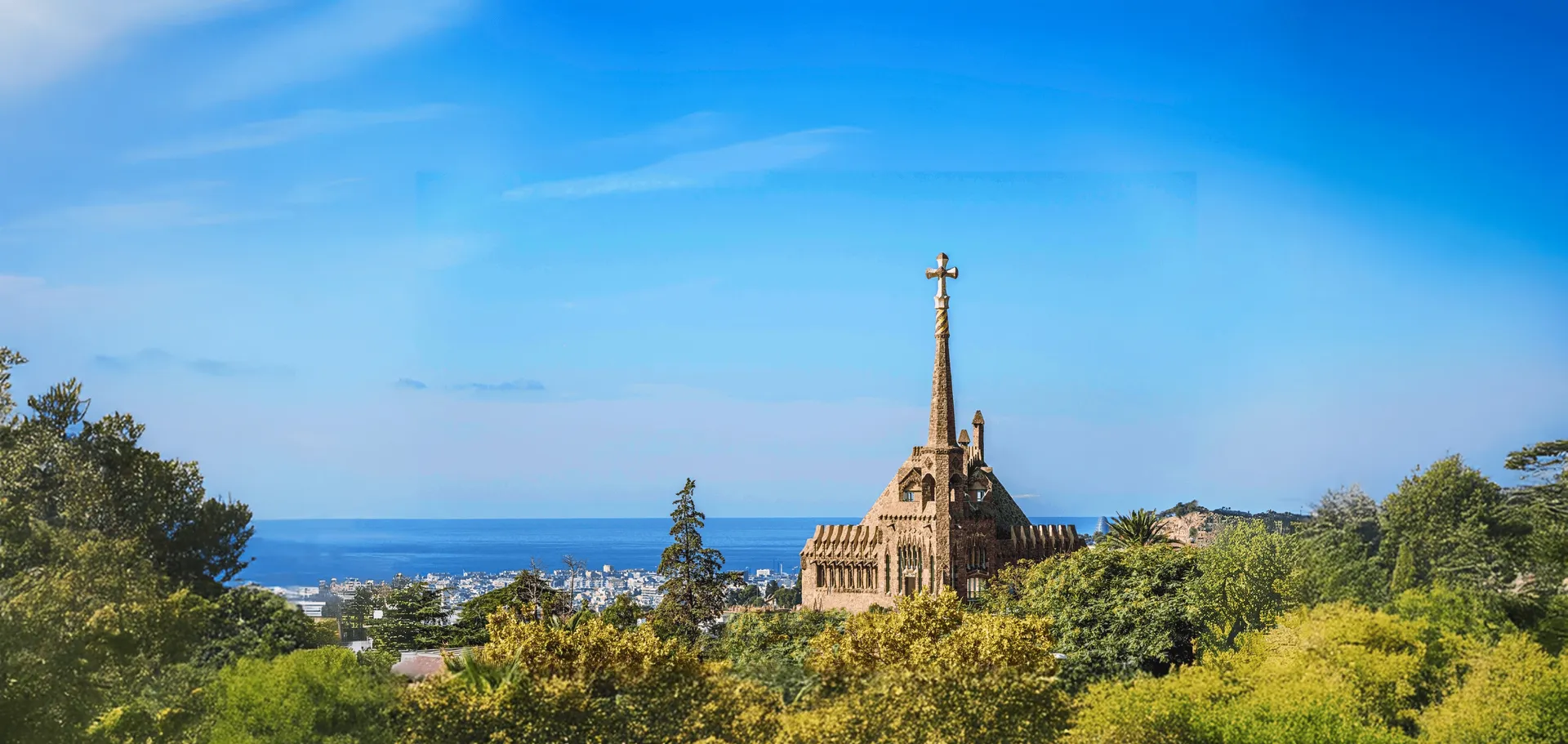
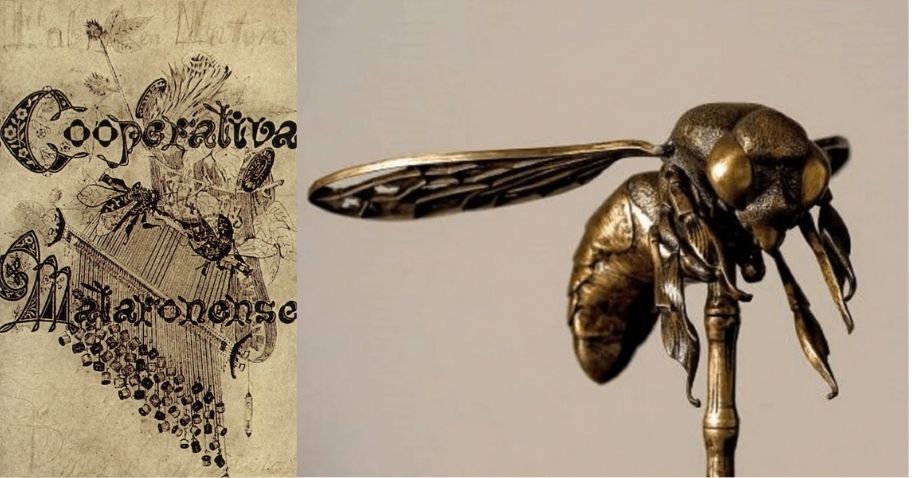
Years later, Gaudí used catenary arches in the Cooperativa Mataronense, one of his earliest works, and furthermore, around 1884, he designed the standard for this association, featuring the symbols of a beehive on the banner and a bronze bee at the top. It has been suggested that the motifs of this standard, especially the beehive, were inspired by Francesc Gaudí’s article. Likewise, Antoni Gaudí’s famous hexagonal paving tile, designed around 1904, resembles the honeycomb cells described by the architect’s brother. Incidentally, this geometric shape can also be seen in the entrance hall of Torre Bellesguard (see: The Bellesguard Tile).
 Francesc Gaudí’s Original Text
In 2015, L’Eco del Centre de Lectura, the same magazine in which Francesc Gaudí had published his article, released a piece recalling the text. The author, Jaume Massó, transcribed the article, standardising its accents. Below we reproduce an excerpt in Spanish because that was the language in which it originally appeared, as was common during the early years of the Renaixença movement (see the full text at: The Article by Gaudí’s Brother).
Overall, the text reflects a conception of nature characteristic of the scientific popularisation of the time, in which the observation of animals was linked to progress and the use of natural resources. The bee colony appears as an example of order, cooperation, division of labour and productivity, which is precisely the message that Gaudí would later project through the standard of the Cooperativa Mataronense. On the other hand, at the end of the text there is a reference to the Camp de Tarragona region, reminding us of the strong connection with his origins that Gaudí maintained throughout his life.
“(The bees) all possess to a high degree the instinct of sociability, to the extent that it is extremely difficult to find a solitary individual. The societies or swarms nest in hollow trees, in thickets, or, more commonly, in hives made by man from reeds, canes, cork, or hollowed-out trunks. / Essential for the formation of the honeycombs are the bee queen, or fertile female, the workers, which are sterile females, and the drones, or males. / Once they have chosen and inspected the place intended as their dwelling or hive, they seal all openings except one, which serves as an entrance and exit, by varnishing the interior with their viscous substance. Inside they build the honeycombs, composed of hexagonal prismatic cells ending in a pyramid of the same shape.
(…) In the province of Tarragona, both products are gathered, although in limited quantities compared to their consumption, in La Espluga de Francolí and along the banks of the Ebro. / It would be beneficial if our farmers devoted themselves to the promotion and reproduction of beehives; for their care consists simply of placing the hives in a flower-rich location and protecting them from bats, sparrows, swallows, spiders and other animals that tend to exterminate them, as well as from the wind, which greatly exhausts them.”