
October 30, 2026
By: Ferran Garcés
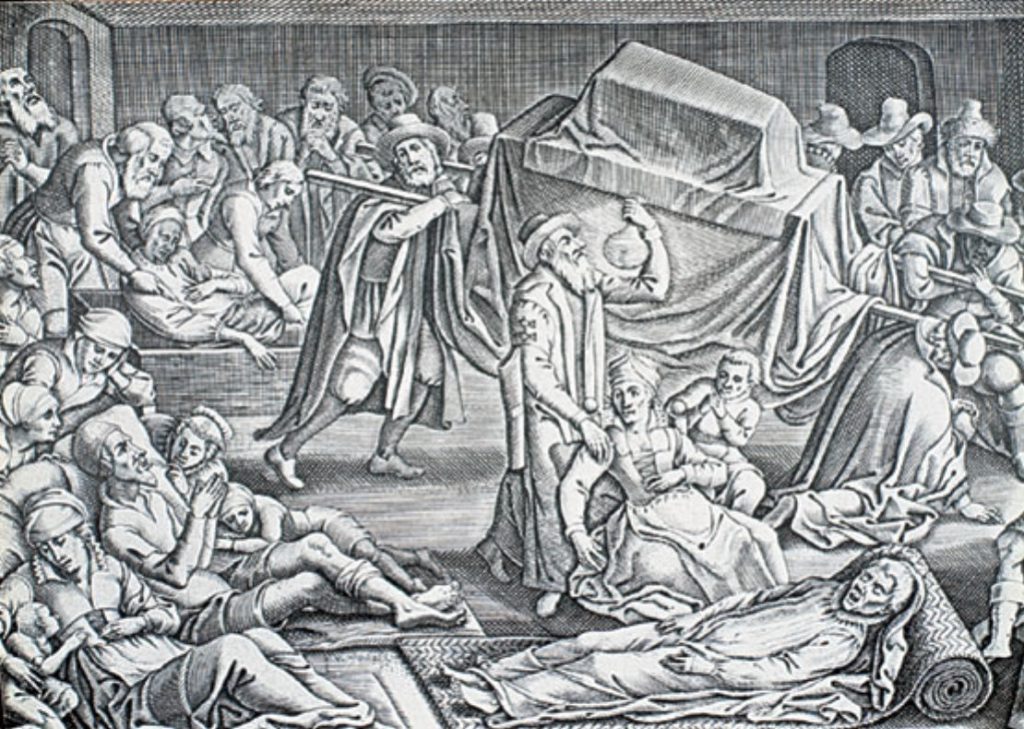
In the late Middle Ages, trade began to connect Europe with Asia, a relationship that brought great wealth, but also the plague, which entered the Old Continent through Mediterranean ports in 1347. Its impact was so profound that it soon caused enormous loss of life. Moreover, over the following centuries, it periodically reappeared, shaping the lives of several generations. Prominent figures such as Benedict XIII, known as Pope Luna, the writer Bernat Metge, Saint Vincent Ferrer and the king Martin I the Humane (1356) lived under the threat of new outbreaks. Bellesguard witnessed some of them…
A palace surrounded by pestilence
Bernat Metge, secretary to King Martin I during his stay at Bellesguard Palace between 1408 and 1410, reflects this atmosphere of fear in an unfinished work: Apologia. The protagonist is, or was intended to be, a desperate citizen who wants to leave Barcelona with his family following a new outbreak of plague.
Two chroniclers writing after the reign of Martin I describe a similar situation. The first was the Italian humanist Lorenzo Valla, author of the Historia de Fernando de Aragón (1445-1446), a work that explains how the king withdrew from “a city that was too plague-ridden” (2). The physician and historian Jerónimo Zurita, in his Anales de Aragón (1532), expresses the same idea when he states that «en la primavera deste año estuvo el rey en aquella su casa de Belesguart porque en la ciudad morían de pestilencia» (3).
The plague also had a profound impact on Pope Benedict XIII, who was forced to change various plans throughout his life because of epidemics. In fact, when he arrived in Barcelona in 1409, he was fleeing an outbreak in the city of Perpignan, only to encounter another epidemic in Barcelona. The seriousness of the situation forced him, together with the religious and municipal authorities, to organise several public processions «per rahó de les mortaldats» (4).
Despite the risks, however, the pope did not leave Barcelona. The political situation was too delicate. King Martin’s only son had died shortly beforehand, placing the succession to the Crown in jeopardy. In an attempt to secure an heir, Martin I married Margaret of Prades. Benedict XIII officiated at the wedding at Bellesguard Castle, assisted by Vincent Ferrer, the future saint whom popular tradition would turn into one of the spiritual protectors against plague and epidemics, as Catholic tradition attributed numerous healing miracles to him, both during his lifetime and after his death.
Despite the presence of such distinguished guests, the marriage produced no descendants. Moreover, Martin I died in 1410. The exact causes of his death remain a matter of debate among historians. Some authors, including Lorenzo Valla, have suggested that he may have fallen victim to the plague, although there is no conclusive evidence (5). The Italian humanist also stated that, following the king’s death, “almost everyone in the household died of plague or fever, along with many other citizens” (6). Queen Margaret herself was among these victims.
A bishop’s refuge
The effects of the plague extended far beyond the Middle Ages. At the end of the 16th century, during the outbreak that affected Barcelona between 1589 and 1590, Bishop Joan Dimes Loris became a particularly respected figure for his work assisting the population.
The Jesuit Pere Gil, from Reus, explains in the Llibre primer de la història catalana that the bishop was temporarily residing at the Tower of Bellesguard to distance himself from the infected city, while continuing to govern the diocese and attend to the spiritual needs of the population. Gil himself describes how he visited the bishop regularly and how, from this refuge, they received constant information about the situation in Barcelona and the affected parishes (7).
Looking at Bellesguard today, it is difficult to imagine that this very place witnessed some of the episodes that shaped the history of epidemics in Barcelona. Kings, popes, saints and bishops lived here under the threat of the plague, seeking refuge or attempting to deal with its consequences. A story that, centuries later, remains part of Bellesguard’s memory.
Notes
(1) Echauz, Pau (29/03/2020), “El sorprendente tratado médico del siglo XIV con
medidas todavía vigentes para combatir una pandemia”, La Vanguardia.
(2) Valla, Lorenzo (2005). Historia de Fernando de Aragón. Edición de Santiago López
Moreda, Madrid, Akal, p. 145.
(3) Zurrita, Jerónimo (2003) Anales de Aragón (versión electrónica), “De la muerte del rey
don Martín; y del estado en que dejó sus reinos”, cap. XCI, Institución Fernando el
Católico.
(4) Juncosa Bonet, Eduard (2025), “El papa Luna y el linaje nobiliario de los Prades”,
en Benedicto XIII, el Papa Luna (1394-1423): avances de la investigación en el
sexto centenario de su muerte, p. 151.
(5) Valla, Lorenzo (2005), Op. Cit. p. 146. In this chapter, Valla mentions the other possible causes of King Martin’s death. For further information, see: “López Rodríguez, C. (2015). Últimas voluntades de Martín I el Humano (30 y 31 de mayo de 1410).” Aragón En La Edad Media, 24, 227-229.
(6) Ibid.
(7) Galdeano Carretero, Rodolfo (2013), “La Historia moral de Cathalunya de Pere Gil (1550-1622) i la historiografia catalana de l’època moderna”, Doctoral thesis, volume one, Universitat de Girona, p. LXVI.