July 4, 2026
By Ferran Garcés
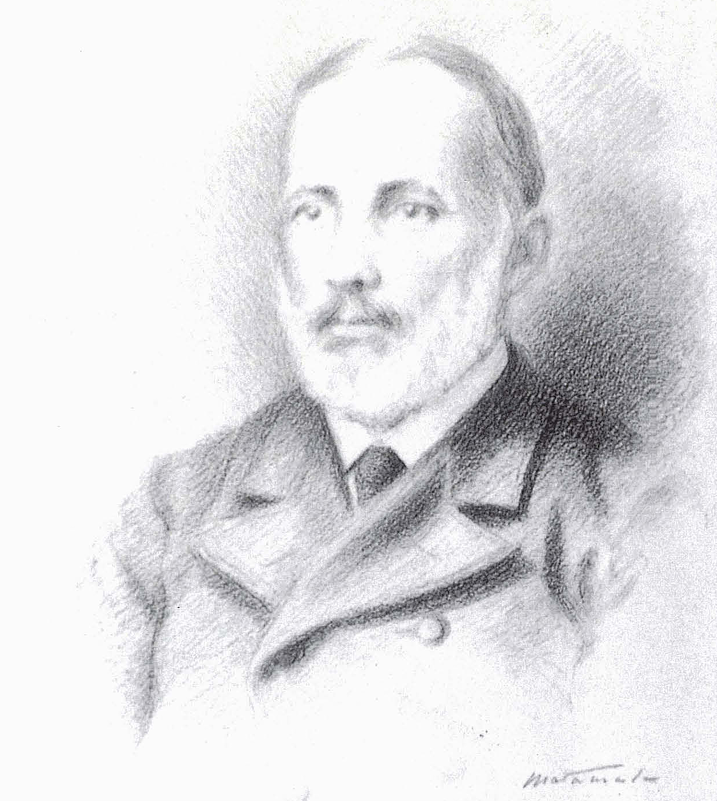
On 5 July 1906, Joan Martorell i Montells (1833–1906) passed away, a Barcelona architect who is unjustly little known today. Not only was he one of the most outstanding artists of his time, but it is difficult to understand the beginnings of Antoni Gaudí (1852–1926) without knowing the guidance that this senior master provided to the young prodigy. Today, as we commemorate the first centenary of Gaudí’s death, we also wish to pay a small tribute to this forgotten mentor on the 120th anniversary of his passing.
“The Instrument of Providence”
The Spiritual Association of Devotees of Saint Joseph, the organization that promoted the construction of the Sagrada Família, reported its important activities through the magazine El Propagador de la Devoción a San José (The Promoter of Devotion to Saint Joseph). In the edition of 1 October 1926, just three months after Gaudí’s death, it published an article entitled “Divine Providence Preparing Gaudí for Our Temple.” Among the “tangible manifestations” that, according to the article, guided Gaudí toward the Sagrada Família, special emphasis was placed on the influence of Joan Martorell.
It should be remembered that after the resignation of the first architect, Francisco de Paula del Villar (1828–1901), it was Martorell who recommended Gaudí, then a promising 32-year-old architect. More precisely, the article states: “Another architect, experienced and distinguished, was asked to take charge of the works. He declined. Instead, he suggested the name of a young architect: Gaudí. Providence made Mr. Martorell the instrument of its choice.” (1)
Joan Matamala, sculptor of the Sagrada Família and biographer who had known Gaudí since childhood, also emphasized the providential nature of the project: “Around 1883, Gaudí received from Martorell the proposal to assume responsibility for the Sagrada Família Temple. Thus, Providence reserved for him a greater dedication to his art, surpassing the horizons he himself had dreamed of.” (2)
One of the First Architects
Who was this instrument of Providence?
According to Gaudí himself, Martorell “was a wise man and a saint,” an opinion he repeated on several occasions (3). In fact, like Gaudí, Martorell “lived entirely devoted to his profession, never married, and devoted his time to nothing other than architecture and religion.” (4)
Gaudí’s future mentor was the son of Pau Martorell, a highly active master builder in Barcelona. On 24 December 1872, he completed his studies at the Provincial School of Architecture of Barcelona, belonging to the institution’s first graduating class, which consisted of only three students: Adriano Casademunt i Vidal, Emilia Sala i Cortés, and Joan Martorell i Montells himself. Nevertheless, the degree was not officially and definitively recognized until 16 November 1876. To celebrate the occasion, he invited his two classmates and a final-year student named Antoni Gaudí, who would earn his own degree two years later.
At that time, Joan Martorell became the foremost representative of the Neo-Gothic style in Catalonia, faithfully following the theories of the French architect and writer Viollet-le-Duc (1814–1879), whose influence extended throughout Europe. A notable example of his work is the Convent and Church of the Adorers, located at the intersection of Casanova and Consell de Cent streets, popularly known as “La Punxa” (“The Spike”) because of the sharp pyramidal spire crowning its tower.
Two Circles: Sant Lluc and the Güell-López Family
Despite being little known today, Joan Martorell was one of the most highly regarded architects of his era. He belonged to the select circle of artists who worked for Count Güell and his brother-in-law Antonio López y López, the first Marquis of Comillas.
Furthermore, Joan Martorell was the brother of Àngel Martorell, director of the company Güell, Ramis & Co., the principal enterprise of Joan Güell i Ferrer, father of Eusebi Güell. In fact, his relationship with these influential clients began in 1876 with the construction of the family residence at Rambla dels Caputxins, number 30. Later, in 1888, he also designed the monument to Joan Güell i Ferrer located on Rambla de Catalunya.
The strong relationship between Martorell and Gaudí can be seen in a significant detail. During his student years, the future genius worked as a draftsman for various architects, but only briefly, except in Martorell’s office, where his collaboration lasted much longer (5). Their relationship continued even after Gaudí became an independent architect. In addition, both men were members of the Cercle de Sant Lluc, an association of Catholic artists founded as a counterpart to secular artistic groups (see “The Circle of Gaudí’s Artist Friends”). It is therefore not surprising that the young apprentice’s earliest works were so closely related to those of his mentor.
Parallel Projects
In 1882, one year before recommending Gaudí for the Sagrada Família, Martorell presented a project to redesign the façade of Barcelona Cathedral. However, the proposal was not approved, despite receiving support from Count Güell, patron of both architects, and from the Artistic Circle of Sant Lluc.
Even so, the project earned considerable praise, albeit amidst a major controversy (6). The project drawing was drafted by Gaudí and lettered by Lluís Domènech i Montaner, another of Gaudí’s teachers and one of the leading architects of the period.
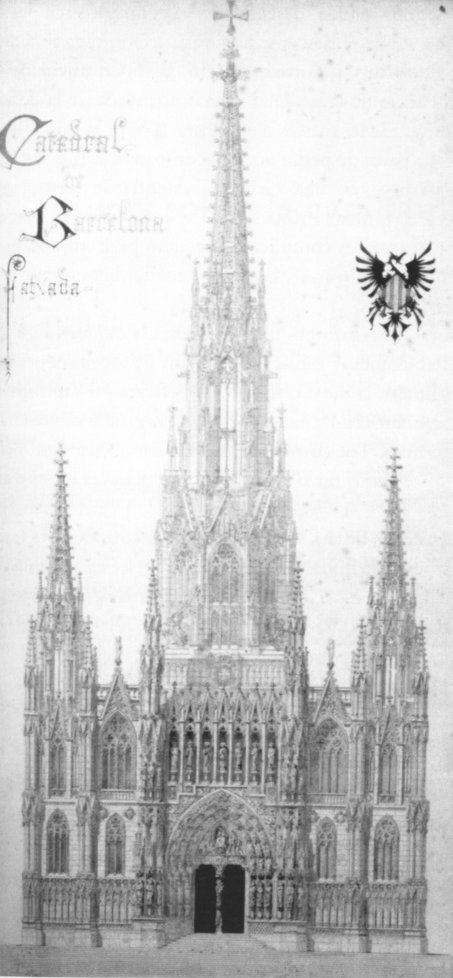
This was not their only collaboration. Joan Matamala writes:
“Under Martorell’s direction, Gaudí participated in the decoration of buildings, altars and various pieces of furniture, intelligently interpreting his master’s style. From the very beginning, Don Joan Martorell admired the talents of that architecture student (…) and became his true professional mentor,” to the point of becoming “the instrument of Providence” by giving him the opportunity, as mentioned earlier, to take responsibility for the construction of the Sagrada Família (7).
Among the projects signed by Martorell’s office, “the one in which Gaudí’s contribution is most clearly evident is the Church and Convent of the Salesas, at Passeig de Sant Joan 88–92, built between 1882 and 1885” (8), located very close to the Sagrada Família. And it is far from the only parallel work.
In the town of Comillas, cradle of the López family, there are two monumental buildings. One is Martorell’s Palace of Sobrellano (1881–1888). The other is Gaudí’s El Capricho, commissioned by Máximo Díaz de Quijano y Fernández, another relative of the López family. When the first Marquis died, Martorell designed the chapel of his mausoleum (1878–1881), while the young Gaudí was responsible for its interior furnishings. Let us continue following the thread.
At the foot of the Collserola hills stands the Jesuit School of Sarrià (1883–1890), designed by Joan Martorell, and a little farther downhill, Gaudí’s Teresian School. Not far away are the Güell Pavilions. As is well known, the gates of the estate, with their magnificent wrought-iron dragon, were designed by Gaudí, while the renovation of the main house, now demolished, was the work of Joan Martorell.
To Learn More, What Better Than a Visit?
Do the coincidences end here? No.
Around 1897, Martorell directed the restoration of the Monastery of Pedralbes, promoted by Sister Eulàlia Anzizu, niece of Eusebi Güell and the monastery’s first archivist and historian.
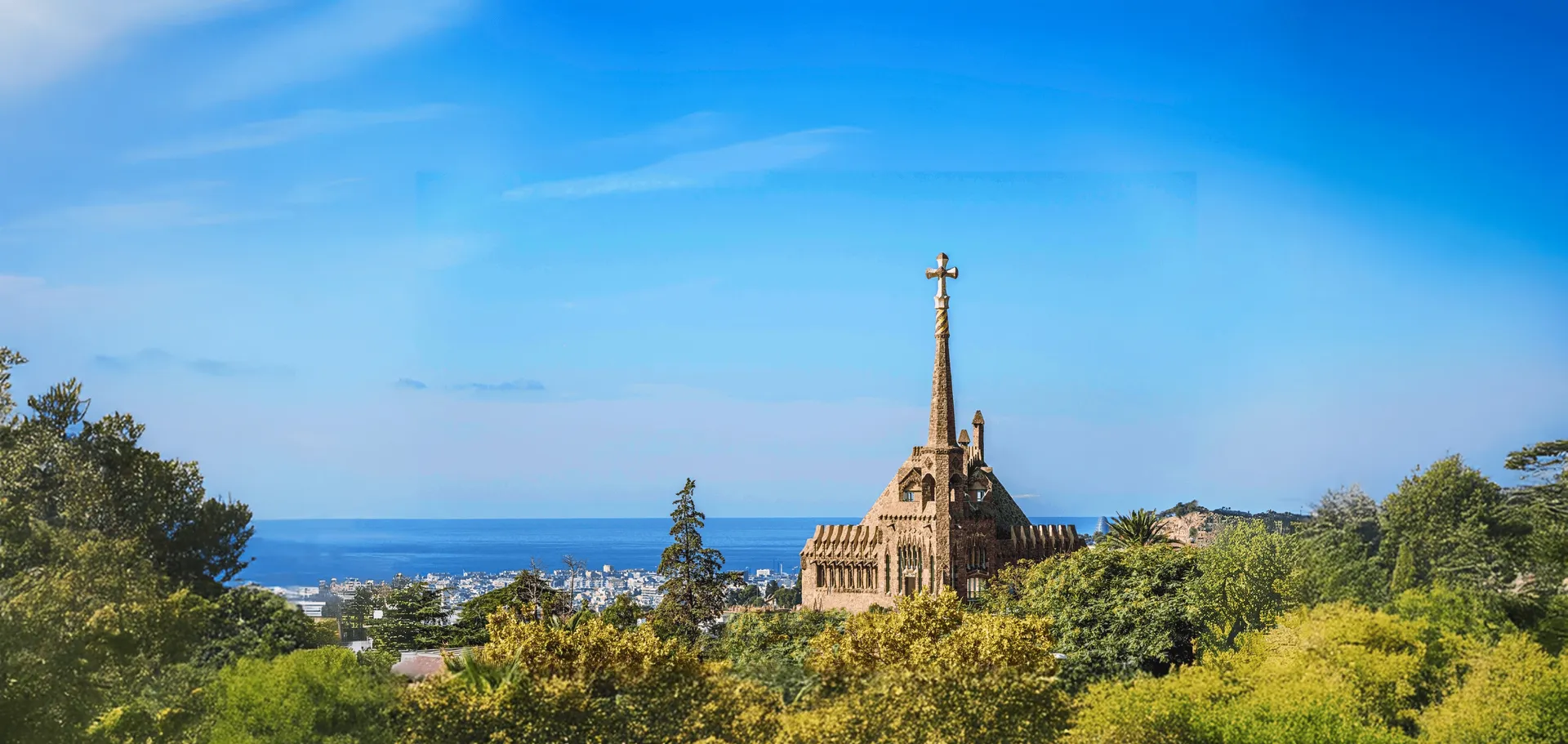
A decade later, Gaudí restored the ruins of the palace of King Martin I of Aragon, known as Martin the Humane, at Bellesguard. Today, thanks to these restoration projects, the monastery and the tower are among the finest testimonies to the medieval past of the area.
To help visitors better understand this history, we have prepared a route that recalls both the era of splendour and its later recovery. Would you like to discover it? Sign up for our “Spaces of Power” tour!
Spaces of Power Tour
Book the guided tour
Notes
(1) “La Divina Providencia formando a Gaudí para nuestro Templo,” El Propagador de la Devoción a San José.
(2) Matamala Flotats, Juan (2006), Antoni Gaudí. My Journey with the Architect, Editorial Claret, pp. 48 / 59–61.
(3) Bassegoda i Nonell, Joan, “Master of Nineteenth-Century Catalan Architecture,” Espais, July–August, p. 92.
(4) Ibid.
(5) Serrallonga i Gash, Jaume (2003), Geometry and Mechanics in Gaudí’s Models, Vol. 1, dissertation supervised by Josep Gómez Serrano, University of Barcelona, p. 182.
(6) Sesé, Teresa (19/02/2020), “Money, Plagiarism and Controversy in Barcelona Cathedral,” La Vanguardia.
(7) Matamala Flotats, Op. cit., p. 32.
(8) Serrallonga i Gash, Op. cit., p. 182.