June 9, 2026
By Ferran Garcés
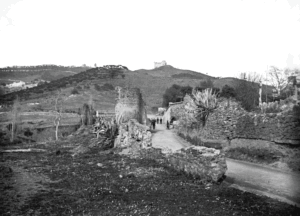
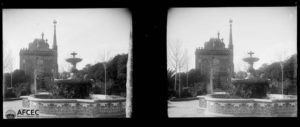
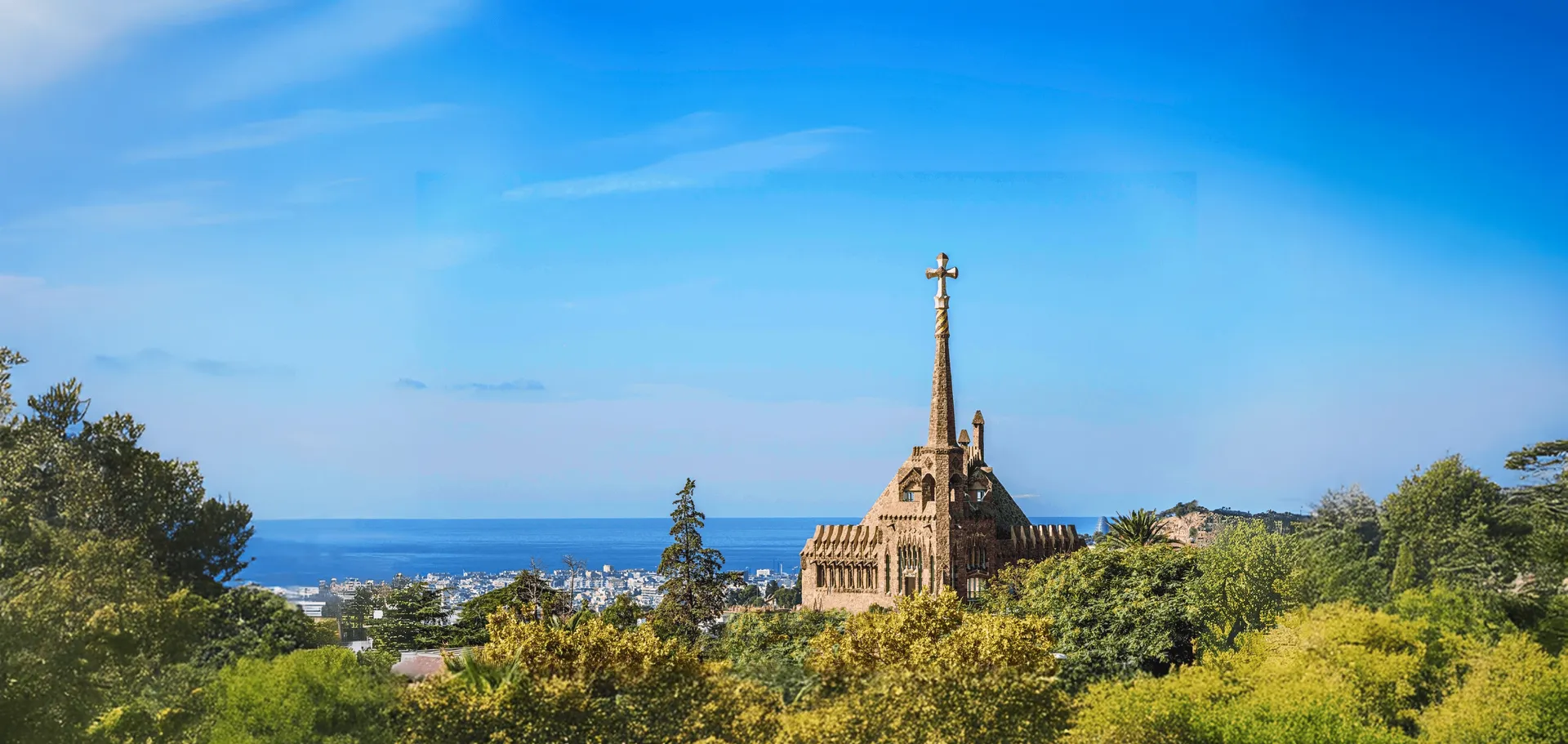
 Without a doubt, this week’s big news is the visit of Pope Leo XIV to Spain and, more specifically, to the Sagrada Familia, coinciding with Gaudí Year 2026. The event has generated great interest in all matters related to the papacy and the architect. We would also like to contribute to this interest by recalling the first arrival of a pope in Barcelona—an event that, six hundred and seventeen years ago, had as its setting the former palace of Bellesguard, then a royal and papal residence and, five centuries later, a source of inspiration for Antoni Gaudí.
Thirteen means thirteen
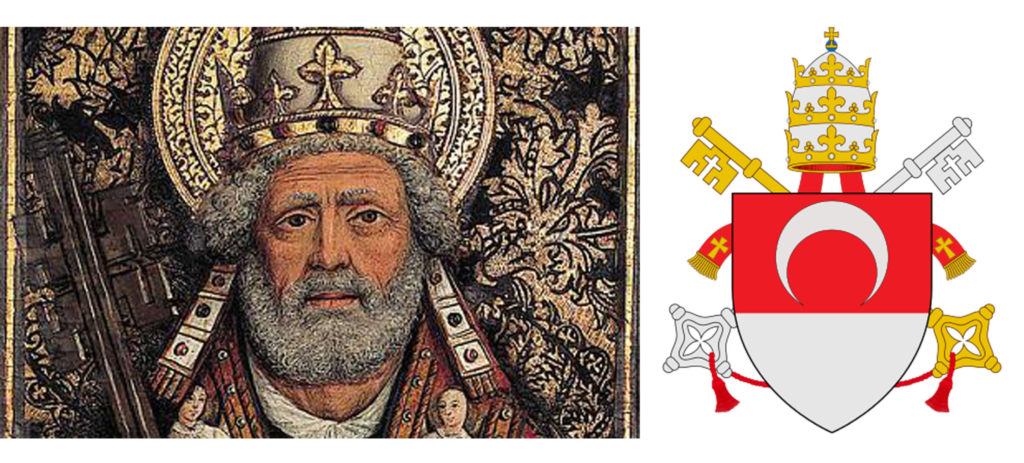
The arrival of the first pope in Barcelona depends on how we define this title, since its protagonist is still considered an “antipope.” However, he himself never renounced his status as pontiff. The well-known Spanish expression “mantenerse en sus trece” (in Catalan, “Tretze són tretze”) refers to stubbornness. It is attributed to Pedro Martínez de Luna, the Aragonese cleric who was proclaimed Benedict XIII in the French city of Avignon in 1394, although not recognized as such by most of the Church. Because of his struggle to assert his rights, his popular name, Pope Luna, remains a symbol of perseverance and determination. His figure is framed within one of the most serious crises of the Catholic Church, the so-called Western Schism (1378–1417), when as many as three popes competed against each other.
The rivalry took the form of debates but also armed conflict. Between 1398 and 1403, the King of France besieged the palace of Avignon. Only thanks to the help sent by Martin I did the stubborn pontiff manage to escape, finding himself without any other support. He first settled in Perpignan and finally in Peñíscola, as is well known. However, between these two cities, Benedict XIII also resided in Barcelona between 1409 and 1410.
To be precise, Benedict XIII, the rebellious pope, arrived in Barcelona on August 10, 1409, and went straight to the palace of Bellesguard, where he initially settled to console Martin I. These were difficult times for the monarch, as he had just learned of the sudden death of his son, Martin the Younger, King of Sicily and sole heir to the throne. Shortly before, in 1406, his first wife, María de Luna—who belonged to the family of Pope Luna—had also died. The search for a new heir occupied all of the pontiff’s time. Finally, on September 17 of that same year, Pope Luna urgently celebrated the new marriage of the grieving monarch to Margarita de Prades in the chapel of the palace of Bellesguard. It was an intimate and sober ceremony, as the mourning for the death of Martin the Younger still lingered.
Only once these matters were resolved did the official entry of Benedict XIII into the city take place, on September 29. He was received by the entire Barcelona clergy and the city’s leading citizens, as well as, of course, King Martin I himself, together with his new wife. From that day onward, Pope Luna stayed at the Royal Palace Major until after Martin I’s death on May 31, 1410. Unfortunately, Margarita de Prades was not pregnant at the time. The longed-for heir had not arrived naturally. From then on, the succession would have to be resolved through intrigue and new armed conflicts, which would lead Benedict XIII—the stubborn pontiff—to Peñíscola, where he would die in 1423. At that moment, the death of Martin I without an heir had brought about the extinction of the House of Barcelona and the beginning of the Trastámara dynasty (1).
Pope and Lord of Kings
The arrival of the first Pope—or antipope—in Barcelona did not take place under the same circumstances as the current visit of Leo XIV to the city. However, it is striking that, in both cases, the setting involves two works linked to Gaudí: the Tower of Bellesguard and the Sagrada Familia. In relation to the former, there is an additional reason. One that Gaudí, the architect from Reus, would use to design the heart of one of the main elements of the Torre Bellesguard: its distinctive eight-pointed stained glass window…
Among the many titles held by Pedro Martínez de Luna was also that of Lord of Reus, the city where Gaudí was born, or at least where he spent his early years. Galdric Santa, current head of the Gaudí Chair and commissioner of Gaudí Year 2026, as well as the restorer of Torre Bellesguard, has discovered that at the center of the stained glass window—within this Gaudí building full of references to Catalonia’s medieval past—there is an eight-petaled rose, which may refer to the historical heraldic rose of Reus.
“This rose corresponds to the rose in the coat of arms of Reus, which historically had eight petals, with a geometry very similar to that of the stained glass window, in its 17th-century versions.” (…) Galdric adds: “It should also be borne in mind that the coat of arms of Reus has been considered to incorporate the heraldry of the keys of Saint Peter over the Rose, in connection with Pope Luna, whom King Martin invited to settle in Bellesguard in 1409, and who was Lord of Reus.” (2)
Notes
(1) Vall i Comaposada, Josep M. (2014), Bellesguard. From the residence of Martin the Humane to Gaudí’s tower, Duxelem Editorial, pp. 59–73
(2) Santana Roma, Galdric (2021), “On Bellesguard.” In Permanyer, Lluís (ed.), Sagnier and the modernists: the craft of architecture 1880–1930, RBA, Barcelona, pp. 128–131 and p. 133, note 8